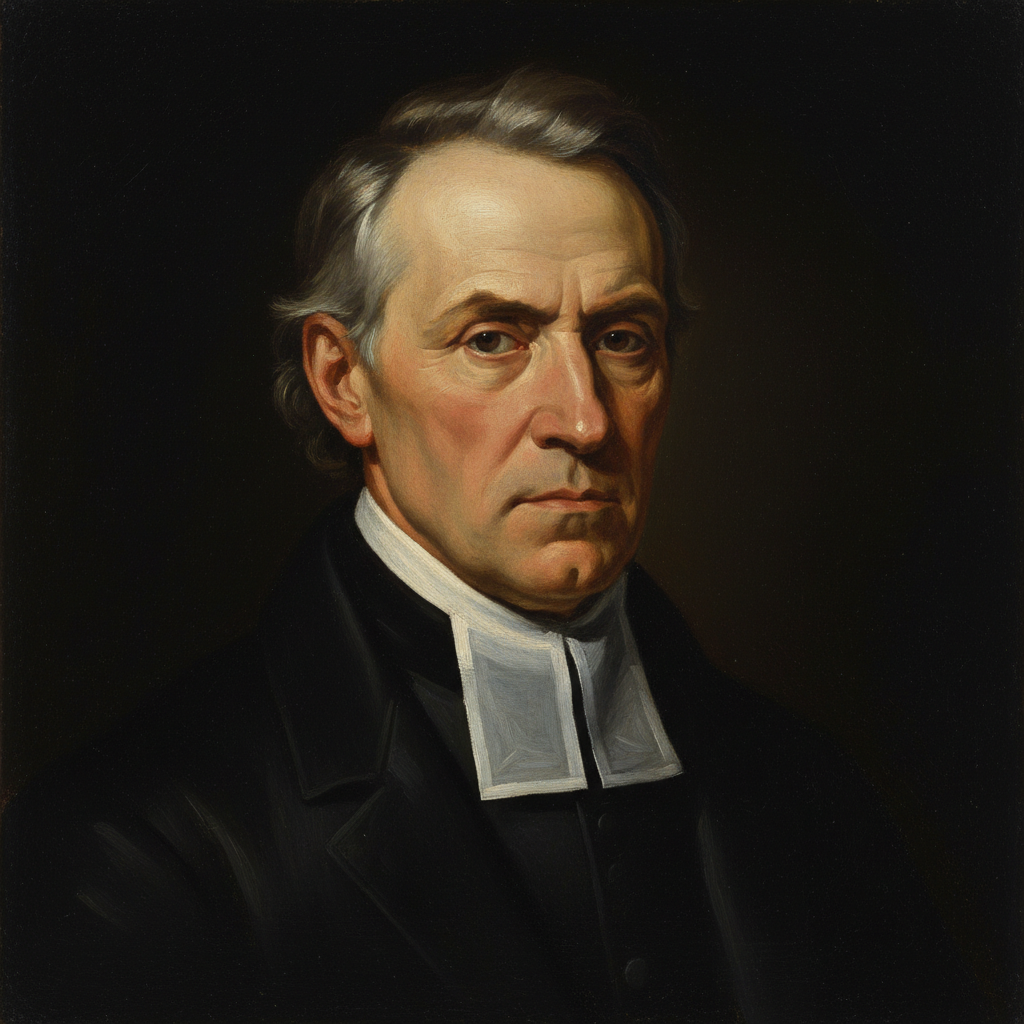
John Wesley — "I continue to dream and pray about a revival of holiness in our day that moves f…"
I continue to dream and pray about a revival of holiness in our day that moves forth in power and reaches to the ends of the earth.
I continue to dream and pray about a revival of holiness in our day that moves forth in power and reaches to the ends of the earth.
Click any product to generate a realistic preview. Up to 3 at a time.
* Initial load can take up to 90 seconds — revising the preview in another color is nearly instant.
"I have no time to be in a hurry."
"Are we not a little too apt to forget that the Methodists are not the only Christians in the world?"
"God grant that we may all make a good end!"
"I am as much a High-Churchman as ever I was. And I hope to live and die so."
"I conceive slavery to be such a thing as is odious to the God of love."
English Anglican cleric and founder of Methodism, whose open-air preaching and class-meeting structure created the largest 18th-century evangelical revival. Closely associated with Charles Wesley (his hymn-writing brother) and George Whitefield (early co-revivalist, later doctrinal opponent). For an intellectual contrast, see George Whitefield, Calvinist evangelical revivalist — Whitefield's predestinarian Calvinism vs Wesley's free-grace Arminian theology split the early Methodist movement permanently in the 1739-41 break. The founding evangelical Calvinist-Arminian schism — the two parallel evangelical traditions American Christianity descends from.
Found in 1 providers: grok
1 source checked
Wesley expresses a deep longing for large-scale spiritual renewal — a collective return to holy living that spreads beyond any single church or nation. 'Holiness' means practical moral purity and closeness to God, not abstract doctrine. 'Revival' implies society has grown spiritually cold and needs reawakening. The global scope — 'ends of the earth' — frames this not as denominational ambition but as a universal human need for genuinely transformed character.
Wesley traveled over 250,000 miles on horseback across Britain, preaching to miners, mill workers, and the poor the established church ignored. His theology centered on 'entire sanctification' — the conviction that believers could achieve full holiness in this life through disciplined practice. He organized converts into small accountability groups called class meetings. This quote captures the engine of his entire ministry: holiness was not a private achievement but a living, spreading force.
Eighteenth-century Britain was convulsed by early industrialization — factory labor, urban squalor, and mass alcoholism created a moral and spiritual crisis the Church of England was ill-equipped to address, serving mainly the wealthy landowning class. Simultaneously, Enlightenment rationalism eroded traditional faith. Wesley's field preaching and call for revival directly responded to this collapse of organized religion's reach, coinciding with the Great Awakening sweeping the American colonies.
AI-generated insights based on extensive research and information for context. Factual errors? Email [email protected].
Your cart is empty