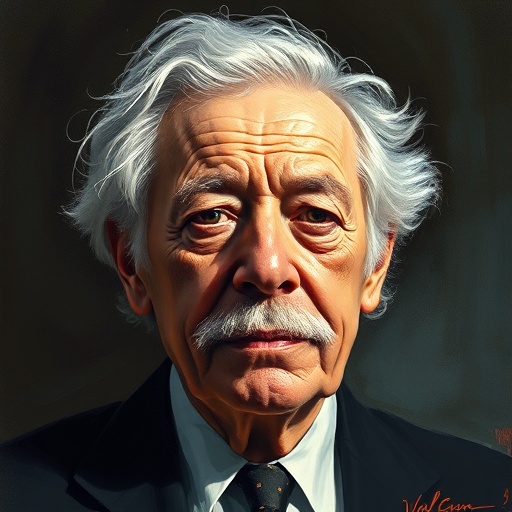
Linus Pauling — "Well David, I have a lot of ideas and throw away the bad ones."
Well David, I have a lot of ideas and throw away the bad ones.
Well David, I have a lot of ideas and throw away the bad ones.
Click any product to generate a realistic preview. Up to 3 at a time.
* Initial load can take up to 90 seconds — revising the preview in another color is nearly instant.
"I am a scientist, and I believe in the scientific method. But I also believe that there are things that science cannot explain."
"I am not a quack. I am a scientist."
"I have come to the conclusion that the proper way to live is to be kind to everyone."
"Just one living cell in the human body is, more complex than New York City."
"I might well have become egotistical as a result [of the Langmuir Prize].... But... I think that I just said I shouldn't let this go to my head. I shouldn't think I'm really better than other people e…"
Response to David Harker asking how he had so many good ideas
Date: c. 1930s (as recalled later)
Self-DeprecatingFound in 1 providers: gemini
1 source checked
Productivity and genius are not about having only good ideas — they are about generating many ideas and ruthlessly discarding the weak ones. The filtering process, not the initial inspiration, is where quality emerges. Most ideas will fail; the discipline lies in honest self-evaluation and the willingness to abandon what does not work without attachment or ego.
Pauling won two Nobel Prizes — Chemistry and Peace — demonstrating extraordinary range. His scientific method involved proposing bold structural hypotheses for chemical bonds, testing them rigorously, and abandoning failed models. His vitamin C megadose advocacy later showed the same prolific idea-generation, though the filtering occasionally failed him, revealing this principle as both his strength and limitation.
Pauling worked through the mid-20th century scientific explosion, when chemistry, biology, and physics were rapidly intersecting. The race to decode DNA, understand molecular structure, and develop new materials demanded creative volume. In an era before computational modeling, scientists had to generate and mentally stress-test many competing structural theories, making high-volume ideation paired with disciplined rejection an essential working method.
AI-generated insights based on extensive research and information for context. Factual errors? Email [email protected].
Your cart is empty