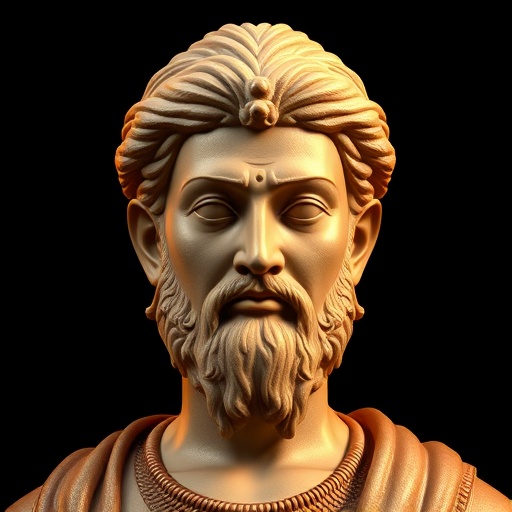
Mahavira — "A wise man should abstain from killing any living being."
A wise man should abstain from killing any living being.
A wise man should abstain from killing any living being.
Click any product to generate a realistic preview. Up to 3 at a time.
* Initial load can take up to 90 seconds — revising the preview in another color is nearly instant.
"Look at the world in the way it is, and do not try to rearrange it to suit your desires."
"All things are impermanent, and the soul is eternal."
"The world is full of illusion, and the truth is hidden."
"The world is a prison, and the soul is the prisoner."
"The greatest mistake of a man is to think that he is not a man."
24th and last Tirthankara of Jainism, whose teachings of strict ahimsa (non-violence), aparigraha (non-attachment), and karma reshaped ancient Indian religion. Closely associated with The Buddha (near-contemporary moral revolutionary, also reacting against Vedic ritualism). For an intellectual contrast, see Vedic Brahmanical ritual sacrifice, the animal-sacrifice-centered Vedic religion of his era — Mahavira's ahimsa demanded total non-violence, including not eating root vegetables that kill the plant — a maximum-distance ethical move from the Vedic priestly tradition that ritually sacrificed cattle and horses. The two cleanest poles of ancient Indian religious ethics.
Found in 1 providers: deepseek
1 source checked
Non-violence isn't just a rule against murder — it extends to every creature capable of experiencing life. This calls for radical ethical consistency: the same moral weight you assign to harming a person must apply to animals, insects, even microorganisms. Wisdom here means practical discipline — minimizing harm across all living things, treating the capacity to suffer, not the species, as the threshold for moral consideration.
Mahavira abandoned his royal life at thirty and practiced twelve years of extreme asceticism — walking barefoot, pulling out his own hair, refusing to brush insects off his skin. Ahimsa was the cornerstone of his entire spiritual framework. He codified it into five strict vows for Jain monastics, where even accidental harm required penance. This teaching wasn't theoretical for Mahavira; it governed every physical movement of his life.
Sixth-century BCE northeastern India centered religious authority on Vedic sacrifice — horses, goats, and cattle killed by the hundreds at elite yajnas that reinforced Brahmin social power. Mahavira's absolute prohibition against killing any living being was a direct political and religious challenge to this system. His era, now called the Axial Age, witnessed simultaneous moral revolutions across cultures, but Jainism's total non-violence doctrine remains the most radical extension of that impulse.
AI-generated insights based on extensive research and information for context. Factual errors? Email [email protected].
Your cart is empty