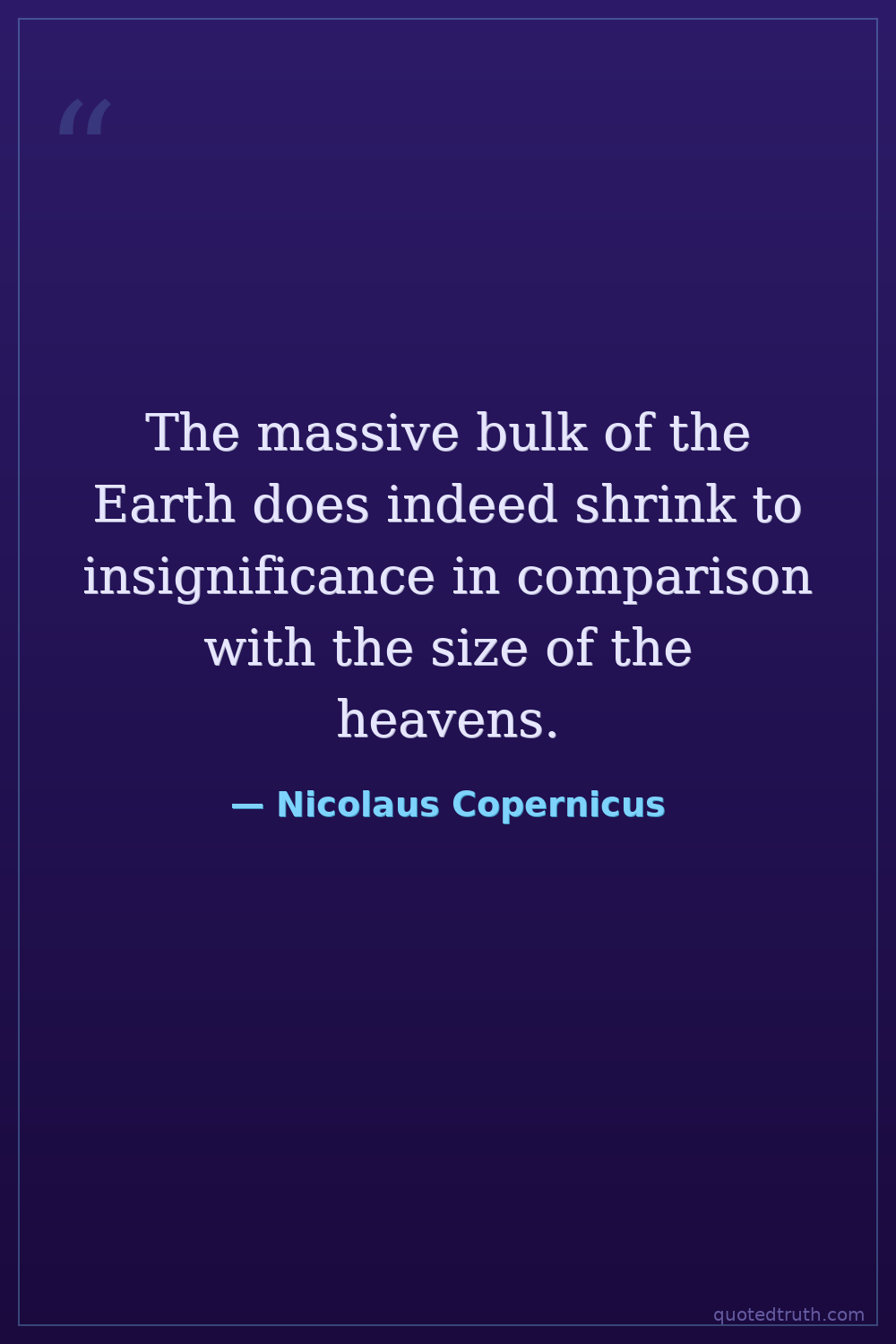
Nicolaus Copernicus — "The massive bulk of the Earth does indeed shrink to insignificance in comparison…"
The massive bulk of the Earth does indeed shrink to insignificance in comparison with the size of the heavens.
The massive bulk of the Earth does indeed shrink to insignificance in comparison with the size of the heavens.
Click any product to generate a realistic preview. Up to 3 at a time.
* Initial load can take up to 90 seconds — revising the preview in another color is nearly instant.
"Therefore, let us not be afraid to follow truth wherever it may lead us, even if it contradicts our preconceived notions."
"For, when a ship is floating calmly on a smooth sea, and the mariners are thinking of nothing but the voyage, if a sudden storm should strike it, and the ship should be driven by the wind, it is not t…"
"The scorn which I had reason to fear on account of the novelty and unconventionality of my opinion almost induced me to abandon completely the work which I had undertaken...."
"For it is the duty of an astronomer to compose the history of the celestial motions from a careful and skillful study of the observations."
"Finally we shall place the Sun himself at the center of the Universe."
Found in 1 providers: deepseek
1 source checked
This expresses cosmic humility — Earth, despite feeling enormous to us, is tiny compared to the universe's vast scale. It challenges human-centric thinking by framing our world as a minuscule point in an incomprehensibly large cosmos. The observation invites perspective: whatever seems monumental on Earth loses its grandeur when measured against the boundless heavens, urging us to reconsider our place in existence.
Copernicus spent decades calculating planetary orbits, which revealed Earth was not the center of the solar system. This quote reflects his heliocentric model's core implication: Earth is just one planet among others orbiting the Sun. As a canon in Frombork Cathedral, he reconciled scientific inquiry with faith, but his mathematics forced him to confront and embrace the diminished stature of Earth. His life's work was an exercise in recalibrating human cosmic significance.
In early modern Europe, the Church-endorsed Ptolemaic system placed Earth at the universe's center, a cosmology intertwined with theology and human dignity. Copernicus published De Revolutionibus in 1543, the year he died, carefully delaying it to avoid persecution. Exploration was reshaping worldly geography and the Renaissance was questioning inherited authority. Asserting Earth's smallness against infinite heavens was intellectually radical, quietly dismantling centuries of geocentric dogma that underpinned both science and religious doctrine.
AI-generated insights based on extensive research and information for context. Factual errors? Email [email protected].
Your cart is empty