What it means
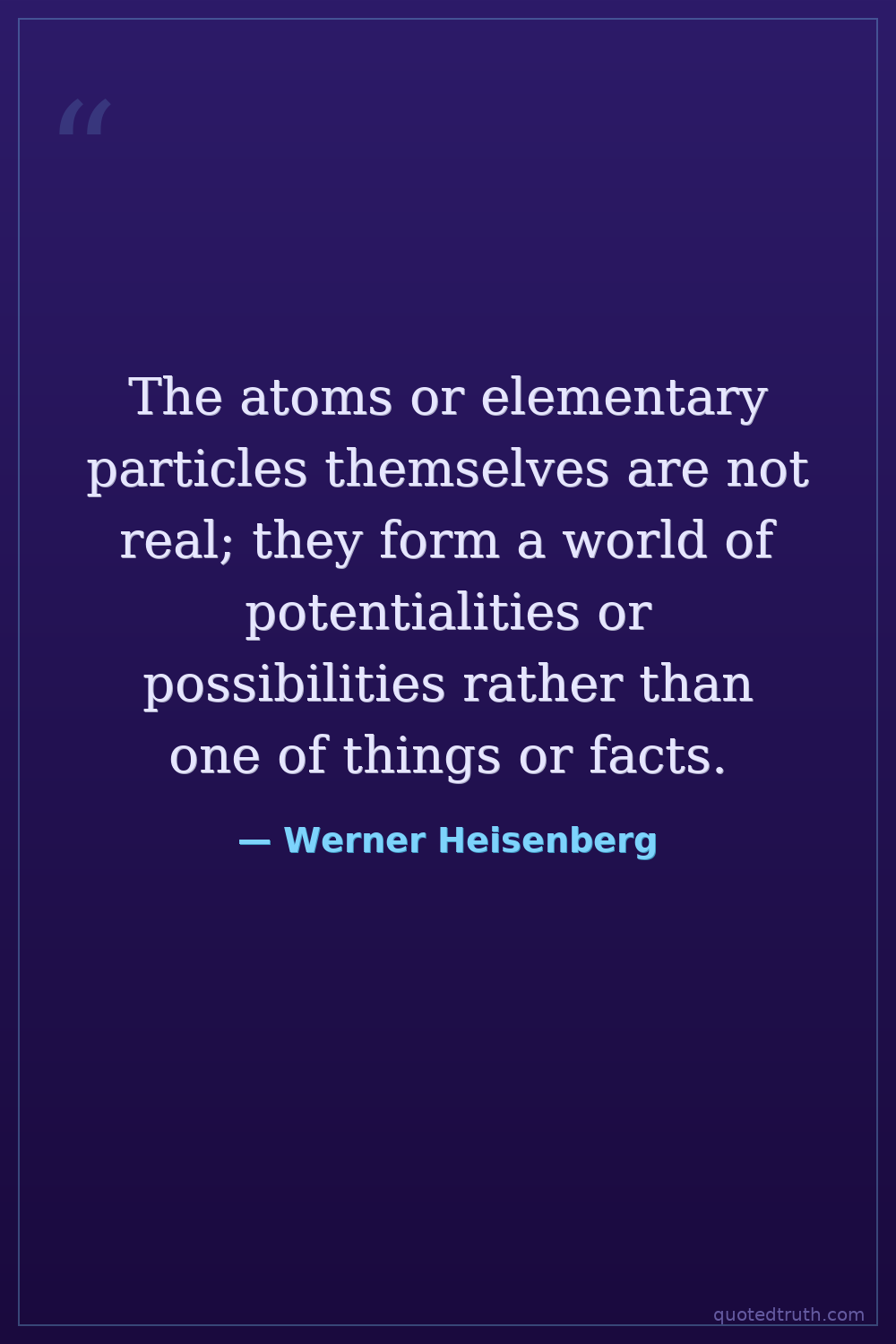
Heisenberg says the tiniest building blocks of matter don't exist as solid objects with definite properties. Instead, they exist as tendencies or probabilities until measured or observed. Before measurement, a particle isn't really anywhere specific or doing anything specific—it's a cloud of possible outcomes. Reality at the smallest scale is more like a menu of what could happen than a fixed arrangement of what is.
Relevance to Werner Heisenberg
Heisenberg founded quantum mechanics and discovered the uncertainty principle in 1927, proving you cannot simultaneously know a particle's position and momentum. This quote captures his Copenhagen interpretation view that quantum objects lack definite properties until observed. As a philosopher-physicist trained under Bohr, he spent his career arguing that classical notions of objective reality break down at atomic scales, replaced by probability waves and observer-dependent outcomes.
The era
Written during the mid-20th century quantum revolution, when physicists were dismantling the Newtonian clockwork universe. Einstein famously resisted with 'God does not play dice,' while Heisenberg, Bohr, and Born defended probabilistic reality. This philosophical battle unfolded alongside atomic weapons development, Nazi Germany's physics purges, and postwar reckoning. Heisenberg himself led Germany's wartime nuclear program, making questions about the 'reality' of atoms both metaphysically and politically charged.
AI-generated insights based on extensive research and information for context. Factual errors? Email [email protected].