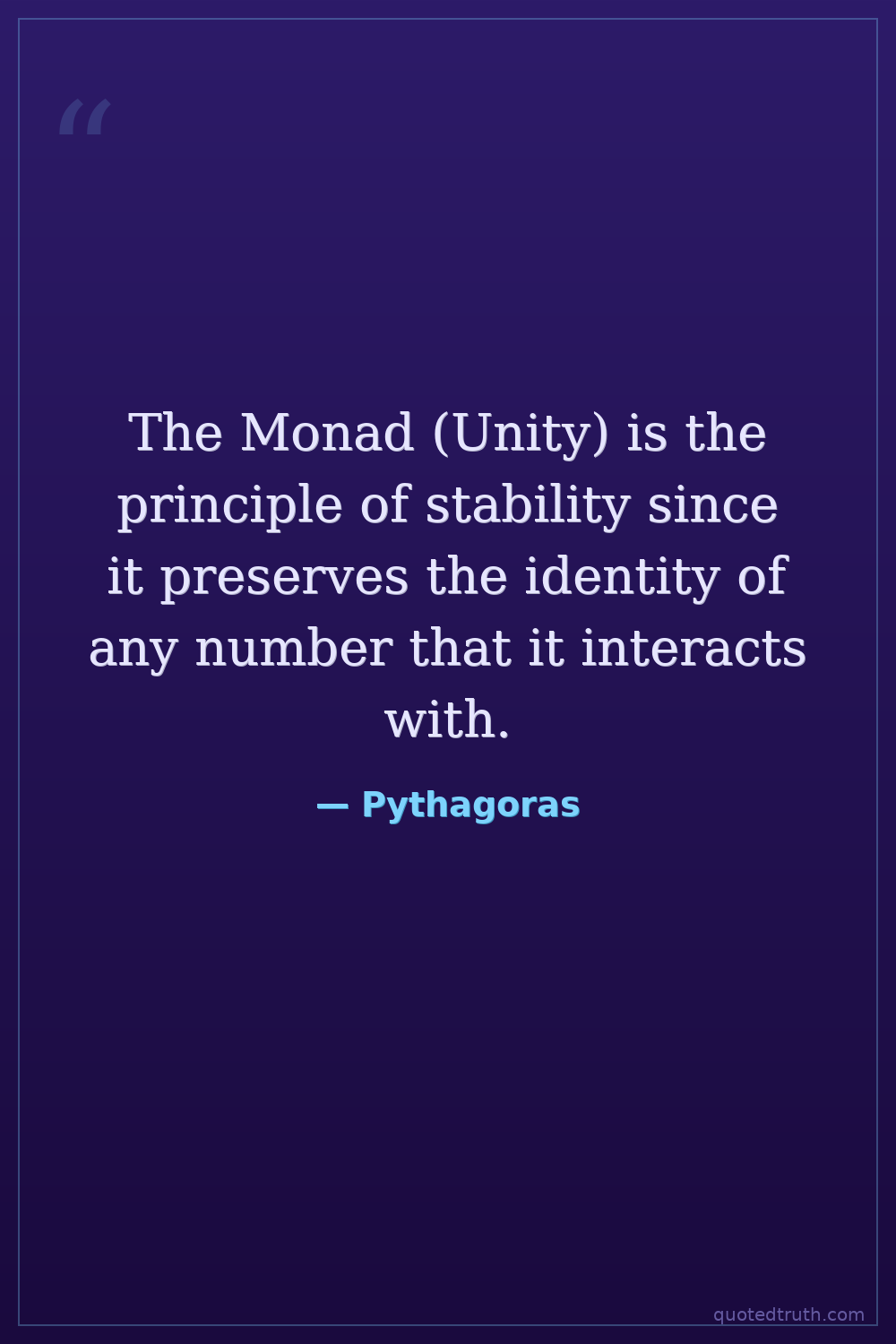
Pythagoras — "The Monad (Unity) is the principle of stability since it preserves the identity …"
The Monad (Unity) is the principle of stability since it preserves the identity of any number that it interacts with.
The Monad (Unity) is the principle of stability since it preserves the identity of any number that it interacts with.
Click any product to generate a realistic preview. Up to 3 at a time.
* Initial load can take up to 90 seconds — revising the preview in another color is nearly instant.
"It is not possible to conceal a base mind by a fair face."
"Do not eat beans."
"Beans look like the gates of Hades."
"Sacrifice an odd number to the celestial gods, and to the infernal an even."
"Truth is so great a perfection, that if God would render himself visible to men, he would choose light for his body and truth for his soul."
Greek philosopher and mathematician whose school in Croton combined geometry (the Pythagorean theorem), number-mysticism, and a religious-vegetarian way of life. Closely associated with Thales of Miletus (earlier pre-Socratic and the first philosopher). For an intellectual contrast, see Heraclitus, pre-Socratic Greek philosopher of flux — Heraclitus called Pythagoras 'the chief of swindlers' — among the founding insults of the philosophical-rivalry tradition. Their 'all is flux' vs 'all is number' poles still organize the philosophy of mathematics today (Platonist vs anti-realist).
A philosophical belief within Pythagorean numerology.
Date: c. 570-495 BCE (attributed later)
WisdomFound in 1 providers: gemini
1 source checked
The number one acts as a stabilizing force in mathematics — multiplying any number by one leaves it completely unchanged. Beyond arithmetic, this expresses a philosophical claim: unity is the most stable principle because it interacts with things without altering them. Where other numbers transform what they touch, the Monad preserves. Stability comes not from rigidity but from this neutral, unchanging quality of oneness that underlies all numerical relationships.
Pythagoras built an entire cosmology around numbers as the fundamental substance of reality, not mere counting tools. For his brotherhood in Croton, the Monad was the divine origin from which all other numbers — and therefore all things — emanate. His obsession with mathematical harmony, musical ratios, and geometric relationships reflects this conviction: unity was sacred because it underlies all structure. The theorem bearing his name similarly reveals universal patterns hidden in numerical relationships.
In 6th-century BCE Greece, pre-Socratic thinkers competed to identify the single first principle underlying all existence. Pythagoras, who studied in Egypt and Babylon, synthesized Eastern numerical mysticism with Greek philosophy. Most people understood numbers purely as practical counting tools. Declaring the Monad a cosmic principle of stability was radical — it elevated mathematics from craft to metaphysical system, challenging polytheistic frameworks by proposing abstract, universal laws governing all of reality.
AI-generated insights based on extensive research and information for context. Factual errors? Email [email protected].
Your cart is empty