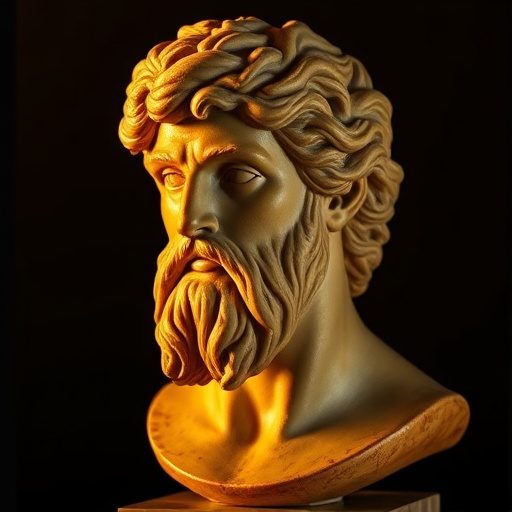
Pythagoras — "Truth is so great a perfection, that if God would render himself visible to men,…"
Truth is so great a perfection, that if God would render himself visible to men, he would choose light for his body and truth for his soul.
Truth is so great a perfection, that if God would render himself visible to men, he would choose light for his body and truth for his soul.
Click any product to generate a realistic preview. Up to 3 at a time.
* Initial load can take up to 90 seconds — revising the preview in another color is nearly instant.
"Do not look in a mirror by lamplight."
"Know thyself and thou wilt know the universe."
"Spit upon the parings of your nails, and the clippings of your hair."
"Silence is better than unmeaning words."
"Numbers rule the universe."
Greek philosopher and mathematician whose school in Croton combined geometry (the Pythagorean theorem), number-mysticism, and a religious-vegetarian way of life. Closely associated with Thales of Miletus (earlier pre-Socratic and the first philosopher). For an intellectual contrast, see Heraclitus, pre-Socratic Greek philosopher of flux — Heraclitus called Pythagoras 'the chief of swindlers' — among the founding insults of the philosophical-rivalry tradition. Their 'all is flux' vs 'all is number' poles still organize the philosophy of mathematics today (Platonist vs anti-realist).
A philosophical statement on the divine nature of truth.
Date: c. 570-495 BCE (attributed later)
BiblicalFound in 1 providers: gemini
1 source checked
Truth is elevated here as the highest form of perfection imaginable—so supreme that even divinity would embody it. Light represents the purest, most penetrating physical substance, while truth is its invisible counterpart: the inner essence of all that is perfect. The claim dissolves the boundary between the divine and the knowable, positioning truth as humanity's most direct access to the sacred rather than ritual or myth.
Pythagoras founded a secretive brotherhood in Croton treating mathematics as a spiritual practice. For him, numbers encoded divine order—his theorem revealed eternal, provable truth independent of human opinion. He believed the cosmos was fundamentally mathematical, and mathematical truths were sacred discoveries, not inventions. This quote directly echoes that conviction: truth is not merely useful but holy, making his geometric proofs acts of encountering the divine.
Pythagoras lived circa 570–495 BCE, when Greek thinkers were dismantling mythological explanations of reality. Pre-Socratics sought universal principles underlying visible phenomena—water, fire, number. Light carried profound religious weight as Apollo's symbol and the medium of divine revelation in mystery cults Pythagoras studied in Egypt and Mesopotamia. Declaring truth the soul of divinity reframed Greek religion around intellectual inquiry rather than sacrifice and augury.
AI-generated insights based on extensive research and information for context. Factual errors? Email [email protected].
Your cart is empty