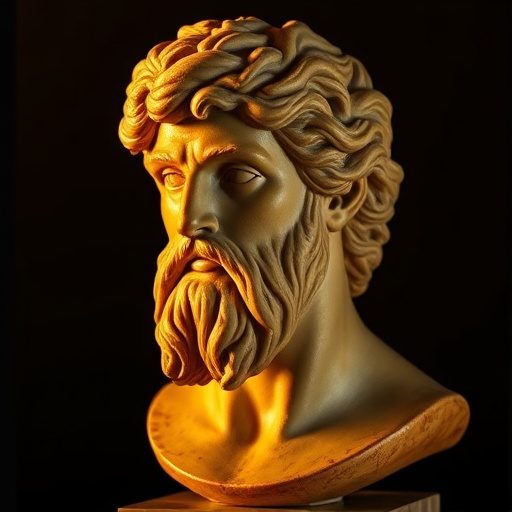
Pythagoras — "Learn to be silent. Let your quiet mind listen and absorb."
Learn to be silent. Let your quiet mind listen and absorb.
Learn to be silent. Let your quiet mind listen and absorb.
Click any product to generate a realistic preview. Up to 3 at a time.
* Initial load can take up to 90 seconds — revising the preview in another color is nearly instant.
"Declining from the public ways, walk in unfrequented paths."
"The highest good is the purification of the soul."
"The monad, is god and the good, which is the origin of the One, and is itself intelligence; but the undefined dyad is a deity and the evil, surrounding which is the mass of matter."
"Do not eat beans."
"A blow from your friend is better than a kiss from your enemy."
Greek philosopher and mathematician whose school in Croton combined geometry (the Pythagorean theorem), number-mysticism, and a religious-vegetarian way of life. Closely associated with Thales of Miletus (earlier pre-Socratic and the first philosopher). For an intellectual contrast, see Heraclitus, pre-Socratic Greek philosopher of flux — Heraclitus called Pythagoras 'the chief of swindlers' — among the founding insults of the philosophical-rivalry tradition. Their 'all is flux' vs 'all is number' poles still organize the philosophy of mathematics today (Platonist vs anti-realist).
Advice on the importance of silence and contemplation, a key aspect of Pythagorean discipline.
Date: c. 570-495 BCE (attributed later)
EducationalFound in 1 providers: gemini
1 source checked
Silence isn't absence — it's an active state that allows genuine learning. When you stop talking and quiet internal mental noise, your mind becomes receptive enough to truly absorb ideas rather than merely hear them. Deep understanding requires stillness; a cluttered, reactive mind processes information superficially. This is an instruction to cultivate deliberate quiet as a cognitive discipline, not merely politeness.
Pythagoras founded a secretive brotherhood in Croton around 530 BCE where initiates endured mandatory silence for up to five years before speaking. He taught that mathematics and music revealed cosmic order, truths accessible only through contemplative discipline. His belief that numbers underlie all reality required patient, silent observation of nature. Silence wasn't optional in his school; it was the foundational practice separating genuine students from casual listeners.
Pythagoras lived in the 6th century BCE, an era of explosive Greek intellectual awakening known as the Axial Age. Oral debate and rhetoric were central to civic life — the agora was defined by loud discourse. Philosophy itself was just emerging as a discipline. Against this backdrop, demanding silence was radical, directly challenging Greek culture's emphasis on persuasive speech as the defining mark of an educated citizen.
AI-generated insights based on extensive research and information for context. Factual errors? Email [email protected].
Your cart is empty