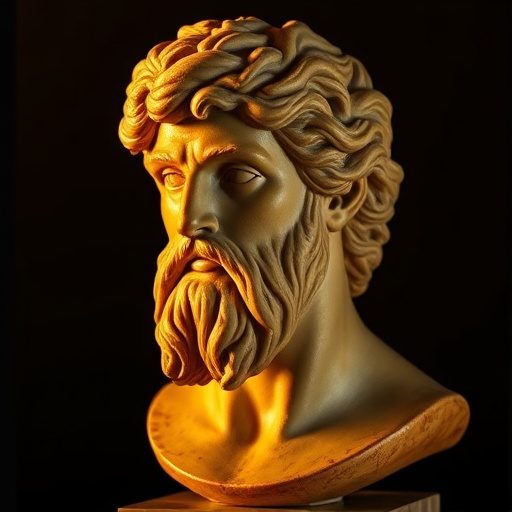
Pythagoras — "As soon as laws are necessary for men, they are no longer fit for freedom."
As soon as laws are necessary for men, they are no longer fit for freedom.
As soon as laws are necessary for men, they are no longer fit for freedom.
Click any product to generate a realistic preview. Up to 3 at a time.
* Initial load can take up to 90 seconds — revising the preview in another color is nearly instant.
"Pythagoras once claimed he had been reincarnated multiple times and was the son of Hermes, who gifted him the power of remembering who he was in all of his past lives."
"Don't help with a burden but put it on."
"Men must be taught as if you taught them not, and things unknown proposed as things forgot."
"Concern should drive us into action and not into a depression."
"Eat not the brain."
Greek philosopher and mathematician whose school in Croton combined geometry (the Pythagorean theorem), number-mysticism, and a religious-vegetarian way of life. Closely associated with Thales of Miletus (earlier pre-Socratic and the first philosopher). For an intellectual contrast, see Heraclitus, pre-Socratic Greek philosopher of flux — Heraclitus called Pythagoras 'the chief of swindlers' — among the founding insults of the philosophical-rivalry tradition. Their 'all is flux' vs 'all is number' poles still organize the philosophy of mathematics today (Platonist vs anti-realist).
A philosophical statement on the relationship between law and freedom.
Date: c. 570-495 BCE (attributed later)
Justice & RightsFound in 1 providers: gemini
1 source checked
When people need laws to behave well, they've already surrendered their capacity for genuine self-governance. True freedom means acting rightly through inner virtue and reason, not because rules compel you. A society that depends on legislation to maintain order is already enslaved to its own moral failures. Laws, in this view, are an admission that people cannot be trusted to govern themselves — a symptom of collective moral failure rather than protection.
Pythagoras founded a communal brotherhood in Croton (~530 BCE) held together by voluntary codes — vegetarianism, communal property, silence disciplines — not external law. He believed mathematical harmony governed the cosmos and that rational souls should mirror that order internally. His community demonstrated that shared philosophical commitment could organize people without coercion. For Pythagoras, wisdom and self-mastery were prerequisites for any meaningful community, making this quote a direct expression of his life's experiment.
Pythagoras lived as Greek city-states actively experimented with law codes — Solon had reformed Athens around 594 BCE, Sparta operated under Lycurgan law, and poleis debated whether justice arose from human convention or natural order. Philosophers wrestled with nomos (convention) versus physis (nature). In this environment of legal ferment, Pythagoras's claim that self-governing wisdom should supersede codified law was radical — positioning inner moral order above the growing apparatus of civic legislation.
AI-generated insights based on extensive research and information for context. Factual errors? Email [email protected].
Your cart is empty