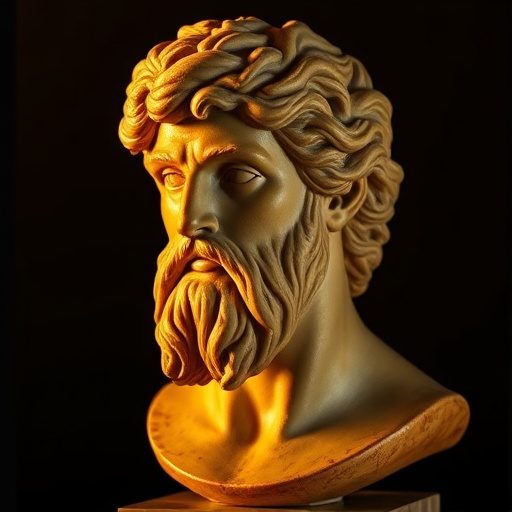
Pythagoras — "Do not speak a little on many subjects, but much on a few."
Do not speak a little on many subjects, but much on a few.
Do not speak a little on many subjects, but much on a few.
Click any product to generate a realistic preview. Up to 3 at a time.
* Initial load can take up to 90 seconds — revising the preview in another color is nearly instant.
"The soul of man is divided into three parts, intelligence, reason, and passion. Intelligence and passion are possessed by other animals, but reason by man alone."
"The beginning is half of the whole."
"Pythagoras once claimed he had been reincarnated multiple times and was the son of Hermes, who gifted him the power of remembering who he was in all of his past lives."
"Don't eat your heart."
"Do not offer the right hand to everyone."
Greek philosopher and mathematician whose school in Croton combined geometry (the Pythagorean theorem), number-mysticism, and a religious-vegetarian way of life. Closely associated with Thales of Miletus (earlier pre-Socratic and the first philosopher). For an intellectual contrast, see Heraclitus, pre-Socratic Greek philosopher of flux — Heraclitus called Pythagoras 'the chief of swindlers' — among the founding insults of the philosophical-rivalry tradition. Their 'all is flux' vs 'all is number' poles still organize the philosophy of mathematics today (Platonist vs anti-realist).
Found in 2 providers: deepseek,gemini
2 sources checked
Focus your words: say a great deal about a small number of topics rather than scattering shallow remarks across many. Depth beats breadth in communication. A person who speaks briefly on everything signals they understand nothing fully, while one who speaks extensively on a few subjects demonstrates genuine mastery and invites others to truly learn something worthwhile.
Pythagoras built an entire philosophical brotherhood around deep mastery of specific disciplines: mathematics, music, astronomy, and cosmology. He famously devoted his life to understanding numerical relationships underlying reality, producing the theorem bearing his name through sustained focused inquiry. His Pythagorean school demanded rigorous initiation precisely because shallow knowledge was considered dangerous; members spent years in silence before being permitted to speak publicly.
In ancient Greece around 500 BCE, the agora and symposium rewarded eloquent generalists who could speak persuasively on any topic. Sophists built careers selling rhetoric on demand. Pythagoras challenged this culture by founding a disciplined community in Croton where silence was cultivated and knowledge was sacred. His emphasis on depth over breadth directly contested the sophistic ideal, anticipating Socrates's later critique of those who mistake voluble confidence for wisdom.
AI-generated insights based on extensive research and information for context. Factual errors? Email [email protected].
Your cart is empty