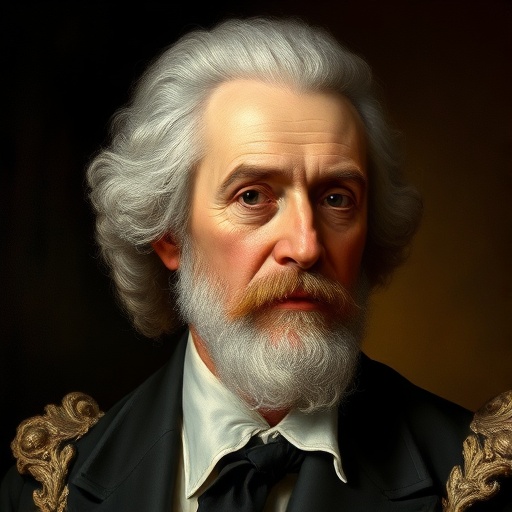
Antoine Lavoisier — "We must trust to nothing but facts: these are presented to us by nature and cann…"
We must trust to nothing but facts: these are presented to us by nature and cannot deceive.
We must trust to nothing but facts: these are presented to us by nature and cannot deceive.
Click any product to generate a realistic preview. Up to 3 at a time.
* Initial load can take up to 90 seconds — revising the preview in another color is nearly instant.
"I have always found that the more I learned, the more I realized how much I did not know."
"The most important thing for a man of science is to have a clear head and a good heart."
"The scientist should be a judge, not an advocate."
"It took them only an instant to cut off that head, but France may not produce another like it in a century."
"The art of concluding from experience and observation consists in evaluating probabilities, in estimating if they are high or numerous enough to constitute proof."
Found in 1 providers: deepseek
1 source checked
Only verified observations from the real world deserve our confidence. Human opinions, traditions, and theories can mislead us, but what actually happens in nature is reliable evidence. To understand reality, set aside assumptions and listen to what experiments and careful measurement reveal. Facts gathered directly from the physical world are the only foundation solid enough to build genuine knowledge upon, because nature itself has no motive to lie.
Lavoisier built modern chemistry on precisely this principle. He used meticulous quantitative measurement, especially the balance scale, to overturn the dominant phlogiston theory and establish conservation of mass. By weighing reactants and products, he let nature's numbers dictate conclusions rather than inherited doctrine. His naming system and oxygen theory emerged from the same commitment: trust what the apparatus shows, discard what speculation insists.
Lavoisier worked during the late 1700s Enlightenment, when reason and empirical inquiry were displacing scholastic authority across Europe. Chemistry was still entangled with alchemical tradition and the phlogiston hypothesis, while physics and astronomy had already embraced measurement. France itself was hurtling toward revolution, and Lavoisier, a tax collector, would be guillotined in 1794. His insistence on observable facts marked chemistry's transition into a rigorous, quantitative science.
AI-generated insights based on extensive research and information for context. Factual errors? Email [email protected].
Your cart is empty