Euclid — "Parallelograms which are on the same base and in the same parallels are equal to…"
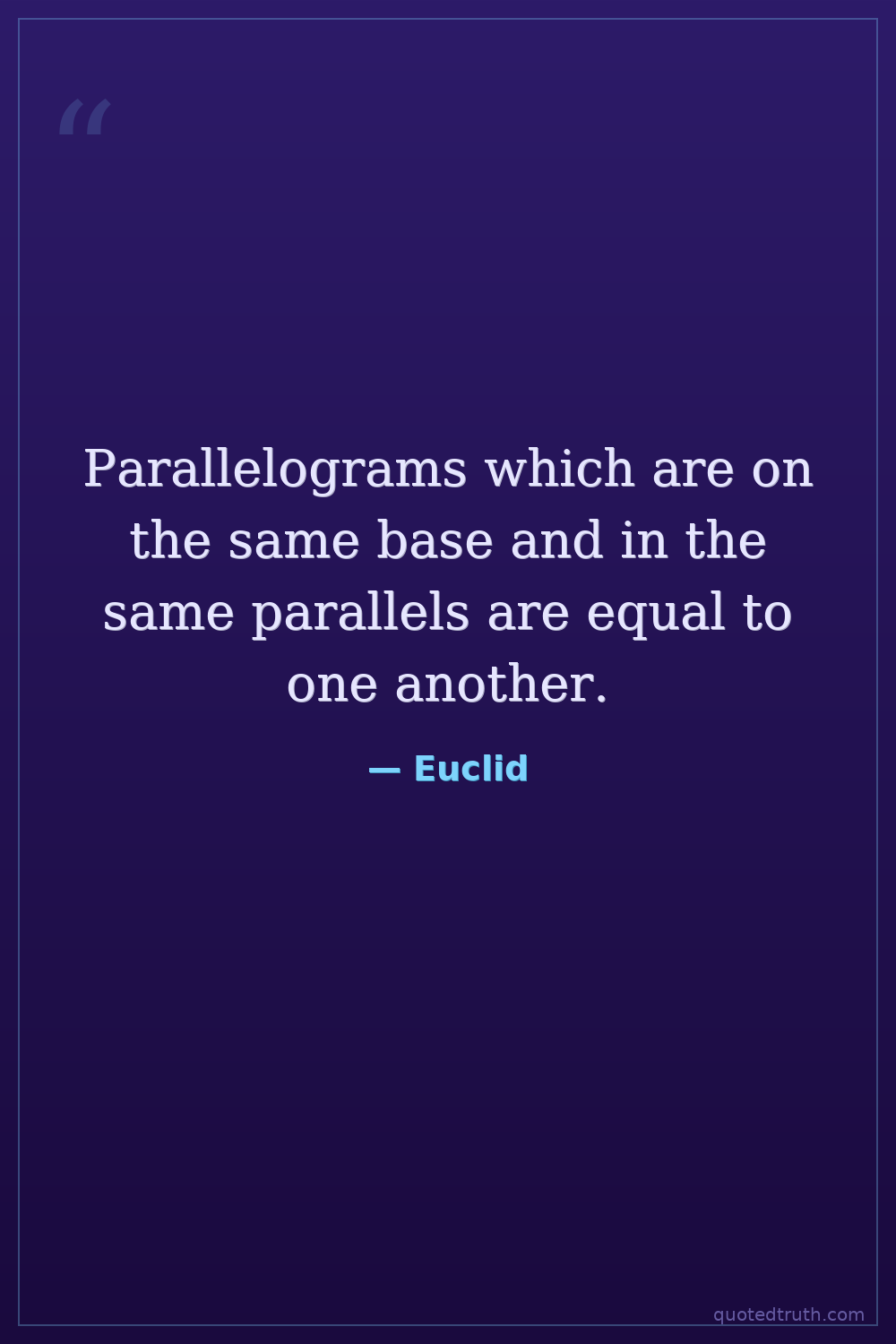
Parallelograms which are on the same base and in the same parallels are equal to one another.
Parallelograms which are on the same base and in the same parallels are equal to one another.
Click any product to generate a realistic preview. Up to 3 at a time.
* Initial load can take up to 90 seconds — revising the preview in another color is nearly instant.
"What advantage shall I get by learning these things?"
"A plane surface is a surface which lies evenly with the straight lines on itself."
"A ratio is a sort of relation in respect of size between two magnitudes of the same kind."
"The elements of geometry are derived from a small set of axioms and postulates."
"Parallel straight lines are straight lines which, being in the same plane and being produced indefinitely in both directions, do not meet one another in either direction."
Found in 1 providers: grok
1 source checked
Two parallelograms sharing the same base and confined between the same two parallel lines always have equal area — no matter how slanted or stretched they appear. A rectangle and a highly skewed parallelogram with identical base and height contain exactly the same area. The shape deceives the eye; the math does not. Area depends only on base times height, not on how tilted the figure looks.
This is Proposition 35 from Euclid's Elements, the foundational text he compiled around 300 BCE in Alexandria. His entire project was proving what seems obvious through airtight logical chains — here demonstrating that visual appearance misleads while axiomatic reasoning reveals truth. His famous rebuke to Ptolemy I — there is no royal road to geometry — captures the same conviction: rigorous proof, not shortcut or intuition, is the only valid path to geometric knowledge.
Around 300 BCE, Greek-ruled Alexandria was becoming the intellectual center of the ancient world. The Nile's annual floods erased farmland boundaries, making accurate area calculation essential for re-surveying and fair taxation — a practice Egyptians called rope-stretching. Greek thinkers were simultaneously elevating geometry from this practical craft into abstract universal science. Euclid's proof that equal-area figures need not look alike gave surveyors and philosophers a tool grounded not in measurement but in pure logical necessity.
AI-generated insights based on extensive research and information for context. Factual errors? Email [email protected].
Your cart is empty