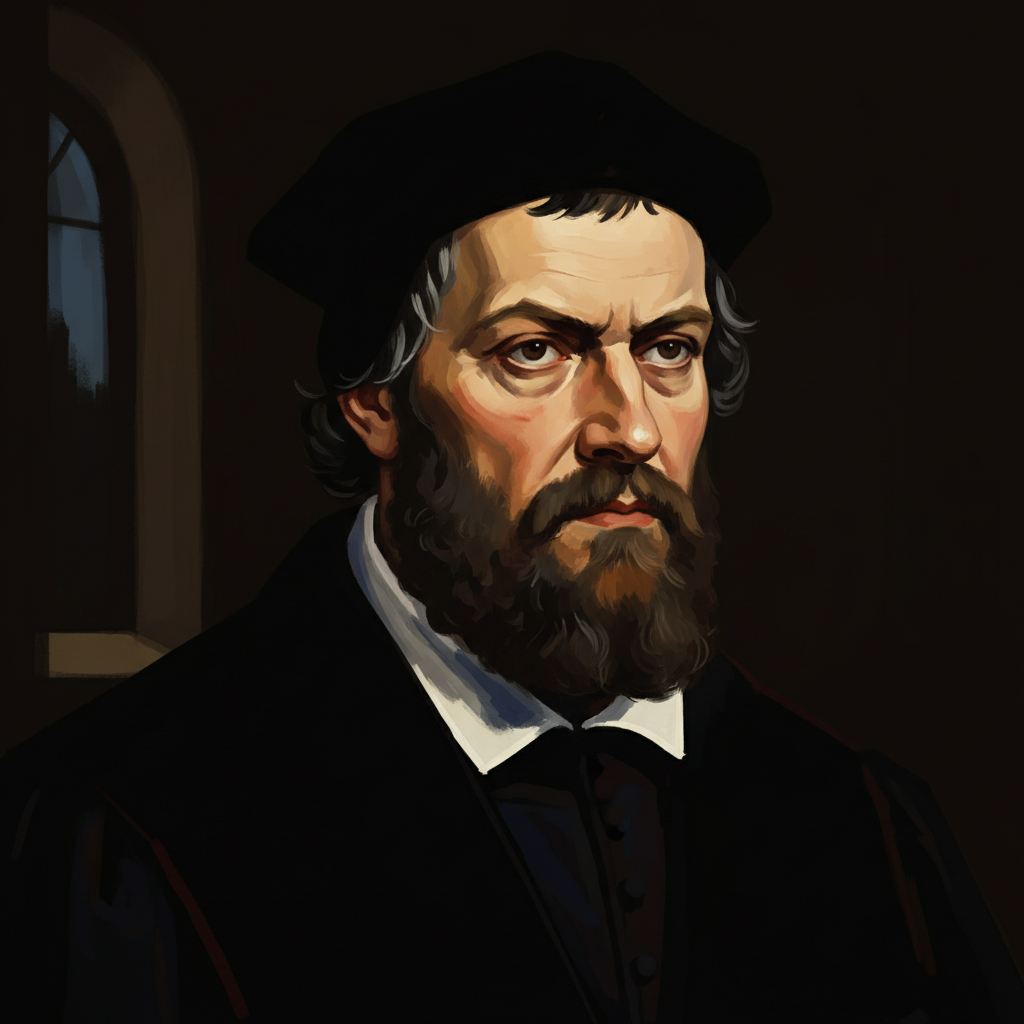
Martin Luther — "I would rather be ruled by a wise Turk than by a foolish Christian."
I would rather be ruled by a wise Turk than by a foolish Christian.
I would rather be ruled by a wise Turk than by a foolish Christian.
Click any product to generate a realistic preview. Up to 3 at a time.
* Initial load can take up to 90 seconds — revising the preview in another color is nearly instant.
"Women should remain at home, sit still, keep house, and bear and bring up children...If a woman grows weary and, at last, dies from childbearing, it matters not. Let her die from bearing - she is ther…"
"He who lets himself be led by reason will never escape sin."
"The more we are afflicted in this world, the more we are conformed to Christ."
"Let us therefore beware of the Jews, and their synagogues, and let us burn their synagogues, and let us destroy their houses, and let us take away their prayer-books and Talmuds, and let us forbid the…"
"God does many things that he does not disclose to us in his word; he also wills many things which he does not disclose himself as willing in his word. Thus he does not will the death of a sinner, acco…"
German theologian whose 95 Theses (1517) launched the Protestant Reformation and broke the Catholic Church's monopoly on Western Christianity. Closely associated with Philipp Melanchthon (Lutheran systematizer) and John Calvin (later Reformer who built on Luther's break). For an intellectual contrast, see Pope Leo X, Renaissance pope (1513-1521) — Leo X's indulgence sales triggered Luther's break and Leo excommunicated him in 1521 — Luther's entire Reformation is structured as a direct answer to the indulgence-funded Vatican Leo represented.
Found in 1 providers: gemini
1 source checked
Competence in leadership matters more than shared religion or identity. A capable outsider who governs wisely will serve people better than an incompetent insider who happens to belong to the right group. Judge rulers by their judgment, fairness, and effectiveness, not by their label. Preferring a skilled stranger over a foolish ally is simple realism about what good government actually requires from those who hold power.
Luther constantly battled church leaders he viewed as corrupt or incompetent, including popes and princes who claimed Christian authority while acting badly. Having been excommunicated in 1521 and protected by secular rulers, he knew firsthand that wearing the Christian label guaranteed nothing about wisdom or justice. His theology separated earthly government from spiritual authority, so competent pagan rule could legitimately outrank foolish Christian rule in worldly affairs.
In the early sixteenth century, the Ottoman Turks were advancing into Europe, besieging Vienna in 1529, and Christians were expected to reflexively condemn them. Meanwhile the Holy Roman Empire was fractured by Reformation conflicts, peasant revolts, and princely rivalries. Saying a Turk might govern better than a Christian prince was provocative because it challenged the crusading mindset and forced readers to separate religious identity from political competence during an existential military threat.
AI-generated insights based on extensive research and information for context. Factual errors? Email [email protected].
Your cart is empty