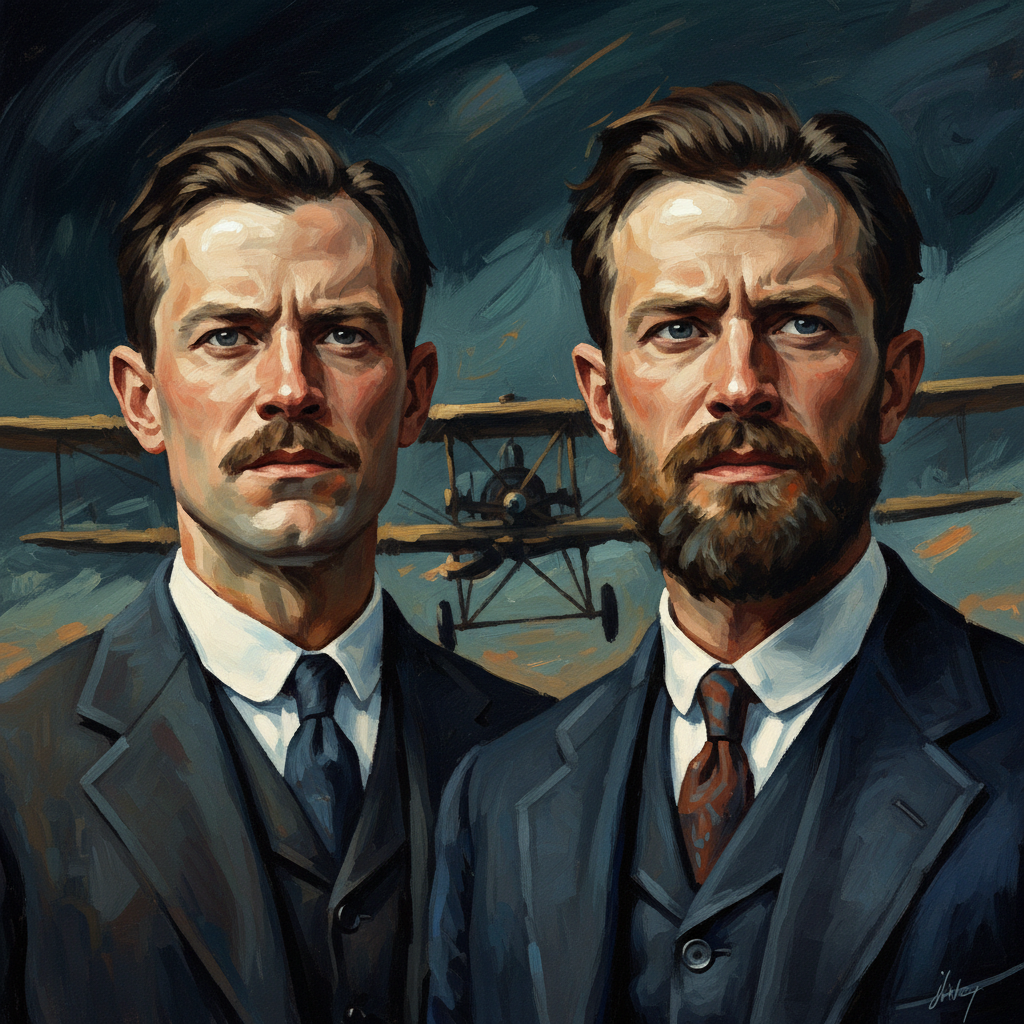
Wright Brothers (Orville & Wilbur) — "It is possible to fly without motors, but not without knowledge and skill."
It is possible to fly without motors, but not without knowledge and skill.
It is possible to fly without motors, but not without knowledge and skill.
Click any product to generate a realistic preview. Up to 3 at a time.
* Initial load can take up to 90 seconds — revising the preview in another color is nearly instant.
"I confess that in 1901 I said to my brother Orville that man would not fly for 50 years. Ever since I have distrusted myself and every time I think that a particular thing will not be done, I recall t…"
"The best thing about being a man of science is that you never have to be bored."
"I know of only one bird — the parrot — that talks; and it can't fly very high."
"The desire to fly is an idea handed down to us by our ancestors who, in their weary journeys over endless plains, yearned for a swifter and less laborious mode of travel."
"Success comes from being prepared for opportunities."
American aviation pioneers who achieved the first sustained powered controlled airplane flight at Kitty Hawk, NC, on December 17, 1903. Closely associated with Octave Chanute (their gliding mentor and aeronautical correspondent). For an intellectual contrast, see Samuel Pierpont Langley, Smithsonian Institution Secretary and government-funded aviation researcher — Langley's Aerodrome crashed twice into the Potomac in October-December 1903 with $50,000 of War Department funding; the Wright Brothers' bicycle-shop empiricism beat Langley's institutional Big Science by 9 days. The most-cited example in engineering history of empirical-tinkerer beating institution-funded credentialism.
Found in 1 providers: deepseek
1 source checked
Machinery and power aren't the foundation of achievement — knowledge and skill are. You can accomplish remarkable things with minimal tools if you've mastered the underlying principles. Raw power without expertise is useless or even dangerous. True capability comes from deep understanding and practiced ability, not from having the most advanced equipment. The hard part was never the machinery; it's always been the human mastery driving it.
The Wrights were self-taught bicycle mechanics who spent years studying bird flight and aerodynamics before ever adding an engine. They flew hundreds of unpowered glider tests at Kitty Hawk, systematically developing three-axis control and understanding lift. Their 1903 success wasn't luck — it was methodical, knowledge-driven experimentation. Well-funded rivals like Samuel Langley had powerful engines and crashed; the Wrights had mastery, which proved the decisive difference.
In the early 1900s, industrialization had made powerful engines synonymous with progress. Competitors like Samuel Langley spent enormous government funds on steam-powered aircraft that crashed spectacularly. Gliding pioneer Otto Lilienthal died in 1896 attempting flight without adequate control mastery. The prevailing belief was that bigger motors solved everything. The Wrights' insistence that knowledge and skill outweigh raw horsepower directly challenged the era's deep faith in technology as a substitute for expertise.
AI-generated insights based on extensive research and information for context. Factual errors? Email [email protected].
Your cart is empty