Wright Brothers (Orville & Wilbur) — "I confess that in 1901 I said to my brother Orville that man would not fly for 5…"

I confess that in 1901 I said to my brother Orville that man would not fly for 50 years. Ever since I have distrusted myself and every time I think that a particular thing will not be done, I recall that it is probably a wrong conclusion.
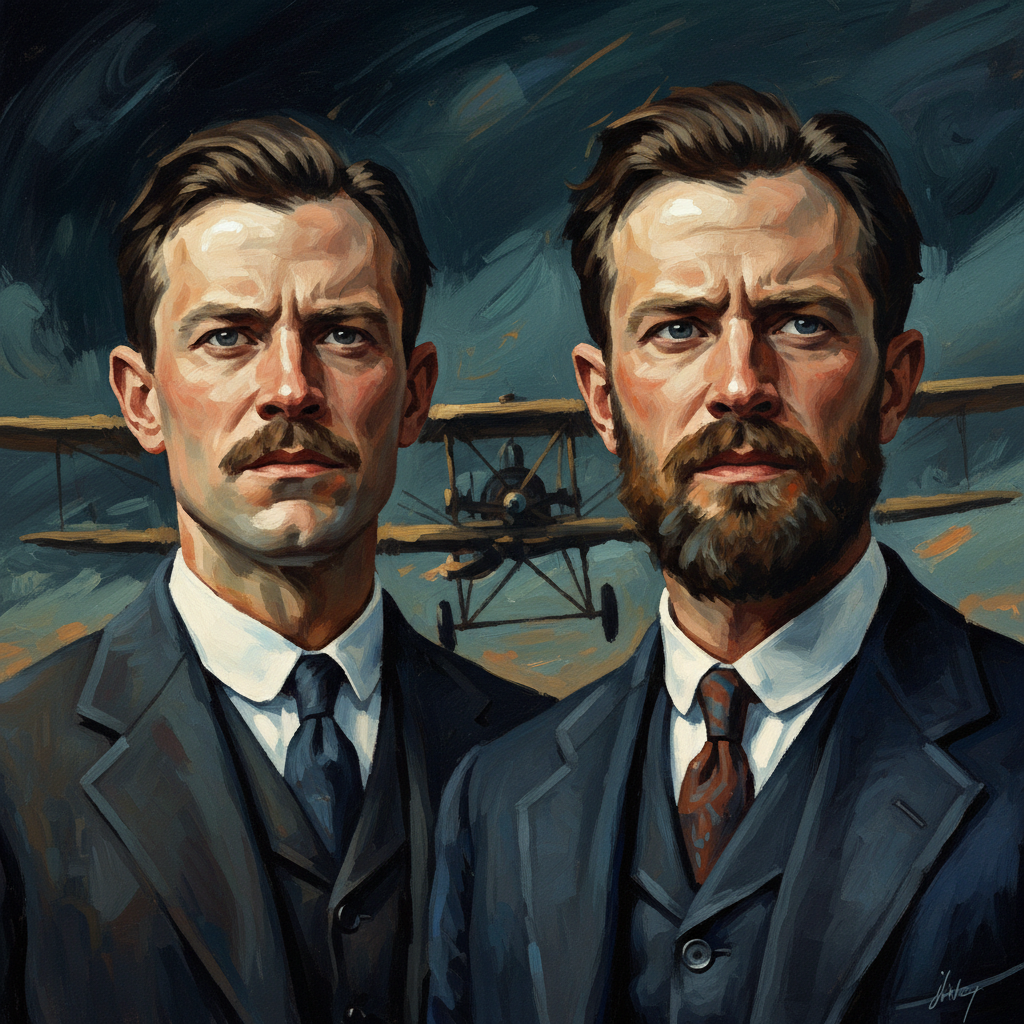
Wright Brothers (Orville & Wilbur) — Wright Brothers (Orville & Wilbur) Modern · First powered flight

Get This Quote & Author's Image Illustrated On:

Click any product to generate a realistic preview. Up to 3 at a time.
* Initial load can take up to 90 seconds — revising the preview in another color is nearly instant.

Kitchen

Apparel

Other

About Wright Brothers (Orville & Wilbur) (Wilbur 1867-1912; Orville 1871-1948)

American aviation pioneers who achieved the first sustained powered controlled airplane flight at Kitty Hawk, NC, on December 17, 1903. Closely associated with Octave Chanute (their gliding mentor and aeronautical correspondent). For an intellectual contrast, see Samuel Pierpont Langley, Smithsonian Institution Secretary and government-funded aviation researcher — Langley's Aerodrome crashed twice into the Potomac in October-December 1903 with $50,000 of War Department funding; the Wright Brothers' bicycle-shop empiricism beat Langley's institutional Big Science by 9 days. The most-cited example in engineering history of empirical-tinkerer beating institution-funded credentialism.

Details

Wilbur Wright, 'Some Aeronautical Experiments'

Date: 1902

Self-Deprecating

Verification

Unverifiable

Found in 1 providers: grok

1 source checked

Understanding this quote

What it means

Even the most knowledgeable experts can be spectacularly wrong about what's possible. This quote is a personal admission that confident predictions about human limits are often just failures of imagination. When you're certain something can't happen, that certainty itself should trigger suspicion—history repeatedly proves that what seems impossible today becomes routine tomorrow.

Relevance to Wright Brothers (Orville & Wilbur)

Wilbur Wright predicted in 1901 that powered flight was fifty years away—then achieved it himself just two years later in 1903 at Kitty Hawk. This self-correcting humility defined the brothers: bicycle mechanics who ignored expert consensus, ran thousands of wind tunnel experiments, and succeeded precisely because they questioned received wisdom, including their own.

The era

The early 1900s were defined by radical technological acceleration—automobiles, electricity, radio—upending centuries-old assumptions about what was physically achievable. Established scientists like Samuel Langley commanded government funding and credibility yet failed at powered flight. Two self-taught craftsmen succeeded instead, making the era a living lesson that institutional authority and personal certainty were poor guides to the boundaries of human capability.

AI-generated insights based on extensive research and information for context. Factual errors? Email [email protected].
Your Cart

Your cart is empty