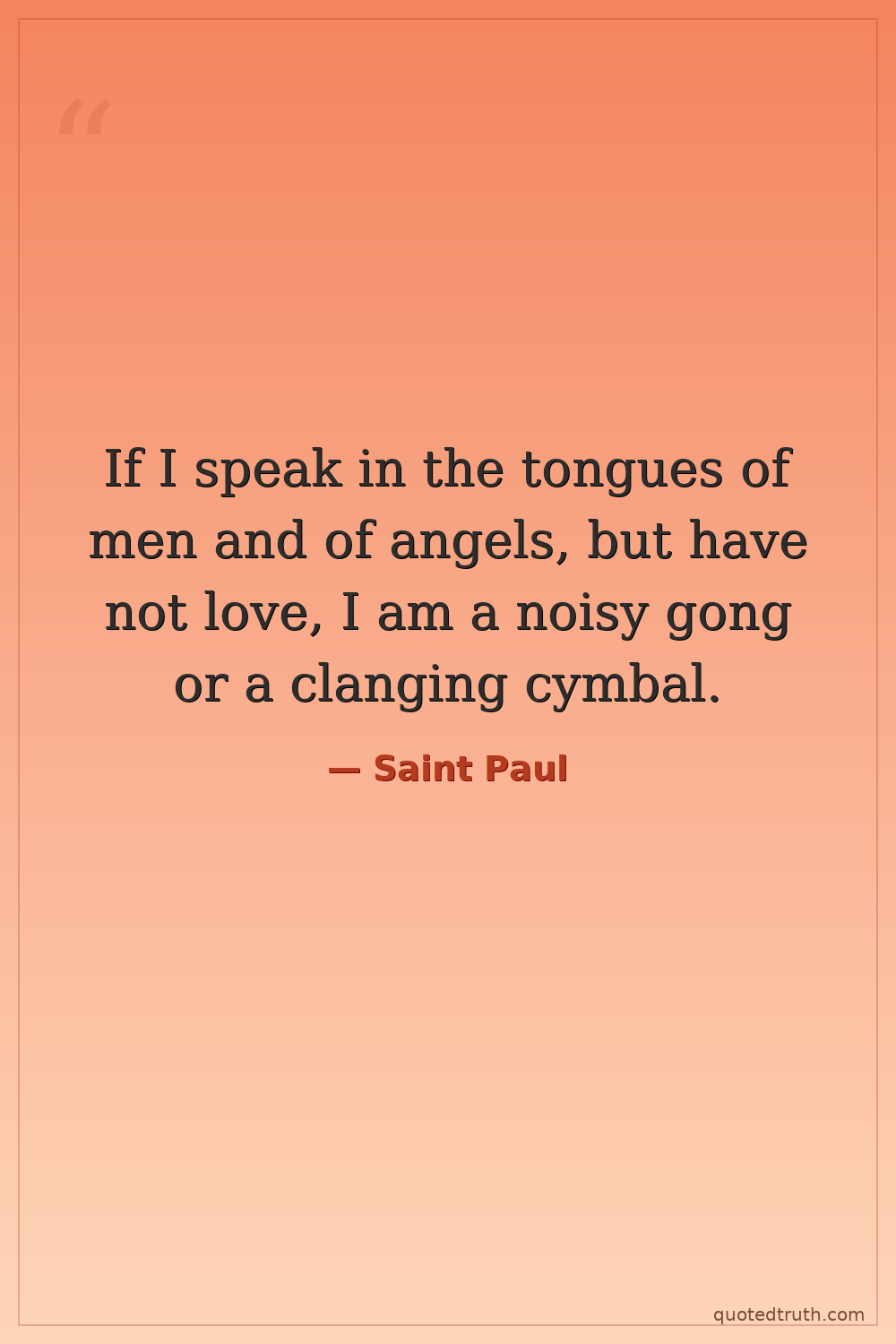
Saint Paul — "If I speak in the tongues of men and of angels, but have not love, I am a noisy …"
If I speak in the tongues of men and of angels, but have not love, I am a noisy gong or a clanging cymbal.
If I speak in the tongues of men and of angels, but have not love, I am a noisy gong or a clanging cymbal.
Click any product to generate a realistic preview. Up to 3 at a time.
* Initial load can take up to 90 seconds — revising the preview in another color is nearly instant.
"For in him we live and move and have our being."
"For we wrestle not against flesh and blood, but against principalities, against powers, against the rulers of the darkness of this world, against spiritual wickedness in high places."
"For this cause ought the woman to have power on her head because of the angels."
"Do not be deceived: ‘Bad company ruins good morals.’"
"For he that eateth and drinketh unworthily, eateth and drinketh damnation to himself, not discerning the Lord's body."
Found in 2 providers: grok,gemini
2 sources checked
Eloquence and impressive speech mean nothing without genuine love behind them. You can have the most powerful communication skills imaginable, even speaking divine languages, but if love does not motivate your words, you produce only empty noise. Talent and ability without compassion become hollow performances that annoy rather than inspire. The character of the speaker matters more than the brilliance of the speech, because love is what gives words real meaning and lasting impact.
Paul wrote this in his letter to the Corinthians, a divided community obsessed with showy spiritual gifts like speaking in tongues. As a former Pharisee trained in rhetoric and law, Paul knew the seduction of clever speech. His own dramatic conversion on the road to Damascus taught him that knowledge and zeal without love produced a persecutor, not a servant. He spent his missionary career arguing that character outweighs credentials.
First-century Corinth was a wealthy Greek port city where rhetoric was prized as the mark of an educated man, and traveling sophists charged fees for impressive oratory. Mystery religions emphasized ecstatic speech and supernatural gifts as proof of divine favor. Public bronze gongs and cymbals were used in pagan temple rituals to summon gods. Paul deliberately compared spiritual showmanship to these familiar pagan noisemakers, undercutting Corinth's status-driven religious culture.
AI-generated insights based on extensive research and information for context. Factual errors? Email [email protected].
Your cart is empty