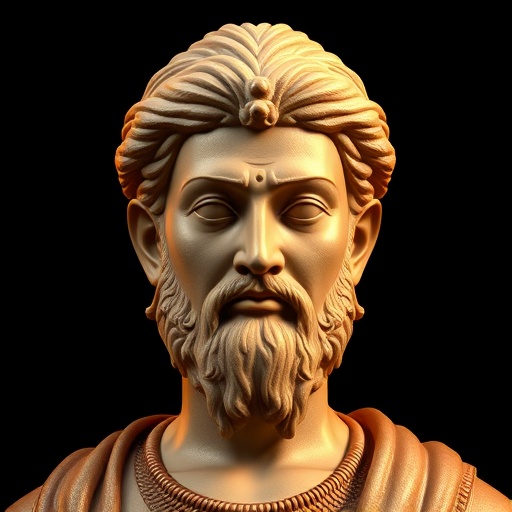
Mahavira — "All living beings are miserable because of their own actions."
All living beings are miserable because of their own actions.
All living beings are miserable because of their own actions.
Click any product to generate a realistic preview. Up to 3 at a time.
* Initial load can take up to 90 seconds — revising the preview in another color is nearly instant.
"Attachment and aversion are the root causes of Karma."
"The universe is governed by immutable laws."
"Renunciation is the key to eternal happiness."
"Every soul is pure in its origin."
"The soul is the same in all living creatures, although the body is different."
24th and last Tirthankara of Jainism, whose teachings of strict ahimsa (non-violence), aparigraha (non-attachment), and karma reshaped ancient Indian religion. Closely associated with The Buddha (near-contemporary moral revolutionary, also reacting against Vedic ritualism). For an intellectual contrast, see Vedic Brahmanical ritual sacrifice, the animal-sacrifice-centered Vedic religion of his era — Mahavira's ahimsa demanded total non-violence, including not eating root vegetables that kill the plant — a maximum-distance ethical move from the Vedic priestly tradition that ritually sacrificed cattle and horses. The two cleanest poles of ancient Indian religious ethics.
Found in 1 providers: grok
1 source checked
Your suffering is not random, not divine punishment, and not someone else's fault — it flows directly from your own past choices and actions. Every being carries the weight of its own karma. This is a call to radical personal accountability: rather than blaming circumstances or external forces, recognize that the roots of your pain lie within your own behavior, and therefore so does the path to freedom.
Mahavira abandoned wealth and royal comfort at thirty to practice rigorous asceticism for twelve years, pursuing liberation from exactly this karmic bondage. As Jainism's central architect, he taught that souls accumulate karma through every action — physical, verbal, even mental — trapping them in cycles of rebirth. His extreme self-discipline, including nudity and prolonged fasting, was a direct attempt to shed accumulated karma and prove that individuals alone control their spiritual destiny.
Mahavira lived in northeastern India around 599–527 BCE during the Axial Age, when Vedic Brahmanism dominated — a system where priests mediated karma through ritual sacrifice and gods determined fate. His teaching that suffering arose purely from individual action, with no divine intervention possible, was profoundly subversive. It stripped priests of spiritual authority and placed moral responsibility entirely on each person, resonating strongly with a growing merchant class seeking liberation outside the rigid caste hierarchy.
AI-generated insights based on extensive research and information for context. Factual errors? Email [email protected].
Your cart is empty