Charles Darwin — "The love of experiment and the patient observation of nature are the two great q…"
The love of experiment and the patient observation of nature are the two great qualifications for a naturalist.
The love of experiment and the patient observation of nature are the two great qualifications for a naturalist.
Click any product to generate a realistic preview. Up to 3 at a time.
* Initial load can take up to 90 seconds — revising the preview in another color is nearly instant.
"But I am very poorly today and very stupid and hate everybody and everything."
"I am almost convinced that species are not (it is like confessing a murder) immutable."
"There is no fundamental difference between man and the higher mammals in their mental faculties."
"To kill an error is as good a service as to establish a new truth."
"It is not the strongest of the species that survives, nor the most intelligent that survives. It is the one that is most adaptable to change."
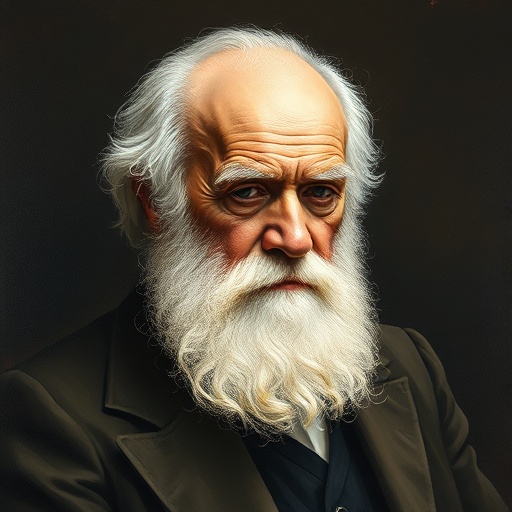
British naturalist whose On the Origin of Species (1859) established evolution by natural selection — the unifying theory of modern biology. Closely associated with Thomas Henry Huxley (his 'bulldog' public defender) and Alfred Russel Wallace (independent co-discoverer of natural selection). For an intellectual contrast, see William Paley, Anglican theologian and Natural Theology author (1743-1805) — Origin of Species is structurally a 400-page reply to Paley — Darwin admired Paley's watchmaker-argument as an undergraduate at Cambridge and then spent 20 years building the empirical machinery to displace him. The cleanest 'design argument vs natural selection' founding rebuttal in science.
The standard scholarly entry points to Charles Darwin's work: Janet Browne (Harvard, history of science) — Charles Darwin: Voyaging (1995) and The Power of Place (2002); Adrian Desmond (UCL, biographer) — Darwin: The Life of a Tormented Evolutionist (1991, with James Moore). These are the works graduate seminars cite when teaching Charles Darwin.
Found in 1 providers: grok
1 source checked
To truly understand the natural world, a scientist needs two things: genuine curiosity that drives them to test ideas through experiment, and the discipline to watch, wait, and record what nature actually does over time. Passion alone isn't enough without rigorous observation, and observation without the drive to experiment stagnates. Together, these qualities transform a curious person into someone capable of uncovering how life actually works.
Darwin embodied both qualities throughout his career. His five-year Beagle voyage was defined by relentless specimen collection and detailed field observation. Back in England, he spent over twenty years refining his theory through experiments on barnacles, pigeons, and plant behavior before publishing On the Origin of Species. He never rushed a conclusion without data. His patient accumulation of evidence across decades exemplifies exactly what he described as essential for scientific work.
During Darwin's Victorian era, natural history was both a popular gentleman's hobby and an emerging rigorous science. Many wealthy collectors gathered specimens without systematic method. Simultaneously, the Industrial Revolution accelerated interest in understanding natural resources, while natural theology held that studying nature revealed divine design. Darwin's insistence on experiment and patient observation helped define what separated serious scientific inquiry from casual collecting, precisely as biology was formalizing into a professional discipline.
AI-generated insights based on extensive research and information for context. Factual errors? Email [email protected].
Your cart is empty