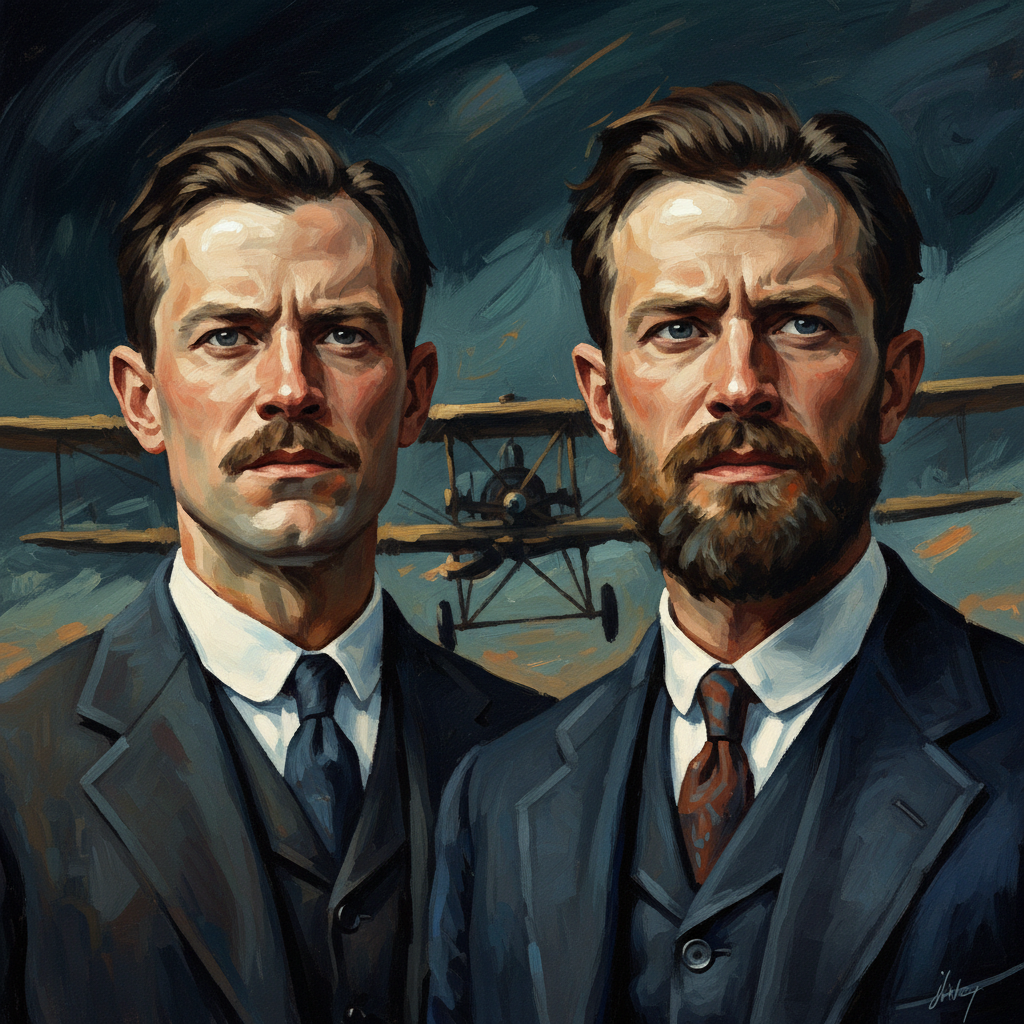
Wright Brothers (Orville & Wilbur) — "The age of the flying machine is coming; it is not here yet, but it is coming."
The age of the flying machine is coming; it is not here yet, but it is coming.
The age of the flying machine is coming; it is not here yet, but it is coming.
Click any product to generate a realistic preview. Up to 3 at a time.
* Initial load can take up to 90 seconds — revising the preview in another color is nearly instant.
"The desire for flight is the expression of a deep-seated human instinct."
"We worked together and we thought together."
"It is not necessary to be a horse to be a good jockey."
"Success in inventing depends on the close observation of nature."
"The course of the experiment was not exactly according to calculations, but was a success nevertheless."
American aviation pioneers who achieved the first sustained powered controlled airplane flight at Kitty Hawk, NC, on December 17, 1903. Closely associated with Octave Chanute (their gliding mentor and aeronautical correspondent). For an intellectual contrast, see Samuel Pierpont Langley, Smithsonian Institution Secretary and government-funded aviation researcher — Langley's Aerodrome crashed twice into the Potomac in October-December 1903 with $50,000 of War Department funding; the Wright Brothers' bicycle-shop empiricism beat Langley's institutional Big Science by 9 days. The most-cited example in engineering history of empirical-tinkerer beating institution-funded credentialism.
Found in 1 providers: grok
1 source checked
Patient, forward-looking confidence — knowing a transformative technology is inevitable even before it's fully realized. Not wishful thinking, but a calculated prediction rooted in real technical progress. The repeated 'it is coming' signals conviction without arrogance, honestly acknowledging current limitations while affirming an unstoppable trajectory. It captures the mindset of someone actively building a future others can barely imagine, certain of arrival even if the exact timing remains unknown.
The Wright Brothers spent years in their Dayton bicycle shop conducting systematic experiments — wind tunnel tests, hundreds of glider trials, custom engine design — before their Kitty Hawk breakthrough in December 1903. This reflects their methodical patience: both brothers knew flight was achievable because they solved each engineering problem in sequence. Wilbur's rigorous analytical approach and Orville's mechanical precision meant they never doubted the destination, only the timeline.
In the late 1890s and early 1900s, heavier-than-air flight was aviation's holy grail, attempted by Langley, Maxim, and others amid spectacular failures. Steam and gasoline engines were maturing rapidly. Samuel Langley's government-funded Aerodrome crashed publicly just nine days before Kitty Hawk. The brothers worked in this charged atmosphere of competitive urgency, where the race felt very real and the goal was tantalizingly close but still unclaimed by anyone.
AI-generated insights based on extensive research and information for context. Factual errors? Email [email protected].
Your cart is empty