What it means
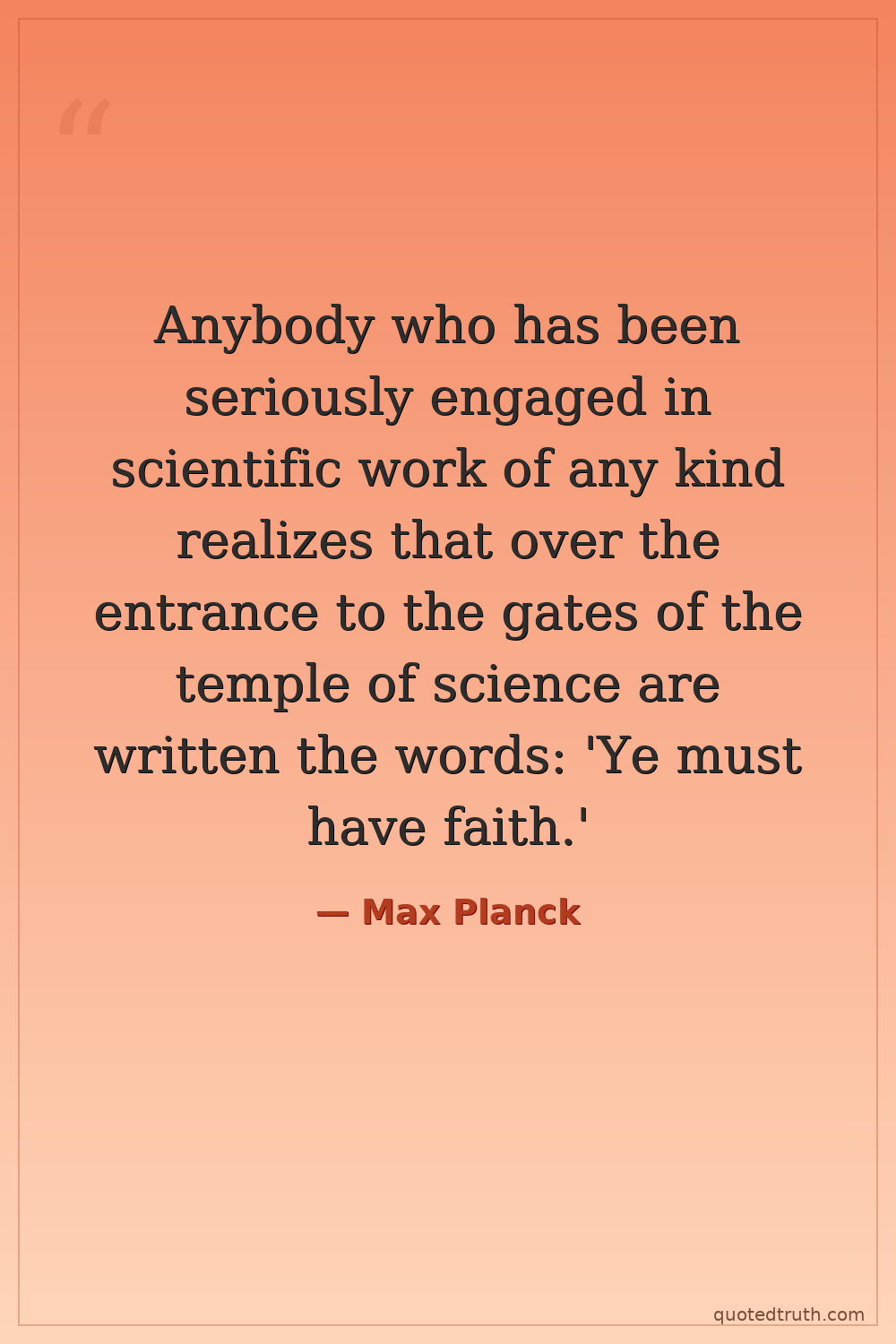
Doing real scientific work requires a kind of faith—not religious belief, but trust that the universe is orderly, that nature follows discoverable laws, and that sustained investigation will eventually yield truth. Before evidence arrives, scientists must commit to hypotheses, endure long stretches without results, and believe their methods can reach reality. Without this underlying conviction, no one would persist through the grinding uncertainty that genuine research demands.
Relevance to Max Planck
Planck spent six years wrestling with blackbody radiation before proposing energy quanta in 1900, an idea so radical he called it an 'act of desperation.' He trusted the math even when its implications horrified him, and he was a devout Lutheran who openly rejected any conflict between religion and science. This quote mirrors his lived experience: faith in orderly natural law sustained him through decades of theoretical struggle.
The era
Planck worked as classical physics was collapsing—Newtonian certainty giving way to relativity and quantum mechanics. Early 20th-century Europe saw fierce debate over positivism, which insisted science needed no metaphysical assumptions. Meanwhile, religion and science were increasingly framed as enemies. Planck, writing amid two world wars and the Nazi persecution that killed his son, defended science as a disciplined act of trust, pushing back against both dogmatic materialism and anti-intellectual ideology sweeping Germany.
AI-generated insights based on extensive research and information for context. Factual errors? Email [email protected].