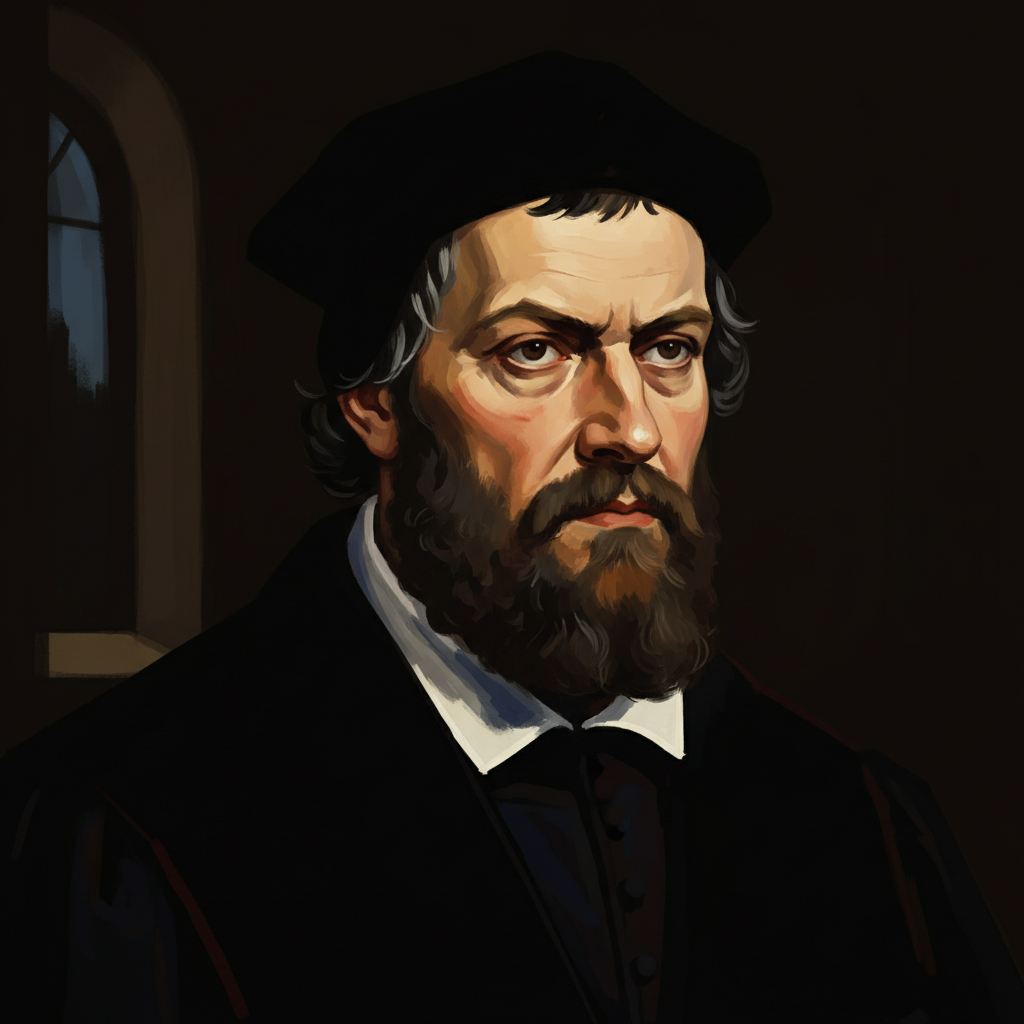
Martin Luther — "Eating is a serious business. You must eat with delight and not as if you were d…"
Eating is a serious business. You must eat with delight and not as if you were doing penance.
Eating is a serious business. You must eat with delight and not as if you were doing penance.
Click any product to generate a realistic preview. Up to 3 at a time.
* Initial load can take up to 90 seconds — revising the preview in another color is nearly instant.
"What is worse, the Jews, in their synagogues, curse our Lord Jesus Christ and Mary His mother, and call her a whore, and Christ a mamzer [bastard], that is, a son of a whore."
"The Christian shoemaker does his duty not by putting little crosses on the shoes, but by making good shoes, because God is interested in good craftsmanship."
"A woman is to be from home only when she is going to church or to the garden."
"The best way to worship God is to do your duty."
"Faith is permitting ourselves to be seized by the things we do not see."
German theologian whose 95 Theses (1517) launched the Protestant Reformation and broke the Catholic Church's monopoly on Western Christianity. Closely associated with Philipp Melanchthon (Lutheran systematizer) and John Calvin (later Reformer who built on Luther's break). For an intellectual contrast, see Pope Leo X, Renaissance pope (1513-1521) — Leo X's indulgence sales triggered Luther's break and Leo excommunicated him in 1521 — Luther's entire Reformation is structured as a direct answer to the indulgence-funded Vatican Leo represented.
Found in 1 providers: gemini
1 source checked
Meals should be enjoyed, not endured. Eating is a meaningful daily act that deserves attention and pleasure, not guilt or grim duty. Treating food as a punishment or empty obligation drains the joy from something God intended to nourish and satisfy. Approach the table with gratitude and genuine appetite rather than shame. Delight in eating is not indulgence but the proper attitude toward a gift, while forcing yourself through meals as penance distorts both body and spirit.
Luther famously rejected monastic fasting and self-denial as paths to holiness, breaking from his own Augustinian friar background where penitential meals were routine. He married former nun Katharina von Bora, kept a lively household, and hosted the famous Table Talks over hearty German food and beer. His robust appetite and enjoyment of bodily pleasures reflected his theology that grace, not ascetic suffering, saves, and that creation is meant to be received with thanks.
In early 16th-century Europe, Catholic practice imposed frequent fast days, Lenten restrictions, and monastic mortification, treating bodily appetite as spiritually dangerous. Luther's 1517 Reformation challenged works-based piety, including dietary penance. The Diet of Worms, dissolution of monasteries in Protestant regions, and rejection of mandatory fasting redefined Christian life around vocation and family. Luther's reclaiming of the dinner table as sacred space reflected a broader cultural shift toward valuing everyday domestic life over cloistered asceticism.
AI-generated insights based on extensive research and information for context. Factual errors? Email [email protected].
Your cart is empty