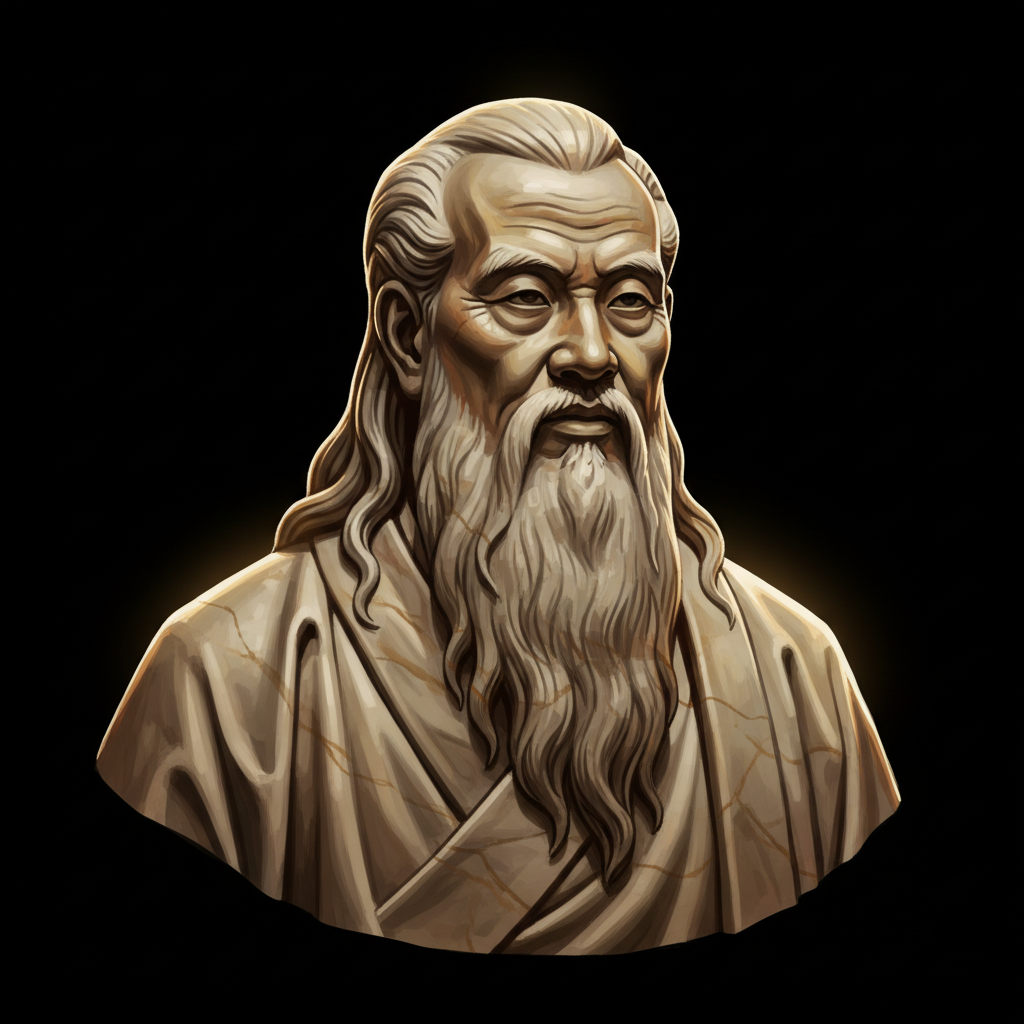
Laozi — "Govern a state by justice, wage war by surprise, and take the world by doing not…"
Govern a state by justice, wage war by surprise, and take the world by doing nothing.
Govern a state by justice, wage war by surprise, and take the world by doing nothing.
Click any product to generate a realistic preview. Up to 3 at a time.
* Initial load can take up to 90 seconds — revising the preview in another color is nearly instant.
"The sage has no mind of his own. He takes the mind of the people as his mind."
"A multitude of words is tiresome, unlike remaining centered."
"Empty your mind of all thoughts. Let your heart be at peace. Watch the turmoil of the world, but let your serenity remain intact."
"To lead people, walk behind them."
"Water is fluid, soft, and yielding. But water will wear away rock, which is rigid and cannot yield. As a rule, whatever is fluid, soft, and yielding will overcome whatever is rigid and hard. This is a…"
Reputed founder of Taoism and author of the Tao Te Ching, whose wu wei (effortless action) shaped East Asian philosophy. Closely associated with Zhuangzi (later Taoist who extended Laozi's framework). For an intellectual contrast, see Confucius, near-contemporary Chinese sage of social ritual and duty — Confucius systematized social order through ritual and hierarchy; Laozi argued that all such systems were the disease, not the cure — the two founding poles of Chinese moral philosophy.
Found in 1 providers: grok
1 source checked
Different goals require different methods. Running a country well demands fairness and clear principles so people trust the system. Winning a war demands the opposite, unpredictability that keeps enemies off balance. But the highest achievement, influencing the whole world, comes not from force or cleverness but from restraint, from stepping back and letting things unfold naturally rather than constantly meddling, pushing, or imposing your will.
Laozi served as an archivist in the Zhou royal court, observing rulers grasp and fail. His central teaching, wu wei or effortless action, argued that the more leaders intervened, the worse things became. This saying distills his philosophy perfectly: he accepts that justice and cunning have their places, but reserves true mastery for non-action. It reflects his disillusionment with court politics that pushed him to leave civilization entirely.
Laozi lived during China's Spring and Autumn period around the 6th century BCE, when the Zhou dynasty was fragmenting and rival states waged constant war. Rulers obsessed over laws, rituals, and military stratagems to control collapsing order. Against this backdrop of aggressive statecraft and Confucian emphasis on active governance, Laozi's call to rule through non-interference was radical, offering an escape from the exhausting cycle of intervention that defined his chaotic age.
AI-generated insights based on extensive research and information for context. Factual errors? Email [email protected].
Your cart is empty