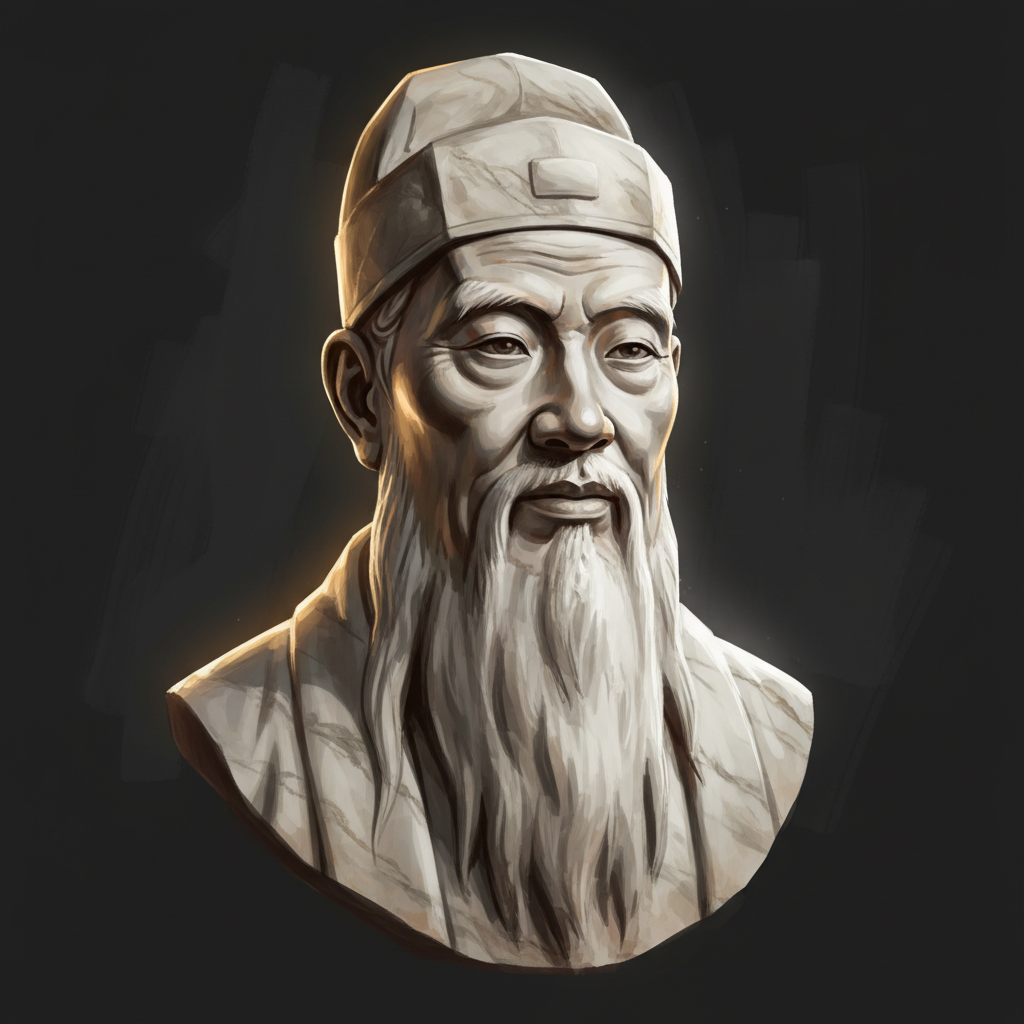
Confucius — "First he behaves properly and then he speaks, so that his words follow his actio…"
First he behaves properly and then he speaks, so that his words follow his actions.
First he behaves properly and then he speaks, so that his words follow his actions.
Click any product to generate a realistic preview. Up to 3 at a time.
* Initial load can take up to 90 seconds — revising the preview in another color is nearly instant.
"To be wealthy and honored in an unjust society is a disgrace."
"The people may be made to follow a path of action, but they may not be made to understand it."
"The gentleman is calm and at ease; the small man is fretful and ill at ease."
"The gentleman makes demands on himself, the small man makes demands on others."
"The superior man thinks of virtue; the small man thinks of comfort."
Chinese philosopher and teacher whose teachings (compiled by his students in the Analects) became the foundational ethical framework of East Asian civilization for 2,500 years. Closely associated with Mencius (his most-influential follower a century later). For an intellectual contrast, see Laozi, near-contemporary Chinese sage and Tao Te Ching author — Confucius systematized social order through ritual and family hierarchy; Laozi's Taoist effortless-action philosophy argued such systems were the disease, not the cure. The two founding poles of Chinese moral philosophy — every East Asian moral tradition since has positioned itself between them.
The standard scholarly entry points to Confucius's work: Philip J. Ivanhoe (Georgetown, Chinese philosophy) — Confucian Moral Self Cultivation (2000); Edward Slingerland (UBC, Asian Studies) — Effortless Action: Wu-wei as Conceptual Metaphor (2003); Tu Weiming (Harvard, Confucian scholar) — Confucian Thought: Selfhood as Creative Transformation (1985). These are the works graduate seminars cite when teaching Confucius.
From a teaching on integrity in speech and action (Analects 19)
Date: c. 551-479 BCE
PhilosophicalFound in 1 providers: gemini
1 source checked
Act first, talk later. A person's words should describe what they have actually done, not promise what they might do. Integrity means your speech trails your conduct, so you never overstate yourself or make claims your behavior cannot back up. Doing the work before announcing it keeps you honest, while speaking before acting invites hypocrisy. Credibility comes from aligning talk with proven deeds.
Confucius built his entire ethic around ren (humaneness) and li (ritual propriety), teaching that the junzi, or exemplary person, is measured by conduct rather than eloquence. Having served briefly as a minister in Lu and then traveling for years seeking rulers who would practice what they preached, he repeatedly condemned clever talkers and glib officials. This saying mirrors his lifelong frustration with leaders whose promises outran their virtue.
During the Spring and Autumn period around 500 BCE, the Zhou dynasty's authority had collapsed and rival states competed through shifting alliances, court intrigue, and smooth-tongued advisors peddling strategies. Rhetoric was a political weapon, and noble titles often masked misrule. Confucius preached restoration of moral order against this backdrop of empty pledges and broken treaties, insisting that sincere action, not persuasive speech, was the only foundation for stable government and trustworthy society.
AI-generated insights based on extensive research and information for context. Factual errors? Email [email protected].
Your cart is empty