Confucius — "If names be not correct, language is not in accordance with the truth of things.…"

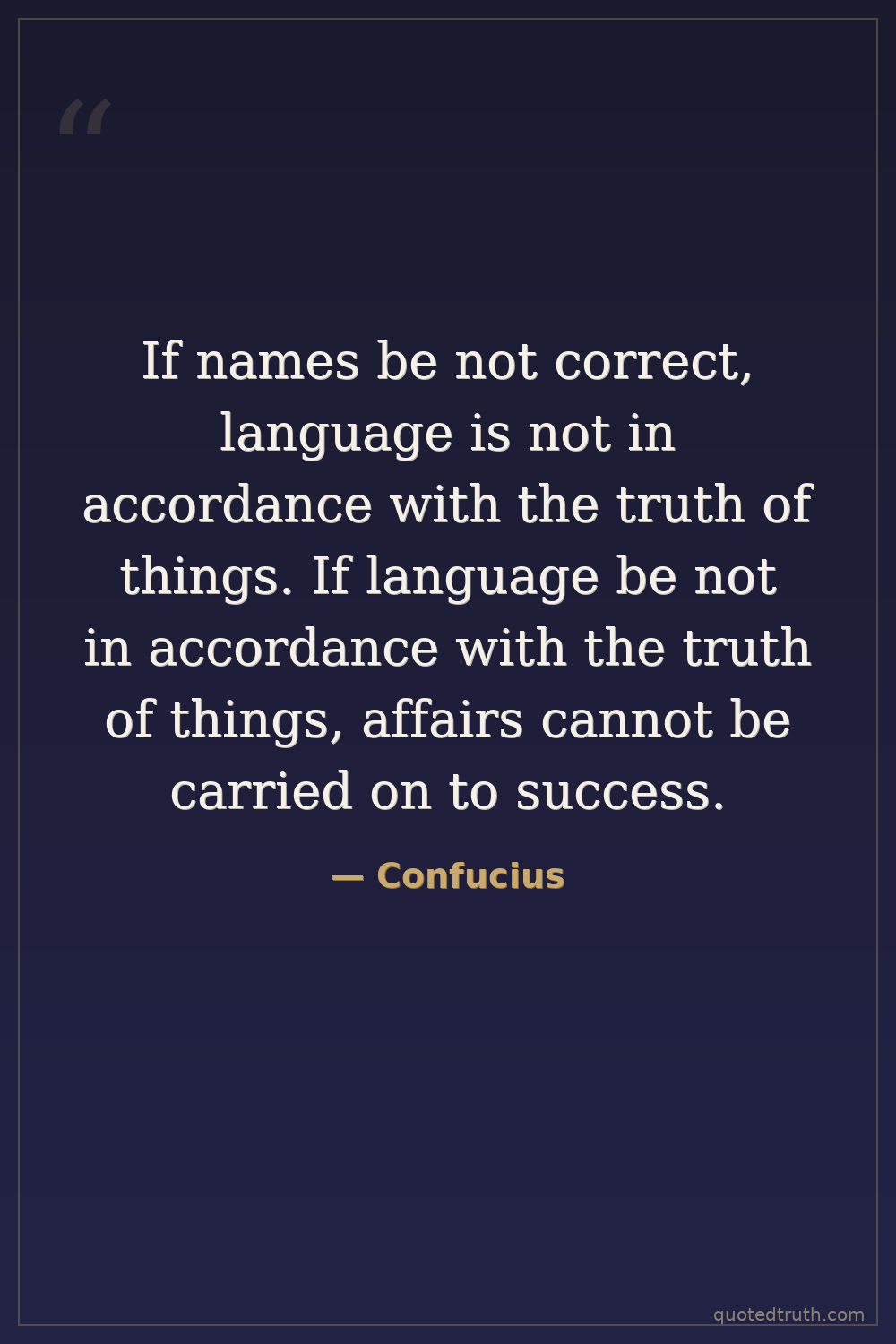
If names be not correct, language is not in accordance with the truth of things. If language be not in accordance with the truth of things, affairs cannot be carried on to success.
Confucius — Confucius Ancient · Chinese philosopher, founder of Confucianism

Get This Quote & Author's Image Illustrated On:

Click any product to generate a realistic preview. Up to 3 at a time.
* Initial load can take up to 90 seconds — revising the preview in another color is nearly instant.

Kitchen

Apparel

Other

About Confucius (551-479 BCE)

Chinese philosopher and teacher whose teachings (compiled by his students in the Analects) became the foundational ethical framework of East Asian civilization for 2,500 years. Closely associated with Mencius (his most-influential follower a century later). For an intellectual contrast, see Laozi, near-contemporary Chinese sage and Tao Te Ching author — Confucius systematized social order through ritual and family hierarchy; Laozi's Taoist effortless-action philosophy argued such systems were the disease, not the cure. The two founding poles of Chinese moral philosophy — every East Asian moral tradition since has positioned itself between them.

The standard scholarly entry points to Confucius's work: Philip J. Ivanhoe (Georgetown, Chinese philosophy) — Confucian Moral Self Cultivation (2000); Edward Slingerland (UBC, Asian Studies) — Effortless Action: Wu-wei as Conceptual Metaphor (2003); Tu Weiming (Harvard, Confucian scholar) — Confucian Thought: Selfhood as Creative Transformation (1985). These are the works graduate seminars cite when teaching Confucius.

Details

From a teaching on the Rectification of Names (Analects 13.3)

Date: c. 551-479 BCE

Philosophical

Verification

Unverifiable

Found in 1 providers: gemini

1 source checked

Understanding this quote

What it means

When we use wrong or vague words for things, our speech no longer matches reality. Once language drifts from truth, communication breaks down, people misunderstand what is actually happening, and coordinated action falls apart. Projects stall, agreements collapse, and nothing gets accomplished because everyone is operating on different understandings. Precise naming is the foundation for clear thinking, honest dialogue, and any practical effort to succeed in the real world.

Relevance to Confucius

Confucius built his entire ethical system around the 'rectification of names' (zhengming), insisting that rulers, fathers, and subjects act according to their titles. As a teacher and minor official who watched the Zhou order crumble, he saw linguistic sloppiness as moral rot: calling a usurper a king legitimized chaos. His life's work was restoring proper roles, rituals, and vocabulary so that society could function with integrity.

The era

Confucius lived during the Spring and Autumn period (roughly 551-479 BCE), when the Zhou dynasty's authority had collapsed and rival states waged constant war. Feudal lords claimed titles they had not earned, ministers assassinated their rulers, and traditional rituals were abandoned. In this breakdown of social order, words lost their binding meaning. Confucius saw restoring accurate language as the first political act needed to rebuild legitimate government, stable families, and a functioning civilization.

AI-generated insights based on extensive research and information for context. Factual errors? Email [email protected].
Your Cart

Your cart is empty