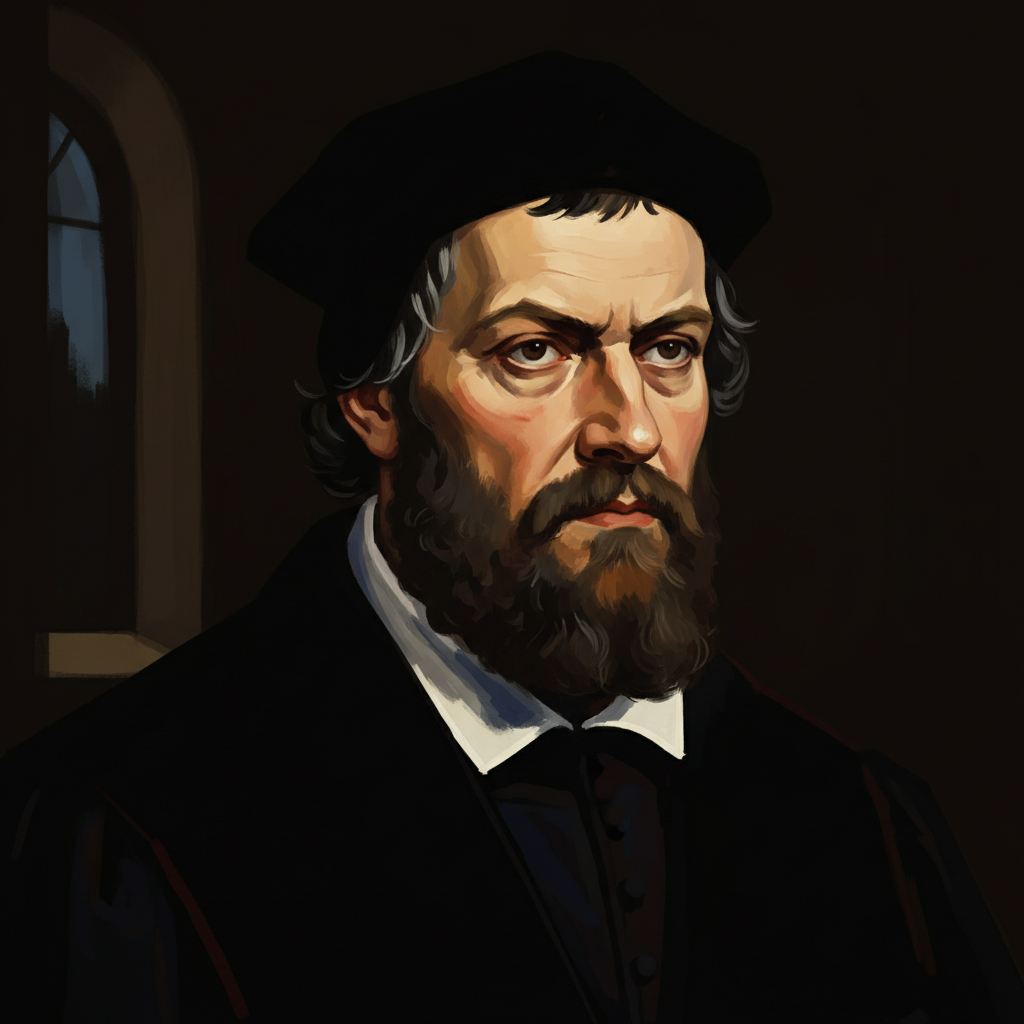
Martin Luther — "No other sin exists in the world save unbelief."
No other sin exists in the world save unbelief.
No other sin exists in the world save unbelief.
Click any product to generate a realistic preview. Up to 3 at a time.
* Initial load can take up to 90 seconds — revising the preview in another color is nearly instant.
"Whoever sticks his nose in every corner will get it stuck."
"A man must have a good mind, and a strong body, and a pure heart, to be a good preacher."
"If a woman grows weary and at last dies from childbearing, it matters not. Let her die in childbearing—she is there to do it."
"The more you read the Bible, the more you will understand it."
"War is the greatest plague that can afflict humanity, it destroys religion, it destroys states, it destroys families. Any scourge is preferable to it."
German theologian whose 95 Theses (1517) launched the Protestant Reformation and broke the Catholic Church's monopoly on Western Christianity. Closely associated with Philipp Melanchthon (Lutheran systematizer) and John Calvin (later Reformer who built on Luther's break). For an intellectual contrast, see Pope Leo X, Renaissance pope (1513-1521) — Leo X's indulgence sales triggered Luther's break and Leo excommunicated him in 1521 — Luther's entire Reformation is structured as a direct answer to the indulgence-funded Vatican Leo represented.
Found in 1 providers: gemini
1 source checked
Luther claims that every moral failure traces back to one root: refusing to trust God. Lying, stealing, pride, and cruelty are only symptoms; the real disease is unbelief. When a person genuinely trusts God's promises, right action follows naturally. When trust collapses, people try to secure life on their own terms, and that self-reliance is what produces the behaviors we call sins.
Luther built his entire theology on justification by faith alone, so sin had to be redefined around faith's opposite. As an Augustinian friar tormented by guilt over individual transgressions, he found peace only by concluding that works could not save and unbelief was the sole damning condition. This statement compresses his break with Rome: confession, penance, and indulgences cannot touch the one sin that matters.
In the early 1500s, the Catholic Church treated sin as a ledger of discrete acts cleared through priestly sacraments and purchased indulgences. Johann Tetzel was selling pardons to fund St. Peter's Basilica when Luther posted his 95 Theses in 1517. Redefining sin as unbelief dismantled that entire economy, letting ordinary Germans bypass the clergy and handing princes theological cover to break with Rome during the Reformation.
AI-generated insights based on extensive research and information for context. Factual errors? Email [email protected].
Your cart is empty