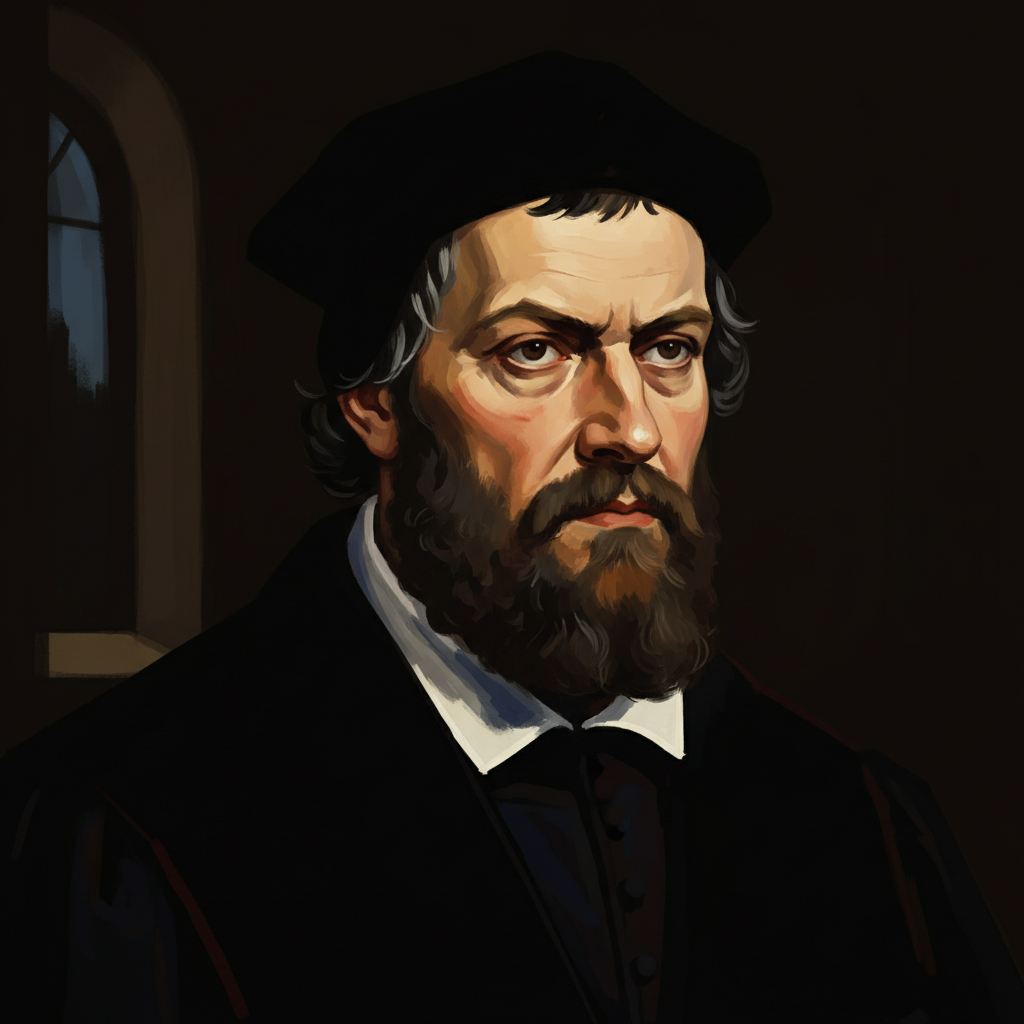
Martin Luther — "Let goods and kindred go, this mortal life also; The body they may kill: God's t…"
Let goods and kindred go, this mortal life also; The body they may kill: God's truth abideth still, His kingdom is forever.
Let goods and kindred go, this mortal life also; The body they may kill: God's truth abideth still, His kingdom is forever.
Click any product to generate a realistic preview. Up to 3 at a time.
* Initial load can take up to 90 seconds — revising the preview in another color is nearly instant.
"Reason is the Devil's greatest whore; by nature and manner of being she is a noxious whore, a stinking whore, she is and must be a mischievous whore."
"I would rather be a sow than a Christian if I had to believe that God is as cruel as some say."
"If any man doth ascribe of salvation, even the very least, to the free will of man, he knoweth nothing of grace, and he hath not learnt Jesus Christ aright."
"My conscience is captive to the Word of God."
"I have so much to do today, I'll need to spend another hour on my knees."
German theologian whose 95 Theses (1517) launched the Protestant Reformation and broke the Catholic Church's monopoly on Western Christianity. Closely associated with Philipp Melanchthon (Lutheran systematizer) and John Calvin (later Reformer who built on Luther's break). For an intellectual contrast, see Pope Leo X, Renaissance pope (1513-1521) — Leo X's indulgence sales triggered Luther's break and Leo excommunicated him in 1521 — Luther's entire Reformation is structured as a direct answer to the indulgence-funded Vatican Leo represented.
Found in 1 providers: gemini
1 source checked
Possessions, family, and even your own life can be taken from you, but that loss does not touch what actually matters. God's truth and his reign continue no matter what happens to you personally. Hold your stuff, your loved ones, and your survival loosely, because none of it is ultimate. The things worth anchoring your identity to are the ones no enemy can destroy.
Luther wrote these lines in A Mighty Fortress, his combat hymn for a movement whose members were losing property, family ties, and lives for rejecting Rome. Excommunicated in 1521 and declared an outlaw at Worms, he spent years hunted, sheltered in the Wartburg, and expected martyrdom. The verse distills his core conviction that Scripture and divine kingship outrank pope, emperor, and self-preservation combined.
Early sixteenth-century Europe was a confessional war zone. Luther's 95 Theses in 1517 cracked open a Christendom where church and state were fused, and reformers faced confiscation, exile, burning, and the Imperial ban. Peasants' War violence, Ottoman pressure at Vienna, and Diets like Worms and Augsburg framed daily life. Singing that goods, kindred, and body could be surrendered was not metaphor but a realistic accounting of the cost of dissent.
AI-generated insights based on extensive research and information for context. Factual errors? Email [email protected].
Your cart is empty