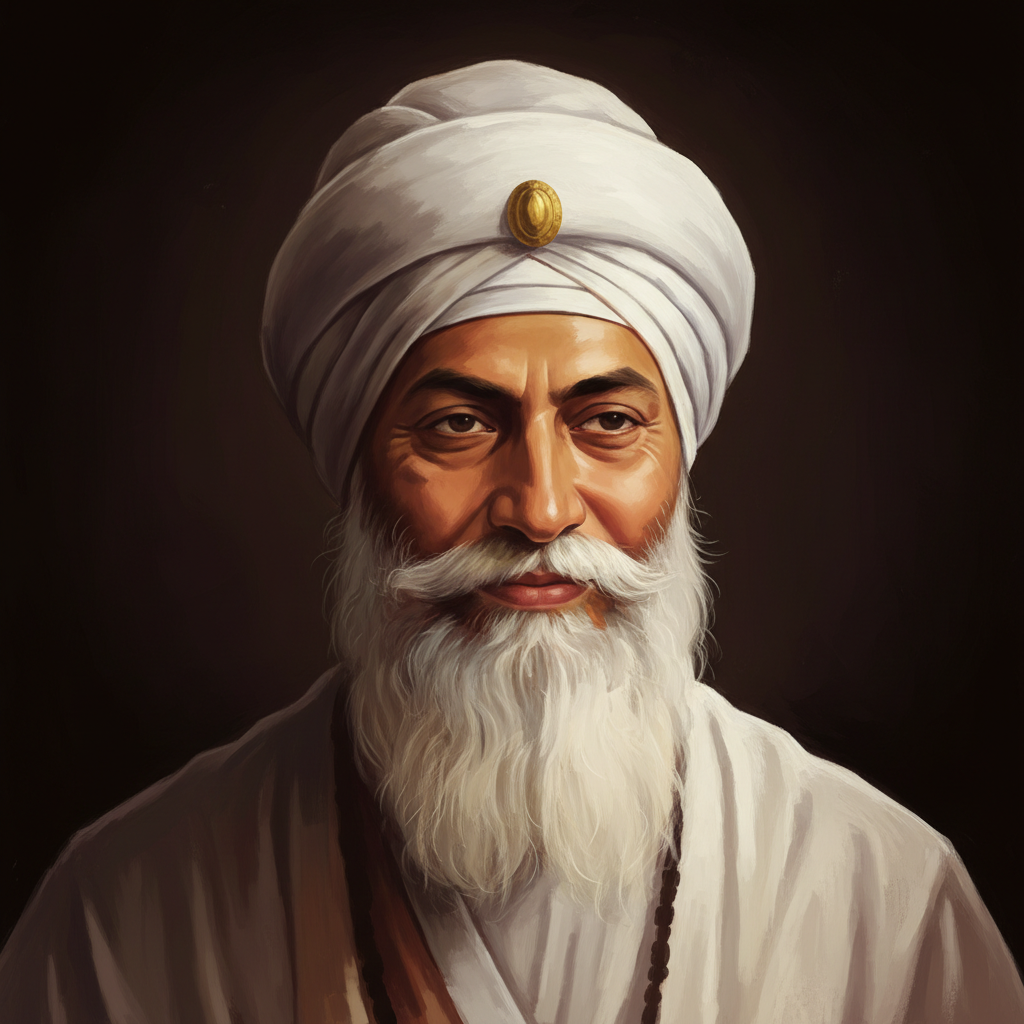
Guru Nanak — "Emotional attachment to Maya is totally painful, this is a bad bargain."
Emotional attachment to Maya is totally painful, this is a bad bargain.
Emotional attachment to Maya is totally painful, this is a bad bargain.
Click any product to generate a realistic preview. Up to 3 at a time.
* Initial load can take up to 90 seconds — revising the preview in another color is nearly instant.
"Without the Guru, no one has found God."
"The world is burning in the fire of desire, O Nanak, save it, save it, Lord!"
"Be the wisdom your support. Be the compassion your guide and listen to the Divine Music that beats in every heart."
"Why do you call her inferior, when from her, kings are born?"
"The Dhoop (burnt incense), lamps and the Naivaed (an offering of eatables presented to deity or idol. All of them become false) by smell. (Then, O Rabb!) If Your Poojaa can be done only with these thi…"
Founder of Sikhism and the first of the Ten Sikh Gurus, whose teachings of one universal God and rejection of caste shaped Punjab. Closely associated with Kabir (mystical poet whose verses appear in the Sikh Guru Granth Sahib). For an intellectual contrast, see Brahmanical orthodoxy, the Hindu caste-and-ritual establishment of his era — Sikhism was founded as a deliberate alternative to both Hindu ritual hierarchy and Islamic exclusivism — Nanak's universalism was a structural rejection of caste and priestly mediation.
Found in 1 providers: gemini
1 source checked
Maya means worldly illusion — the pull of money, status, and ego-driven desires. The quote says clinging to these things brings suffering, not satisfaction. The 'bad bargain' framing is deliberate: you trade inner peace and closeness to the Divine for fleeting pleasures that leave you emptier than before. True fulfillment comes from releasing attachment, not accumulating more of what the material world offers.
Guru Nanak spent decades traveling across India, Arabia, and Central Asia during his Udasis, witnessing how greed and status-obsession corrupted individuals and religious institutions alike. He rejected inherited merchant-class prosperity to preach equality and devotion. His hymns in the Guru Granth Sahib return repeatedly to Maya as humanity's core spiritual trap, making this warning not a peripheral observation but the theological backbone of everything he taught.
Guru Nanak lived through the collapse of the Lodi Sultanate and Babur's brutal Mughal conquest of 1526, witnessing war and the suffering caused by rulers' lust for power. Punjab's thriving trade culture made material attachment a daily temptation. Brahminical and Islamic establishments charged for religious access, commodifying spirituality itself. Against this backdrop, naming worldly attachment a 'bad bargain' carried sharp economic and moral force his audiences immediately understood.
AI-generated insights based on extensive research and information for context. Factual errors? Email [email protected].
Your cart is empty