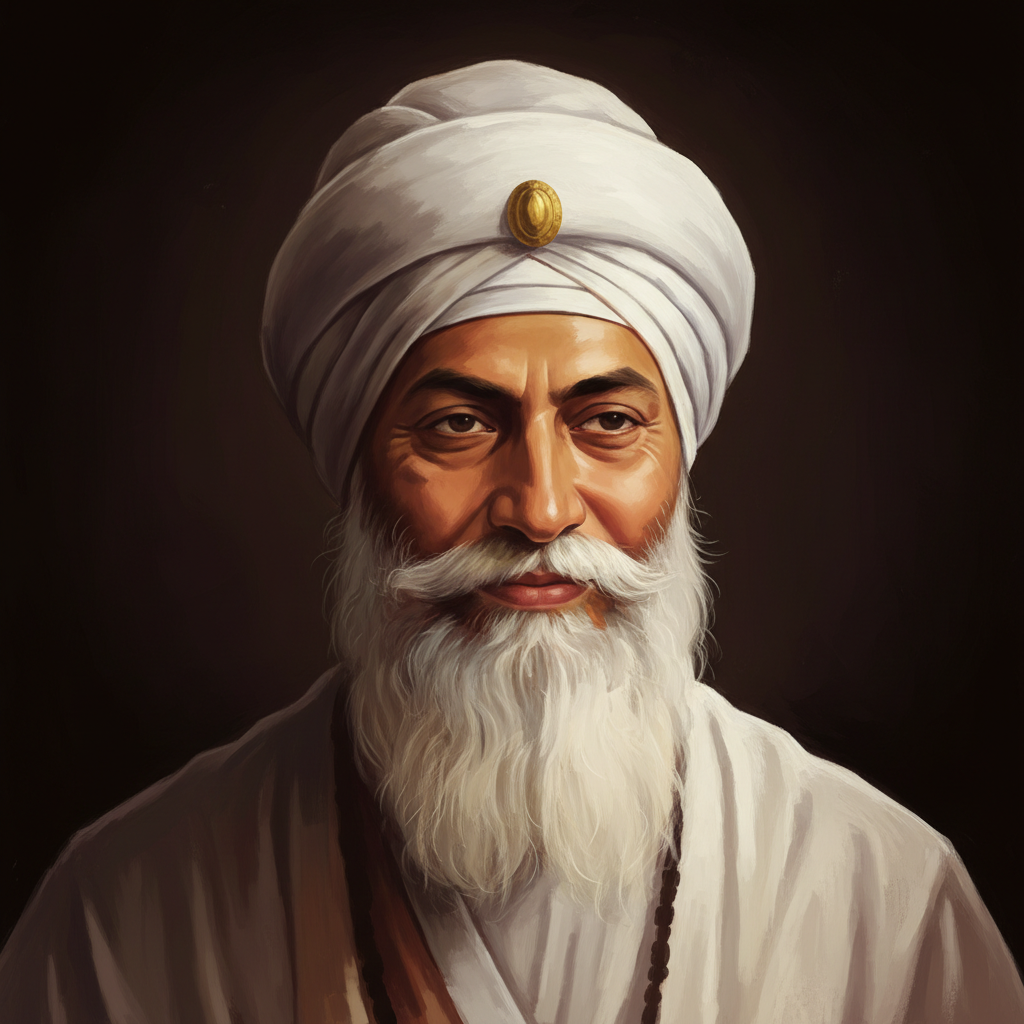
Guru Nanak — "One cannot comprehend Him through the intellect, even if one were to try a hundr…"
One cannot comprehend Him through the intellect, even if one were to try a hundred thousand times.
One cannot comprehend Him through the intellect, even if one were to try a hundred thousand times.
Click any product to generate a realistic preview. Up to 3 at a time.
* Initial load can take up to 90 seconds — revising the preview in another color is nearly instant.
"The Lord Himself is the enjoyer, and He Himself is the enjoyed."
"Only by His Grace, can one be saved."
"Injustice has no place in God's order because He is absolute just."
"The world is suffering in falsehood, and only truth can save it."
"Make compassion the cotton, contentment the thread, modesty the knot and truth the twist. This is the sacred thread of the soul; if you have it, then go ahead and put it on me."
Founder of Sikhism and the first of the Ten Sikh Gurus, whose teachings of one universal God and rejection of caste shaped Punjab. Closely associated with Kabir (mystical poet whose verses appear in the Sikh Guru Granth Sahib). For an intellectual contrast, see Brahmanical orthodoxy, the Hindu caste-and-ritual establishment of his era — Sikhism was founded as a deliberate alternative to both Hindu ritual hierarchy and Islamic exclusivism — Nanak's universalism was a structural rejection of caste and priestly mediation.
Found in 1 providers: gemini
1 source checked
God transcends rational comprehension entirely. No quantity of intellectual effort — even a hundred thousand attempts — can fully grasp the Divine's nature. Understanding the infinite through the finite mind is impossible by design. Genuine connection requires humility, grace, and devotional surrender rather than scholarly analysis. The mind navigates worldly life, but the Divine exists beyond its reach, accessible only through love, inner stillness, and the gift of grace.
Guru Nanak (1469–1539) spent years on udasis — spiritual journeys across South Asia, Persia, and Arabia — debating Hindu pandits and Muslim clerics who claimed divine knowledge through scholarship. He taught naam simran, meditative remembrance of God's name, as the true path. His own awakening came through direct divine experience, not study. This quote mirrors his foundational conviction that grace opens what intellect cannot, and that God is encountered, never merely understood.
In 15th–16th century Punjab, both Hindu Brahminical tradition and Islamic scholarship prized textual mastery as the highest spiritual pursuit, with priests and mullahs holding social power through claimed intellectual authority. Caste hierarchy restricted sacred knowledge to elites. Guru Nanak emerged amid intense religious formalism and sectarian rivalry. Declaring that God surpasses all intellectual frameworks directly challenged religious gatekeepers, democratizing spirituality by making it available to anyone capable of devotion, regardless of learning or caste.
AI-generated insights based on extensive research and information for context. Factual errors? Email [email protected].
Your cart is empty