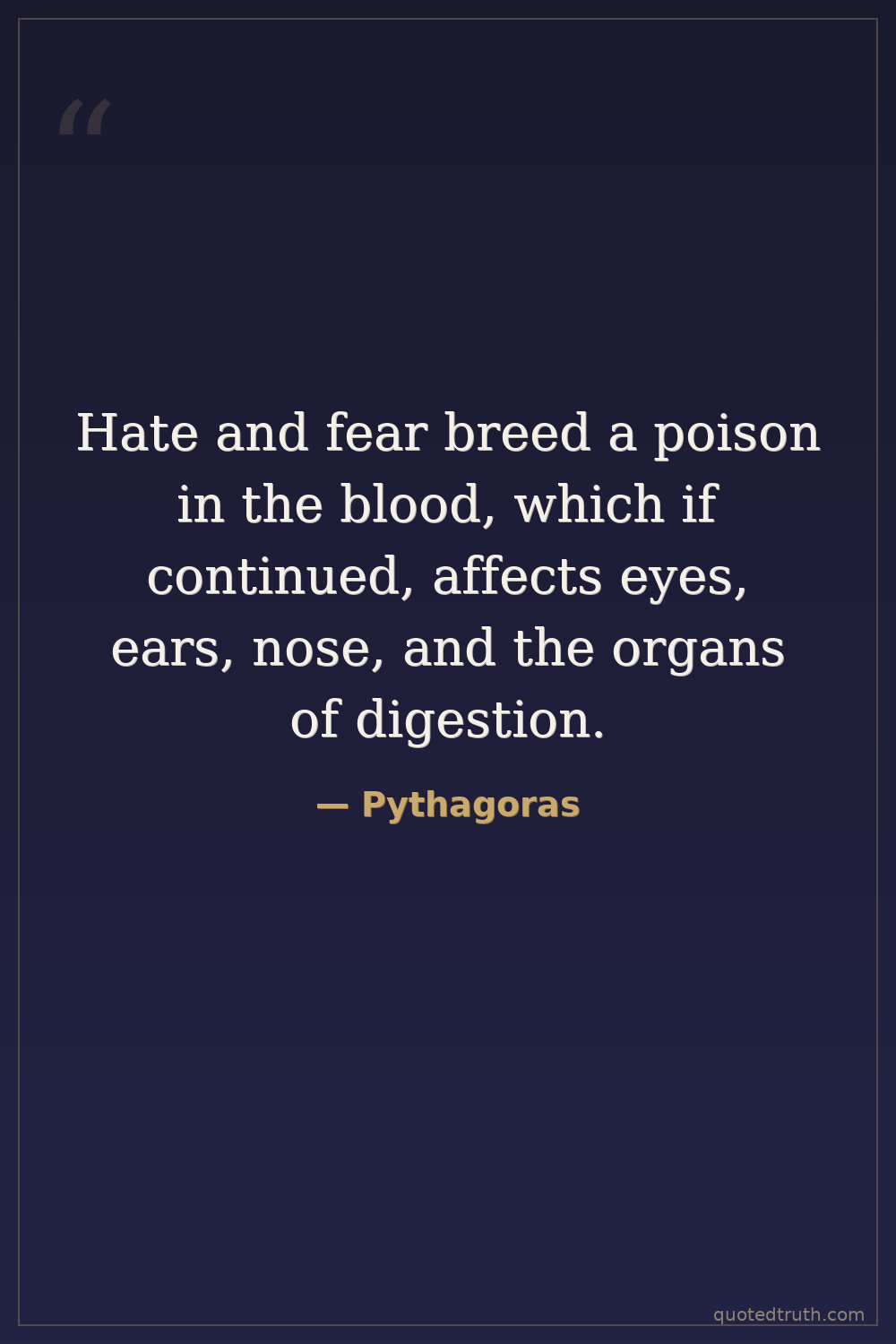
Pythagoras — "Hate and fear breed a poison in the blood, which if continued, affects eyes, ear…"
Hate and fear breed a poison in the blood, which if continued, affects eyes, ears, nose, and the organs of digestion.
Hate and fear breed a poison in the blood, which if continued, affects eyes, ears, nose, and the organs of digestion.
Click any product to generate a realistic preview. Up to 3 at a time.
* Initial load can take up to 90 seconds — revising the preview in another color is nearly instant.
"Number is the within of all things."
"Power is the near neighbour of necessity."
"Above all things, reverence yourself."
"Every man has been made by God in order to acquire knowledge and contemplate."
"The souls of animals called unreasoning are reasonable, not however with active reasoning powers, because of an imperfect mixture of the bodies and because they do not have the power of speech, as in …"
Greek philosopher and mathematician whose school in Croton combined geometry (the Pythagorean theorem), number-mysticism, and a religious-vegetarian way of life. Closely associated with Thales of Miletus (earlier pre-Socratic and the first philosopher). For an intellectual contrast, see Heraclitus, pre-Socratic Greek philosopher of flux — Heraclitus called Pythagoras 'the chief of swindlers' — among the founding insults of the philosophical-rivalry tradition. Their 'all is flux' vs 'all is number' poles still organize the philosophy of mathematics today (Platonist vs anti-realist).
An early recognition of the psychosomatic effects of negative emotions.
Date: c. 5th Century BCE
PhilosophicalFound in 1 providers: gemini
1 source checked
Sustained hatred and fear do not just disturb the mind; they physically harm the body. Chronic negative emotions release something toxic that damages vision, hearing, smell, and digestion over time. In modern terms, prolonged stress and resentment trigger biological changes that impair sensory and digestive health. Emotional states are not separate from physical wellbeing; they poison it gradually when carried long enough without release.
Pythagoras led a communal sect that treated diet, silence, music, and emotional discipline as medicine for the soul and body. His followers practiced daily self-examination to purge anger and fear, believing inner harmony produced physical health. Though remembered for geometry, he taught that numbers, ethics, and bodily purity were inseparable. This saying reflects his conviction that moral psychology directly governs physiology, a cornerstone of Pythagorean living.
In sixth-century BCE Greece, illness was usually blamed on divine punishment or imbalanced humors, not emotions. Pythagoras founded his school in Croton amid political turmoil, factional hatred, and frequent warfare between city-states. Linking chronic fear and hatred to bodily decay was a radical proto-psychosomatic claim, predating Hippocratic medicine by a century. It offered citizens living under constant threat a framework where emotional self-mastery was literal self-preservation, not just philosophy.
AI-generated insights based on extensive research and information for context. Factual errors? Email [email protected].
Your cart is empty