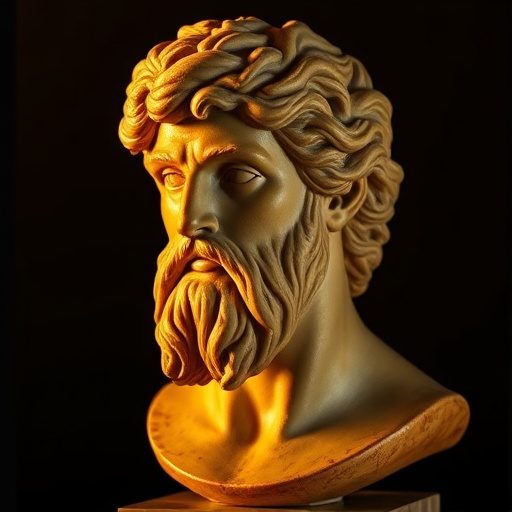
Pythagoras — "Don't try to cover your mistakes with false words. Rather, correct your mistakes…"
Don't try to cover your mistakes with false words. Rather, correct your mistakes with examination.
Don't try to cover your mistakes with false words. Rather, correct your mistakes with examination.
Click any product to generate a realistic preview. Up to 3 at a time.
* Initial load can take up to 90 seconds — revising the preview in another color is nearly instant.
"Men must be taught as if you taught them not, and things unknown proposed as things forgot."
"Know thyself and thou wilt know the universe."
"Above all things, reverence yourself."
"It is better to be silent than to utter words that are not true."
"No one is free who has not obtained the empire of himself. No man is free who cannot command himself."
Greek philosopher and mathematician whose school in Croton combined geometry (the Pythagorean theorem), number-mysticism, and a religious-vegetarian way of life. Closely associated with Thales of Miletus (earlier pre-Socratic and the first philosopher). For an intellectual contrast, see Heraclitus, pre-Socratic Greek philosopher of flux — Heraclitus called Pythagoras 'the chief of swindlers' — among the founding insults of the philosophical-rivalry tradition. Their 'all is flux' vs 'all is number' poles still organize the philosophy of mathematics today (Platonist vs anti-realist).
An ethical teaching on accountability and self-correction.
Date: c. 5th Century BCE
PhilosophicalFound in 1 providers: gemini
1 source checked
Lying about your errors only deepens the damage. Instead, take an honest look at what went wrong, figure out why, and fix the underlying behavior. Words can paper over a mistake for a moment, but real repair comes from examining your actions, owning the failure, and changing what caused it. Self-scrutiny, not spin, is how a person actually grows and avoids repeating the same error.
Pythagoras ran a strict philosophical brotherhood in Croton where members practiced daily self-examination, reportedly reviewing each day's deeds before sleep with questions like 'Where did I go wrong?' His school demanded years of silence, honesty, and disciplined reasoning. As a mathematician, he prized proof over assertion, which carries directly into ethics: a flawed argument isn't rescued by rhetoric, and neither is a flawed life.
In 6th-century BCE Greece, reputation and public honor shaped a man's entire social standing, creating heavy pressure to deny faults and save face. Rhetoric and persuasive speech were becoming prized civic tools, often used to dress up weak positions. Against that current, Pythagoras's community treated truthful self-accounting as a spiritual discipline, part of a broader philosophical turn toward inner virtue, reason, and accountability rather than mere appearance before the polis.
AI-generated insights based on extensive research and information for context. Factual errors? Email [email protected].
Your cart is empty