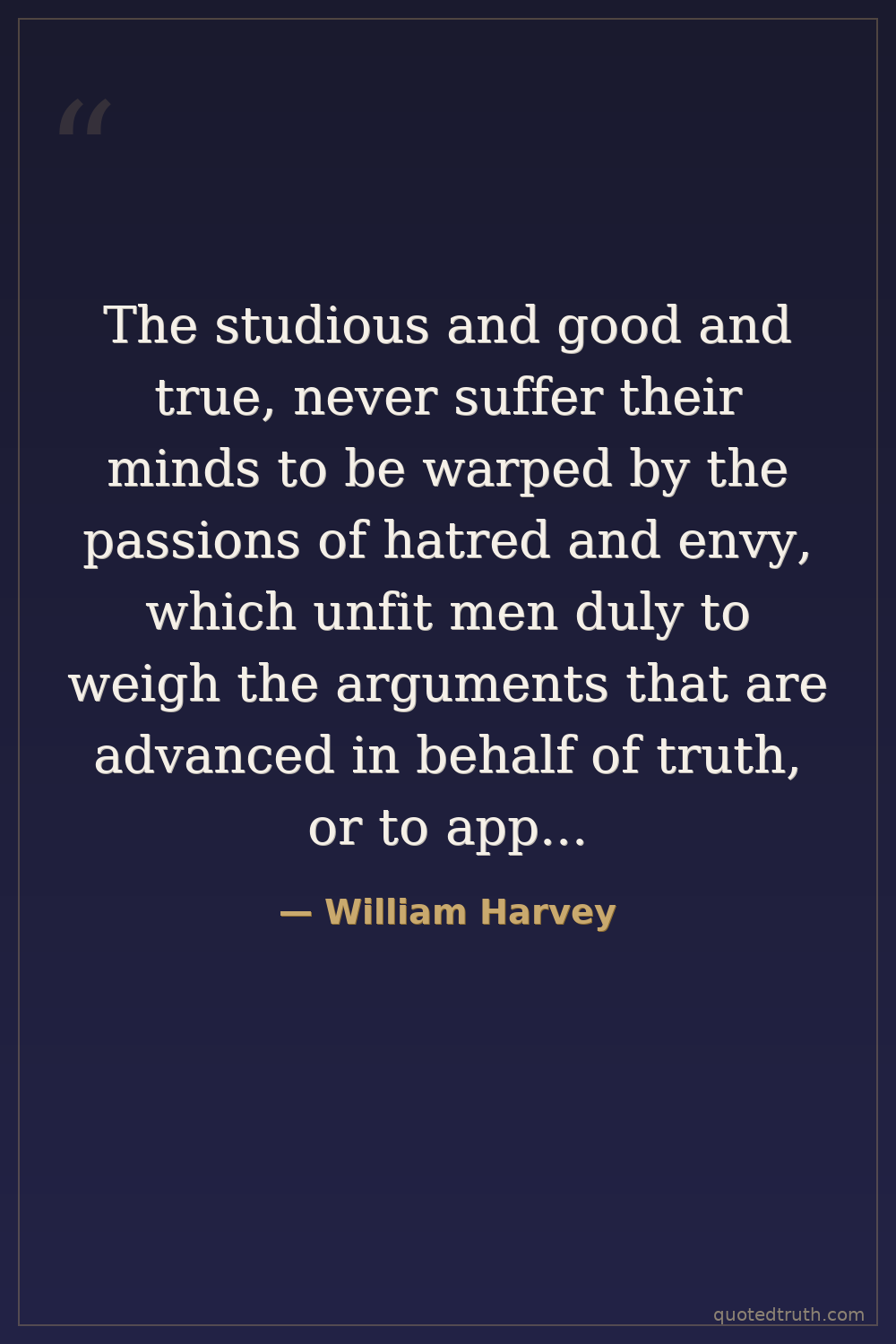
William Harvey — "The studious and good and true, never suffer their minds to be warped by the pas…"

The studious and good and true, never suffer their minds to be warped by the passions of hatred and envy, which unfit men duly to weigh the arguments that are advanced in behalf of truth, or to appreciate the proposition that is even fairly demonstrated.
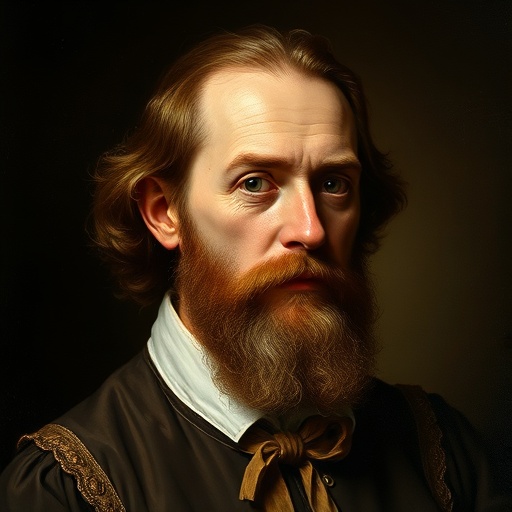
William Harvey — William Harvey Early Modern · Blood circulation

Get This Quote & Author's Image Illustrated On:

Click any product to generate a realistic preview. Up to 3 at a time.
* Initial load can take up to 90 seconds — revising the preview in another color is nearly instant.

Kitchen

Apparel

Other

About William Harvey (1578-1657)

English physician whose On the Motion of the Heart and Blood in Animals (1628) demonstrated blood circulation, overturning 1,400 years of Galenic medicine. Closely associated with Francis Bacon (his contemporary in the new English empiricism). For an intellectual contrast, see Galenic medicine, the 2nd-century Greek medical tradition (humors, blood-as-consumed-fuel) — Harvey calculated that the heart pumps more blood per hour than the body could possibly produce as fuel — a single quantitative observation that demolished the entire Galenic-Aristotelian medical worldview. The cleanest example in medical history of arithmetic disproving 14 centuries of authority.

Details

From 'De Motu Cordis' (1628), Dedication to Doctor Argent. An ethical statement on the importance of impartiality in scientific inquiry.

Date: 1628

Philosophical

Verification

Unverifiable

Found in 1 providers: gemini

1 source checked

Understanding this quote

What it means

People who are genuinely scholarly, moral, and truth-seeking never let hatred or envy distort their judgment. Those emotions make it impossible to evaluate arguments objectively or accept conclusions that have been clearly proven. Real intellectual honesty requires emotional discipline — you cannot fairly weigh evidence while blinded by resentment toward whoever presents it or jealousy of their discovery.

Relevance to William Harvey

Harvey published his proof of blood circulation in 1628, overturning 1,400 years of Galenic medicine. The backlash was fierce — established physicians attacked him from professional jealousy and doctrinal attachment rather than engaging his evidence. He reportedly lost patients and endured sustained ridicule. This quote captures his lived frustration: watching colleagues let envy and bias prevent them from accepting what he had rigorously demonstrated through dissection and quantitative experiment.

The era

The early 17th century was the Scientific Revolution's peak — Galileo, Kepler, and Vesalius had already challenged ancient authority. Yet institutional medicine clung to Galen's 2nd-century framework as near-sacred doctrine. Challenging it risked professional ruin and social condemnation. Academic disputes were intensely personal, driven by guild loyalty and status rather than evidence. New empirical findings were routinely rejected not on logical grounds but through entrenched envy and ideological inertia.

AI-generated insights based on extensive research and information for context. Factual errors? Email [email protected].
Your Cart

Your cart is empty