William Harvey — "We are taught by nature to begin with the simple and proceed to the complex."
We are taught by nature to begin with the simple and proceed to the complex.
We are taught by nature to begin with the simple and proceed to the complex.
Click any product to generate a realistic preview. Up to 3 at a time.
* Initial load can take up to 90 seconds — revising the preview in another color is nearly instant.
"The greatest pleasure is to discover something new."
"The blood in the animal body is impelled in a circle, and is in a state of ceaseless motion."
"Truth is the daughter of time, not of authority."
"Without the circulation of the blood, there can be no true life."
"The art of medicine is to prolong life, not to shorten it."
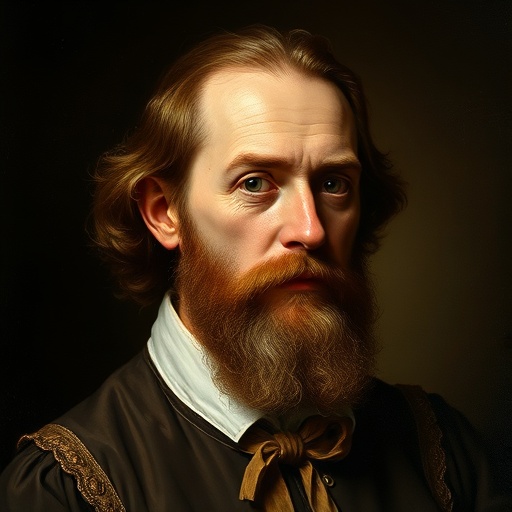
English physician whose On the Motion of the Heart and Blood in Animals (1628) demonstrated blood circulation, overturning 1,400 years of Galenic medicine. Closely associated with Francis Bacon (his contemporary in the new English empiricism). For an intellectual contrast, see Galenic medicine, the 2nd-century Greek medical tradition (humors, blood-as-consumed-fuel) — Harvey calculated that the heart pumps more blood per hour than the body could possibly produce as fuel — a single quantitative observation that demolished the entire Galenic-Aristotelian medical worldview. The cleanest example in medical history of arithmetic disproving 14 centuries of authority.
A methodological principle, advocating for a systematic and foundational approach to understanding.
Date: 17th Century
PhilosophicalFound in 1 providers: gemini
1 source checked
This quote expresses that nature itself serves as our guide in learning and discovery — we should start with basic, observable phenomena and gradually build toward more complex understanding. It advocates inductive reasoning: master fundamentals before attempting grand theories. True knowledge emerges through careful, stepwise progression from simple observations to complex conclusions, not through speculation or inherited dogma handed down without direct investigation.
Harvey embodied this principle in his groundbreaking work on blood circulation. Rather than accepting Galen's ancient theories, he made direct observations: watching hearts beat in living animals, measuring heart volume, calculating blood flow mathematically. He began with the simple observable fact that the heart is a pump, then built his revolutionary conclusion that blood circulates continuously — overturning 1,400 years of medical doctrine through patient, stepwise empirical investigation.
Harvey worked during the Scientific Revolution of the early 1600s, when European scholars were actively challenging ancient Greek authorities like Galen and Aristotle. The printing press had spread new ideas widely, and figures like Francis Bacon and Galileo were championing empirical methods over classical texts. Universities debated observation versus inherited wisdom. Harvey's era demanded direct investigation of nature to displace over a millennium of unquestioned medical doctrine.
AI-generated insights based on extensive research and information for context. Factual errors? Email [email protected].
Your cart is empty