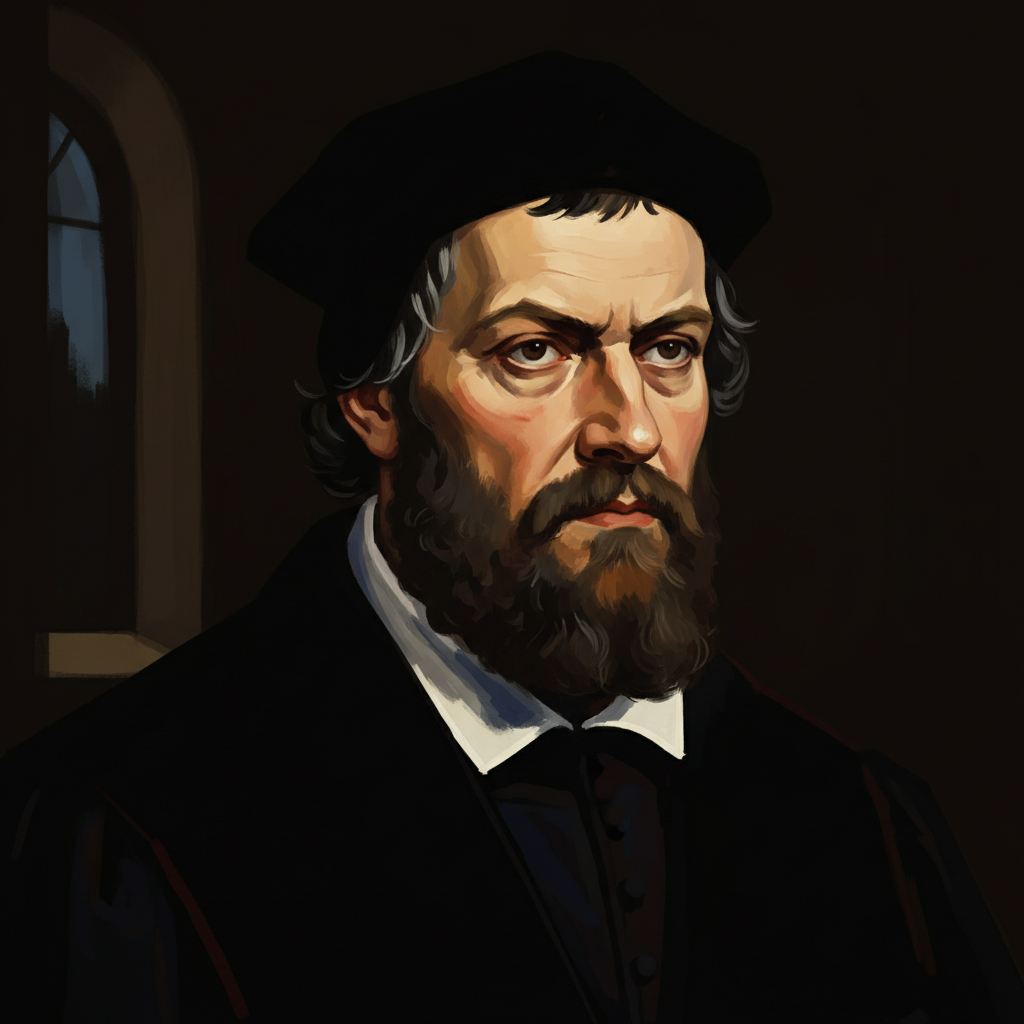
Martin Luther — "A happy fart never comes from a miserable ass."
A happy fart never comes from a miserable ass.
A happy fart never comes from a miserable ass.
Click any product to generate a realistic preview. Up to 3 at a time.
* Initial load can take up to 90 seconds — revising the preview in another color is nearly instant.
"The stomach is the greatest lord on earth."
"Kill them all, God will know his own."
"You people are more stupid than a block of wood."
"In lying fashion you ignore what even children know."
"A dog is a dog, and a cat is a cat, but a man is a man."
German theologian whose 95 Theses (1517) launched the Protestant Reformation and broke the Catholic Church's monopoly on Western Christianity. Closely associated with Philipp Melanchthon (Lutheran systematizer) and John Calvin (later Reformer who built on Luther's break). For an intellectual contrast, see Pope Leo X, Renaissance pope (1513-1521) — Leo X's indulgence sales triggered Luther's break and Leo excommunicated him in 1521 — Luther's entire Reformation is structured as a direct answer to the indulgence-funded Vatican Leo represented.
Found in 1 providers: gemini
1 source checked
A cheerful or genuine expression of joy cannot come from someone who is fundamentally unhappy or spiritually troubled. Outward signs of contentment reveal inward well-being, and you cannot fake lightheartedness when your inner state is miserable. Put simply, what comes out of a person reflects what is actually inside them. Crude humor aside, the point is that authentic joy and gloomy despair cannot share the same source at the same time.
Luther was famous for earthy, scatological humor alongside his theology, frequently using bodily imagery to mock the devil, the pope, and despair itself. A former Augustinian monk tormented by scrupulosity, he came to preach that a joyful conscience flows from faith and grace, not works. This saying mirrors his conviction that genuine spiritual freedom produces visible cheerfulness, while legalism and guilt breed misery that no pious performance can disguise.
In early sixteenth-century Germany, vulgar proverbs and bodily humor were ordinary tools of rhetoric, even in sermons and pamphlets. The Reformation unfolded amid plague, peasant unrest, and fierce polemical warfare waged through cheap printed tracts. Luther weaponized blunt German folk speech to reach common people against a Latin-speaking clerical elite. Coarse sayings like this carried theological weight in an era when preachers routinely contrasted the heavy yoke of Rome with the gospel's promised inner gladness.
AI-generated insights based on extensive research and information for context. Factual errors? Email [email protected].
Your cart is empty