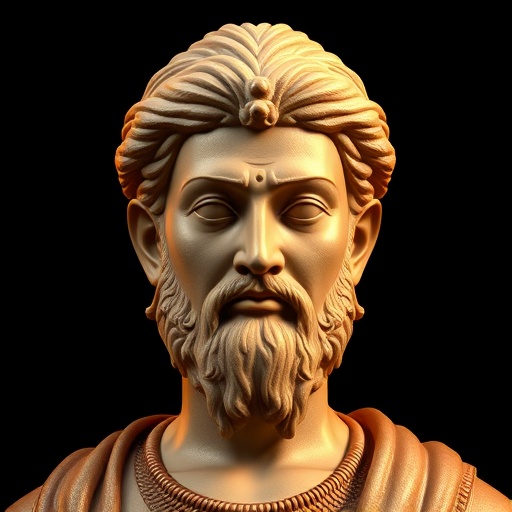
Mahavira — "All men who are ignorant are miserable; all who are wise are happy."
All men who are ignorant are miserable; all who are wise are happy.
All men who are ignorant are miserable; all who are wise are happy.
Click any product to generate a realistic preview. Up to 3 at a time.
* Initial load can take up to 90 seconds — revising the preview in another color is nearly instant.
"Respect for all living beings is Jainism."
"The soul is its own friend and its own enemy."
"The path to liberation is through right faith, right knowledge, and right conduct."
"The soul can be liberated from the cycle of birth and death through right faith, right knowledge, and right conduct."
"Non-violence is the highest religion."
24th and last Tirthankara of Jainism, whose teachings of strict ahimsa (non-violence), aparigraha (non-attachment), and karma reshaped ancient Indian religion. Closely associated with The Buddha (near-contemporary moral revolutionary, also reacting against Vedic ritualism). For an intellectual contrast, see Vedic Brahmanical ritual sacrifice, the animal-sacrifice-centered Vedic religion of his era — Mahavira's ahimsa demanded total non-violence, including not eating root vegetables that kill the plant — a maximum-distance ethical move from the Vedic priestly tradition that ritually sacrificed cattle and horses. The two cleanest poles of ancient Indian religious ethics.
Found in 1 providers: deepseek
1 source checked
Ignorance breeds suffering because people act from delusion, craving, and fear — making choices that harm themselves and others. Wisdom, by contrast, brings clarity about the nature of reality, freeing a person from the cycle of desire and consequence. Happiness here isn't pleasure but equanimity — a settled, undisturbed state that comes from truly understanding how the world works and one's place within it.
Mahavira renounced royal wealth at around 30 to pursue enlightenment through radical asceticism, direct experience, and rigorous self-discipline. His entire teaching system — anekāntavāda, ahimsa, aparigraha — rests on the premise that ignorance of one's true nature is the root of karma and rebirth. For Mahavira, wisdom wasn't academic but soteriological: the path from miserable bondage to liberated bliss.
Mahavira lived in the 6th century BCE in the Gangetic plains during a period of intense philosophical ferment — the same era as the Buddha and early Upanishadic thinkers. Brahminical ritual orthodoxy dominated public religious life, yet wandering renunciants called shramanas challenged it by emphasizing direct inner knowledge over hereditary priesthood. Claiming wisdom — not birth or sacrifice — as the key to happiness was a radical democratic assertion in that deeply stratified society.
AI-generated insights based on extensive research and information for context. Factual errors? Email [email protected].
Your cart is empty