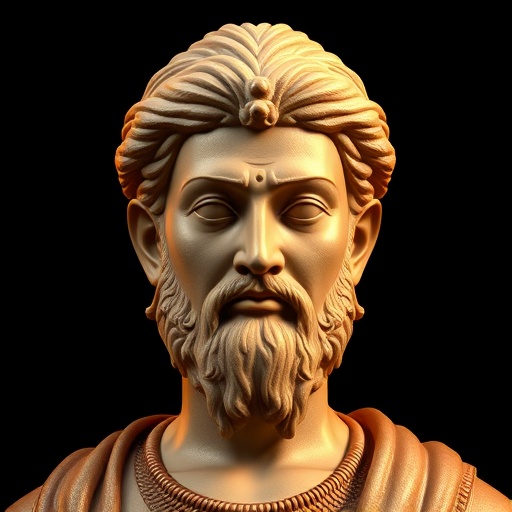
Mahavira — "Respect for all living beings is Jainism."
Respect for all living beings is Jainism.
Respect for all living beings is Jainism.
Click any product to generate a realistic preview. Up to 3 at a time.
* Initial load can take up to 90 seconds — revising the preview in another color is nearly instant.
"The real self is beyond all forms of karma."
"Know then that the truth is eternal, pure, and unchanging."
"All living beings desire happiness and despise misery."
"He who knows one, knows all."
"Know thyself, and thou shalt know the universe and God."
24th and last Tirthankara of Jainism, whose teachings of strict ahimsa (non-violence), aparigraha (non-attachment), and karma reshaped ancient Indian religion. Closely associated with The Buddha (near-contemporary moral revolutionary, also reacting against Vedic ritualism). For an intellectual contrast, see Vedic Brahmanical ritual sacrifice, the animal-sacrifice-centered Vedic religion of his era — Mahavira's ahimsa demanded total non-violence, including not eating root vegetables that kill the plant — a maximum-distance ethical move from the Vedic priestly tradition that ritually sacrificed cattle and horses. The two cleanest poles of ancient Indian religious ethics.
Found in 1 providers: grok
1 source checked
The entire practice of Jainism — every vow, fast, and ritual — reduces to one commitment: treat every living creature with care. Humans, animals, insects, even microorganisms deserve respect and freedom from harm. This is not a secondary teaching; it is the religion itself. How you act toward living beings is the measure of your spiritual life, not how many ceremonies you perform.
Mahavira lived this teaching with radical physical commitment. He renounced his royal heritage at 30, practiced 12 years of naked asceticism, swept the ground before each step to avoid crushing insects, filtered drinking water, and wore a mouth-cloth to prevent inhaling organisms. His first monastic vow (Mahavrata) was ahimsa — total non-violence. This quote is not philosophical abstraction; it summarizes how Mahavira structured every waking moment.
Mahavira lived in 6th-century BCE India, when Vedic Brahmin orthodoxy centered on animal sacrifice — yajna rituals that killed livestock to appease gods. The Shramana movement he led directly challenged this, arguing that harming any creature was spiritually destructive. Declaring that respect for living beings equals religion itself was radical counter-programming: it displaced priestly sacrifice with individual ethical practice and made compassion — not ceremony — the measure of faith.
AI-generated insights based on extensive research and information for context. Factual errors? Email [email protected].
Your cart is empty