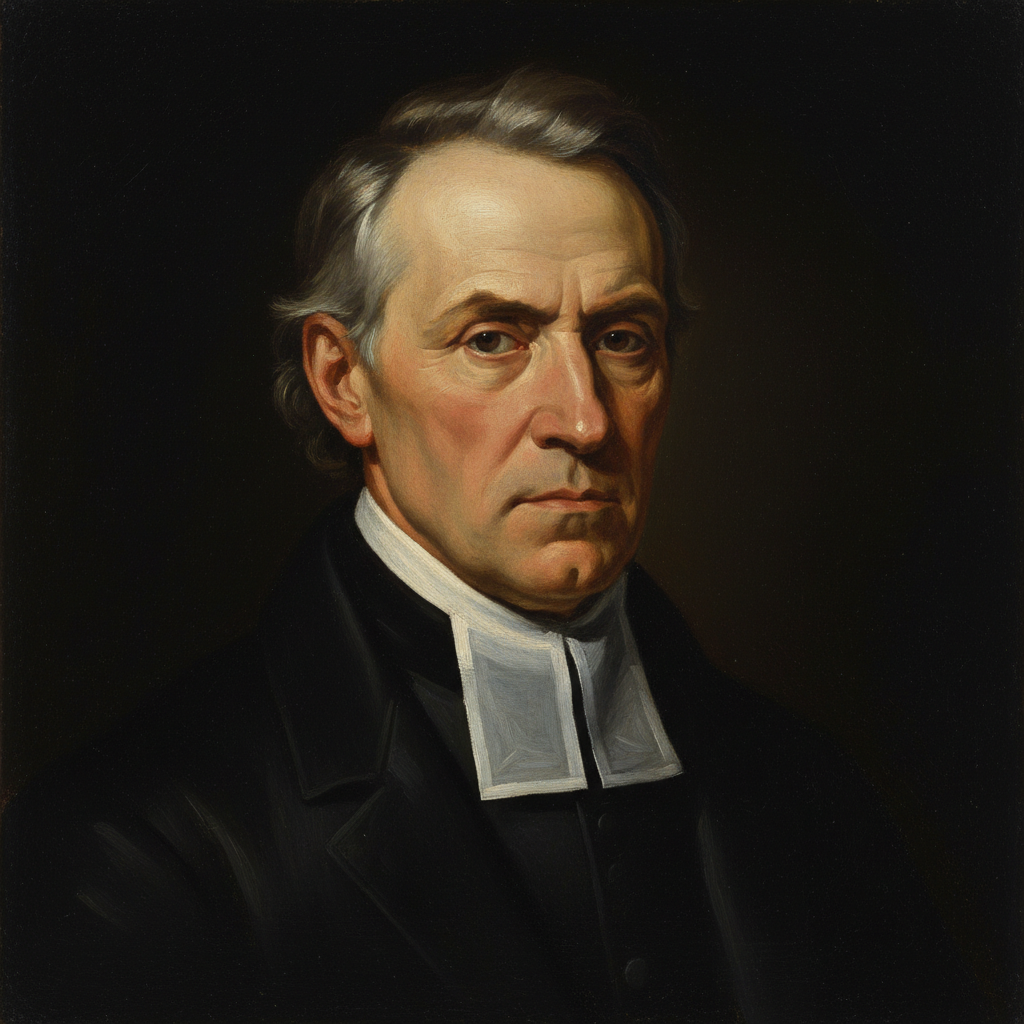
John Wesley — "As to my own comfort, I know not that I ever felt any, from the time I was born."
As to my own comfort, I know not that I ever felt any, from the time I was born.
As to my own comfort, I know not that I ever felt any, from the time I was born.
Click any product to generate a realistic preview. Up to 3 at a time.
* Initial load can take up to 90 seconds — revising the preview in another color is nearly instant.
"I believe that all true Christians are brothers and sisters, whatever their denomination."
"To candid, reasonable men, I am not afraid to lay open what has been the course of my life."
"I am a debtor to all the world, to do all the good I can, in every place, to every soul."
"I am not afraid of being accounted an enthusiast. I am afraid of nothing but sin."
"I have often thought, that if I were to choose a text to preach from, it should be 'God is love.'"
English Anglican cleric and founder of Methodism, whose open-air preaching and class-meeting structure created the largest 18th-century evangelical revival. Closely associated with Charles Wesley (his hymn-writing brother) and George Whitefield (early co-revivalist, later doctrinal opponent). For an intellectual contrast, see George Whitefield, Calvinist evangelical revivalist — Whitefield's predestinarian Calvinism vs Wesley's free-grace Arminian theology split the early Methodist movement permanently in the 1739-41 break. The founding evangelical Calvinist-Arminian schism — the two parallel evangelical traditions American Christianity descends from.
Remark to a friend, often cited as evidence of his austere disposition
Date: c. 1770s
Self-DeprecatingFound in 1 providers: grok
1 source checked
The speaker claims never to have experienced personal comfort or ease throughout their entire life. This isn't self-pity but a declaration of radical self-denial — comfort was never the goal, never sought, never felt. It frames a life defined entirely by labor, service, and purpose rather than personal satisfaction or rest.
Wesley rode over 250,000 miles on horseback, preached 40,000+ sermons, and rose at 4am daily for decades. He gave away nearly all his income, lived ascetically, endured mob violence, and drove himself relentlessly. This statement perfectly captures his Arminian conviction that salvation demanded total consecrated effort — his life was an instrument, not an end.
18th-century Britain was undergoing industrialization, leaving the working poor in brutal conditions with no spiritual home in the established Church of England. Wesley's Methodist movement arose precisely to serve them. In an era when comfort was a class privilege, Wesley's rejection of it was both countercultural and a direct rebuke to comfortable clergy who ignored mass poverty and spiritual destitution.
AI-generated insights based on extensive research and information for context. Factual errors? Email [email protected].
Your cart is empty