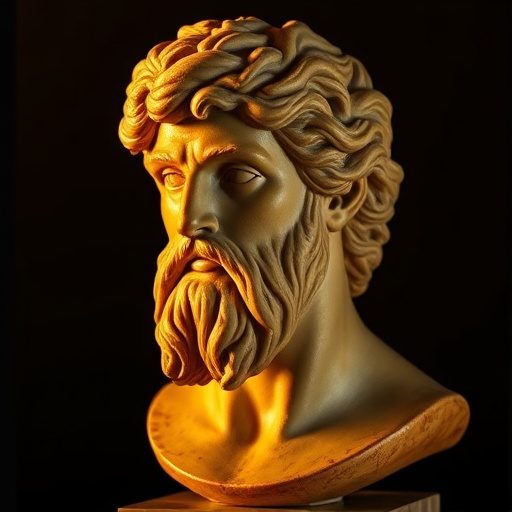
Pythagoras — "Do not say a little in many words, but a great deal in few."
Do not say a little in many words, but a great deal in few.
Do not say a little in many words, but a great deal in few.
Click any product to generate a realistic preview. Up to 3 at a time.
* Initial load can take up to 90 seconds — revising the preview in another color is nearly instant.
"There is geometry in the humming of the strings. There is music in the spacing of the spheres."
"Do not go to bed until you have gone over the day three times in your mind. What did I do wrong? What did I do right? What did I leave undone?"
"The wind is blowing. Worship the sound."
"When you go to the temple to worship, do not wipe up the footprints."
"The highest goal of music is to connect one's soul to their Divine Nature, not entertainment."
Greek philosopher and mathematician whose school in Croton combined geometry (the Pythagorean theorem), number-mysticism, and a religious-vegetarian way of life. Closely associated with Thales of Miletus (earlier pre-Socratic and the first philosopher). For an intellectual contrast, see Heraclitus, pre-Socratic Greek philosopher of flux — Heraclitus called Pythagoras 'the chief of swindlers' — among the founding insults of the philosophical-rivalry tradition. Their 'all is flux' vs 'all is number' poles still organize the philosophy of mathematics today (Platonist vs anti-realist).
Found in 1 providers: deepseek
1 source checked
Communicate with precision and economy. Pack maximum insight into minimum words rather than padding thin ideas with verbose language. A single well-chosen sentence carries more weight than a paragraph of filler. True intelligence shows in distillation, not elaboration. Say exactly what needs saying, nothing more. This is a call for disciplined thought before speech, ensuring every word earns its place.
Pythagoras built his entire legacy on compression: the theorem bearing his name reduces a universal geometric truth to a² + b² = c². He led a secretive philosophical brotherhood where teachings were transmitted in pithy maxims called akousmata. His school prized mathematical elegance, finding that the simplest formula often revealed the deepest truth. This quote mirrors his mathematical instinct to strip problems to their irreducible core.
In 6th-century BCE Greece, oral tradition dominated intellectual life. Philosophers competed for students and influence through public discourse, and verbose sophists were already emerging as a cultural force. Pythagoras founded his school in Croton, southern Italy, amid a world where wisdom was memorized and recited. Concise, memorable maxims survived transmission across generations; long-winded speeches vanished. Brevity was not just style but a survival strategy for ideas.
AI-generated insights based on extensive research and information for context. Factual errors? Email [email protected].
Your cart is empty