Nicolaus Copernicus — "For I am not so enamored of my own opinions that I would disregard what others m…"
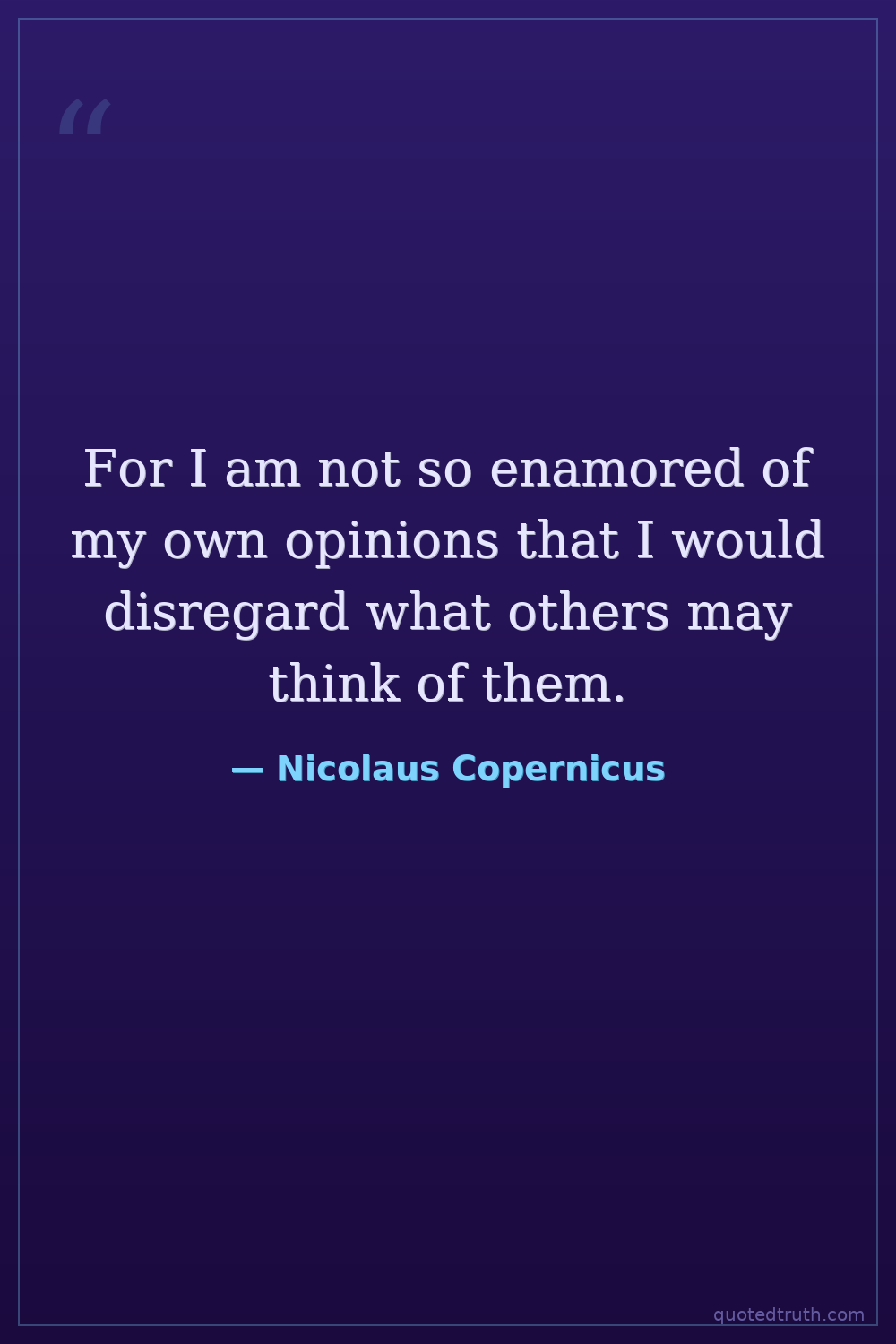
For I am not so enamored of my own opinions that I would disregard what others may think of them.
For I am not so enamored of my own opinions that I would disregard what others may think of them.
Click any product to generate a realistic preview. Up to 3 at a time.
* Initial load can take up to 90 seconds — revising the preview in another color is nearly instant.
"For it is far better to grasp the mind of God as it is, than to impose our own limited understanding upon it."
"I confess that I have been led to conceive of a different arrangement of the spheres of the universe from that of the ancient astronomers."
"For it is the duty of an astronomer to gather by careful and skilled observation the history of the celestial movements, and then to investigate their causes or hypotheses about them, and then to pred…"
"At rest, however, in the middle of everything is the sun."
"For among these, the first and chief consideration is the size of the sphere of the fixed stars, which is immense, and the next is the size of the earth, which is as a point in comparison with the hea…"
Found in 2 providers: gemini,grok
2 sources checked
Copernicus is saying he doesn't cling to his own ideas so fiercely that he dismisses what others think. True intellectual confidence means staying genuinely open to criticism rather than defending conclusions out of pride or ego. He treats external scrutiny as part of honest inquiry — an idea worth sharing must also be worth challenging. Being open to other views is not weakness; it's intellectual integrity.
This line opens the preface to 'De Revolutionibus Orbium Coelestium' (1543), addressed directly to Pope Paul III. Copernicus spent nearly 30 years refining his heliocentric model before agreeing to publish, partly out of real deference to learned criticism. A canon and trained physician rather than a court astronomer, he worked methodically, consulting scholars like Rheticus, whose persistent encouragement finally convinced him the work was ready to face scrutiny.
In Copernicus's era, the Ptolemaic geocentric model was not merely scientific consensus — it was theologically entrenched, supported by Church authority and Aristotelian tradition unchallenged for over a millennium. The Protestant Reformation was simultaneously fracturing Europe's religious unity, making intellectual provocation especially dangerous. Copernicus's deference to learned opinion was both genuine humility and strategic survival; his caution proved prescient when Galileo faced the Inquisition decades later for advancing the same heliocentric argument.
AI-generated insights based on extensive research and information for context. Factual errors? Email [email protected].
Your cart is empty