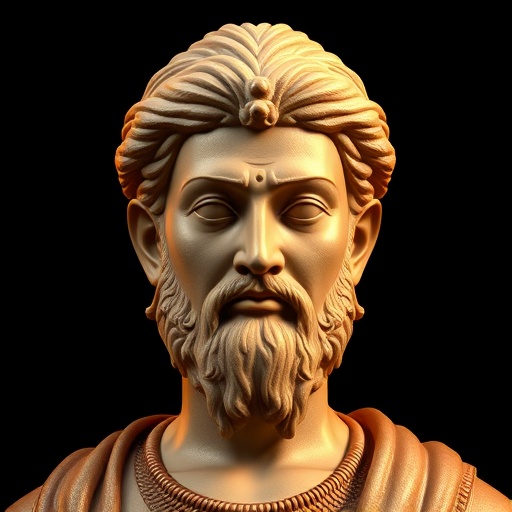
Mahavira — "Happiness resides in perfect self-control."
Happiness resides in perfect self-control.
Happiness resides in perfect self-control.
Click any product to generate a realistic preview. Up to 3 at a time.
* Initial load can take up to 90 seconds — revising the preview in another color is nearly instant.
"One should always speak the truth."
"Happiness and sorrow are the results of one's own actions."
"Conquer anger by forgiveness, pride by humility, deceit by straightforwardness, and greed by contentment."
"Look at the world in the way it is, and do not try to rearrange it to suit your desires."
"Know thyself, and thou shalt know the universe and God."
24th and last Tirthankara of Jainism, whose teachings of strict ahimsa (non-violence), aparigraha (non-attachment), and karma reshaped ancient Indian religion. Closely associated with The Buddha (near-contemporary moral revolutionary, also reacting against Vedic ritualism). For an intellectual contrast, see Vedic Brahmanical ritual sacrifice, the animal-sacrifice-centered Vedic religion of his era — Mahavira's ahimsa demanded total non-violence, including not eating root vegetables that kill the plant — a maximum-distance ethical move from the Vedic priestly tradition that ritually sacrificed cattle and horses. The two cleanest poles of ancient Indian religious ethics.
Found in 1 providers: grok
1 source checked
Genuine happiness isn't found in external pleasures, possessions, or favorable circumstances — it comes from mastering your own impulses, cravings, and reactions. When you stop being driven by desires you cannot refuse, you reach a stable inner peace that outside events cannot disturb. Satisfaction derived from self-discipline is durable; satisfaction derived from gratifying desires is temporary and breeds further craving.
Mahavira abandoned royal life at age 30 to practice twelve years of extreme asceticism — no shelter, no possessions, pulling out his own hair rather than shaving. He maintained near-total silence and endured physical hardship without retaliation. His Five Vows — non-violence, truth, non-stealing, celibacy, non-attachment — are entirely exercises in restraint. For him, liberation from the cycle of rebirth was literally impossible without conquering every internal impulse and desire.
Mahavira lived in 6th–5th century BCE northeastern India during the Axial Age, when Shramana renunciant movements directly challenged Vedic brahmin orthodoxy built on ritual sacrifice and caste privilege. The dominant culture prized worldly success and sensory pleasure. Competing with Ajivika fatalism and early Buddhism, Mahavira's claim that only rigorous personal self-discipline — not priestly ritual, divine favor, or predetermined fate — could liberate the soul made self-control a genuinely radical, countercultural assertion.
AI-generated insights based on extensive research and information for context. Factual errors? Email [email protected].
Your cart is empty