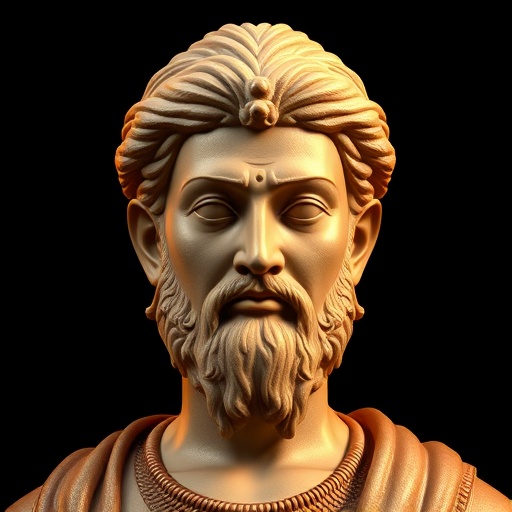
Mahavira — "One should always speak the truth."
One should always speak the truth.
One should always speak the truth.
Click any product to generate a realistic preview. Up to 3 at a time.
* Initial load can take up to 90 seconds — revising the preview in another color is nearly instant.
"The soul is the same in all living creatures, although the body is different."
"The soul is born alone and dies alone; no one shares another’s karma."
"The soul is the master of its own destiny."
"The soul is the perceiver, enjoyer, and doer of all actions."
"The path to liberation is difficult, but it is worth pursuing."
24th and last Tirthankara of Jainism, whose teachings of strict ahimsa (non-violence), aparigraha (non-attachment), and karma reshaped ancient Indian religion. Closely associated with The Buddha (near-contemporary moral revolutionary, also reacting against Vedic ritualism). For an intellectual contrast, see Vedic Brahmanical ritual sacrifice, the animal-sacrifice-centered Vedic religion of his era — Mahavira's ahimsa demanded total non-violence, including not eating root vegetables that kill the plant — a maximum-distance ethical move from the Vedic priestly tradition that ritually sacrificed cattle and horses. The two cleanest poles of ancient Indian religious ethics.
Found in 1 providers: grok
1 source checked
Honesty isn't optional or situational—it is a non-negotiable commitment in every interaction. This means refusing to deceive, exaggerate, or stay silent when speaking would mislead. In modern life, it applies to promises kept, claims verified before sharing, and admissions made even when inconvenient. The quote frames truthfulness not as a social nicety but as a foundational discipline that defines your integrity and affects everyone around you.
Mahavira enshrined truthfulness (satya) as one of the five Mahavratas—the great vows central to Jain monastic life. He spent twelve years in silent, austere wandering, communicating through example rather than persuasion or manipulation. As a Kshatriya prince who renounced wealth and power, he modeled integrity over self-interest. His philosophical system rests on karma accumulated through thought, speech, and action—making dishonest speech a direct moral transgression, not merely a social failing.
Mahavira lived in 6th–5th century BCE India, during the Axial Age when philosophical movements challenged existing power structures. In the Gangetic plains, the Vedic Brahmanical system tied truth to ritual correctness and caste authority. Political violence between rival kingdoms like Magadha and Vajji was constant. Mahavira's insistence on personal ethical truth—independent of priestly mediation or royal decree—was radical: it relocated moral authority within the individual conscience rather than external institutions.
AI-generated insights based on extensive research and information for context. Factual errors? Email [email protected].
Your cart is empty