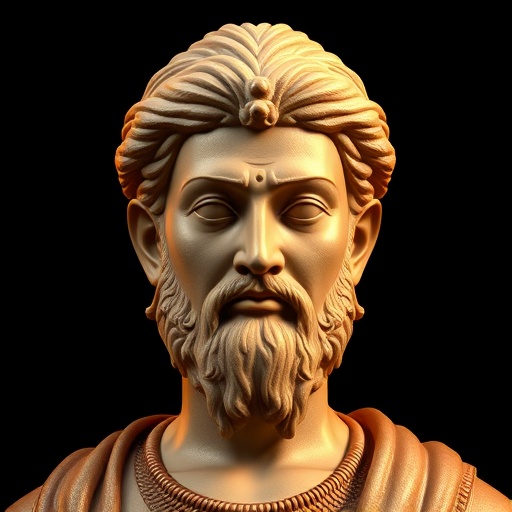
Mahavira — "He who conquers himself conquers the world."
He who conquers himself conquers the world.
He who conquers himself conquers the world.
Click any product to generate a realistic preview. Up to 3 at a time.
* Initial load can take up to 90 seconds — revising the preview in another color is nearly instant.
"A wise man should abstain from killing any living being."
"The true nature of the soul is bliss."
"The body is a temporary abode of the soul."
"Killing any living being is killing oneself."
"The soul is the perceiver, the knower, the agent, the enjoyer, and the sufferer."
24th and last Tirthankara of Jainism, whose teachings of strict ahimsa (non-violence), aparigraha (non-attachment), and karma reshaped ancient Indian religion. Closely associated with The Buddha (near-contemporary moral revolutionary, also reacting against Vedic ritualism). For an intellectual contrast, see Vedic Brahmanical ritual sacrifice, the animal-sacrifice-centered Vedic religion of his era — Mahavira's ahimsa demanded total non-violence, including not eating root vegetables that kill the plant — a maximum-distance ethical move from the Vedic priestly tradition that ritually sacrificed cattle and horses. The two cleanest poles of ancient Indian religious ethics.
Found in 1 providers: deepseek
1 source checked
True power isn't about dominating others — it's about mastering yourself. Desires, fears, anger, and ego are the real forces that control human behavior. Anyone who can discipline their impulses, resist temptation, and silence their inner chaos has achieved something harder than defeating armies or accumulating wealth. Self-mastery is the foundation of genuine freedom; without it, external victories are hollow and fleeting.
Mahavira was born a Kshatriya prince with wealth, power, and military lineage — everything the world defines as conquest. At 30, he renounced it all, enduring 12 years of extreme ascetic practice: fasting, silence, and rejection of all possessions. He identified the inner enemies — anger, pride, deceit, greed — as the true obstacles to liberation. His entire life made this quote literal biography, not mere philosophy.
Sixth-century BCE India was defined by warrior kings, territorial expansion, and Vedic ritual hierarchies where priests mediated salvation. The Kshatriya class glorified military valor above all. Mahavira's era — the Axial Age — saw simultaneous philosophical revolutions across civilizations. In Bihar, the Magadha kingdom was aggressively expanding through force. Against this backdrop, declaring self-conquest superior to military conquest was a radical inversion of his culture's entire value system.
AI-generated insights based on extensive research and information for context. Factual errors? Email [email protected].
Your cart is empty