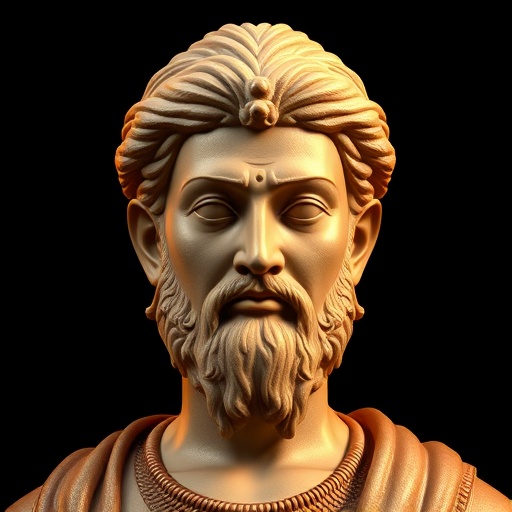
Mahavira — "Killing any living being is killing oneself."
Killing any living being is killing oneself.
Killing any living being is killing oneself.
Click any product to generate a realistic preview. Up to 3 at a time.
* Initial load can take up to 90 seconds — revising the preview in another color is nearly instant.
"All living beings desire happiness and despise misery."
"The soul can be liberated from the cycle of birth and death through right faith, right knowledge, and right conduct."
"A living body is not merely an accumulation of flesh and bones, but it is the abode of the soul."
"The greatest mistake of a soul is non-restraint."
"The self is the friend of the self, and the self is the enemy of the self."
24th and last Tirthankara of Jainism, whose teachings of strict ahimsa (non-violence), aparigraha (non-attachment), and karma reshaped ancient Indian religion. Closely associated with The Buddha (near-contemporary moral revolutionary, also reacting against Vedic ritualism). For an intellectual contrast, see Vedic Brahmanical ritual sacrifice, the animal-sacrifice-centered Vedic religion of his era — Mahavira's ahimsa demanded total non-violence, including not eating root vegetables that kill the plant — a maximum-distance ethical move from the Vedic priestly tradition that ritually sacrificed cattle and horses. The two cleanest poles of ancient Indian religious ethics.
Found in 1 providers: grok
1 source checked
Every living being shares the same fundamental life force — harming another damages your own moral and spiritual state. When you take a life, you corrupt your own soul and accrue karma that binds you to suffering. It's a statement about radical interconnectedness: treating others' lives as expendable reflects a callousness that ultimately destroys your own inner integrity. Violence toward any creature is violence turned inward.
Mahavira spent 12 years as a wandering ascetic practicing extreme non-violence: sweeping the ground before each step to avoid crushing insects, wearing a cloth over his mouth to avoid inhaling small creatures, refusing food requiring killing. He renounced all possessions, eventually all clothing. Ahimsa wasn't abstract philosophy — it was embodied daily practice. This quote captures the core Jain principle he lived completely: every soul is equal, every act of killing is self-harm.
Mahavira lived in 6th-century BCE India when Vedic Brahmanical religion routinely conducted animal sacrifice — elaborate rituals slaughtering horses, cattle, and goats to appease gods. The Gangetic plains were urbanizing rapidly, producing merchant classes questioning old orthodoxies. His era also generated the Buddha and the Upanishads' philosophical turn inward. Declaring all killing self-destructive was a radical challenge to an entire sacrificial economy that legitimized violence as devotion and priestly duty.
AI-generated insights based on extensive research and information for context. Factual errors? Email [email protected].
Your cart is empty