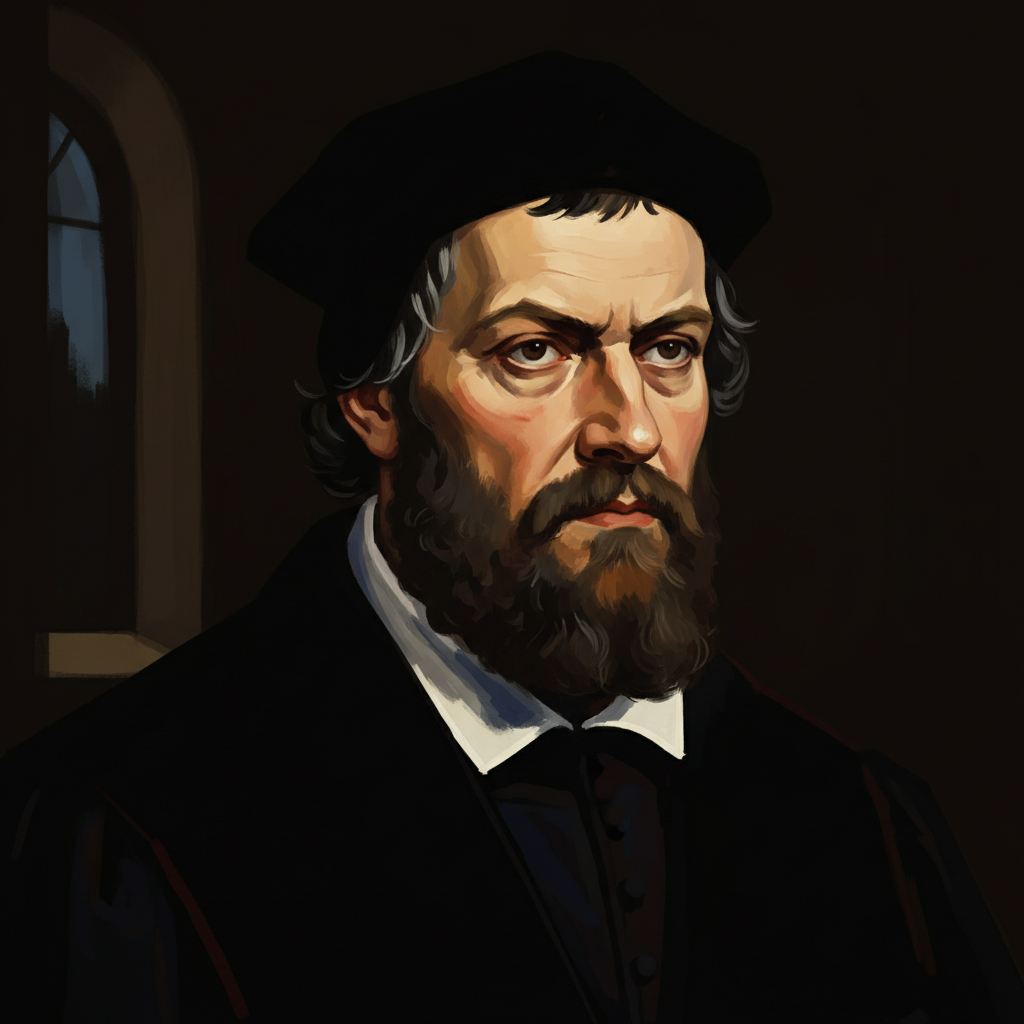
Martin Luther — "He who does not love wine, women, and song remains a fool his whole life long."
He who does not love wine, women, and song remains a fool his whole life long.
He who does not love wine, women, and song remains a fool his whole life long.
Click any product to generate a realistic preview. Up to 3 at a time.
* Initial load can take up to 90 seconds — revising the preview in another color is nearly instant.
"If I had to baptize a Jew, I would take him to the bridge of the Elbe, hang a stone around his neck and push him over with the words 'I baptize thee in the name of Abraham.'"
"I have been so busy with writing that I have not had time to pray."
"A man who has no wife is only half a man."
"Peasants are no better than pigs."
"Reason is the greatest enemy that faith has."
German theologian whose 95 Theses (1517) launched the Protestant Reformation and broke the Catholic Church's monopoly on Western Christianity. Closely associated with Philipp Melanchthon (Lutheran systematizer) and John Calvin (later Reformer who built on Luther's break). For an intellectual contrast, see Pope Leo X, Renaissance pope (1513-1521) — Leo X's indulgence sales triggered Luther's break and Leo excommunicated him in 1521 — Luther's entire Reformation is structured as a direct answer to the indulgence-funded Vatican Leo represented.
Attributed, but often debated if truly his own words or a popular saying he adopted.
Date: undated
ShockingFound in 2 providers: deepseek,grok
2 sources checked
Life's simple pleasures—drink, companionship, and music—aren't distractions from a meaningful existence; they're essential to it. Anyone who rejects enjoyment, beauty, and human connection in pursuit of grim seriousness misses what makes being alive worthwhile. Refusing joy doesn't make you wise or virtuous. It makes you someone who never learned the basic lesson that pleasure, warmth, and celebration are part of a full life, not obstacles to it.
Luther was famously earthy and unmonastic, rejecting the ascetic celibacy of Catholic clergy by marrying ex-nun Katharina von Bora in 1525 and fathering six children. He brewed and drank beer heartily, composed hymns like 'A Mighty Fortress,' and believed God's creation was meant to be enjoyed, not feared. His table talks brim with bawdy humor, showing a reformer who saw sanctified pleasure as opposition to Rome's works-based piety.
In early-16th-century Germany, Catholic teaching exalted monastic withdrawal, priestly celibacy, and bodily mortification as paths to holiness. Luther's 1517 Ninety-Five Theses ignited the Reformation partly by attacking this suspicion of ordinary life. Affirming wine, marriage, and music directly challenged the medieval split between sacred and secular, recasting daily joys as God-given goods. His stance helped legitimize Protestant clerical marriage and the flourishing congregational music tradition that reshaped European worship.
AI-generated insights based on extensive research and information for context. Factual errors? Email [email protected].
Your cart is empty