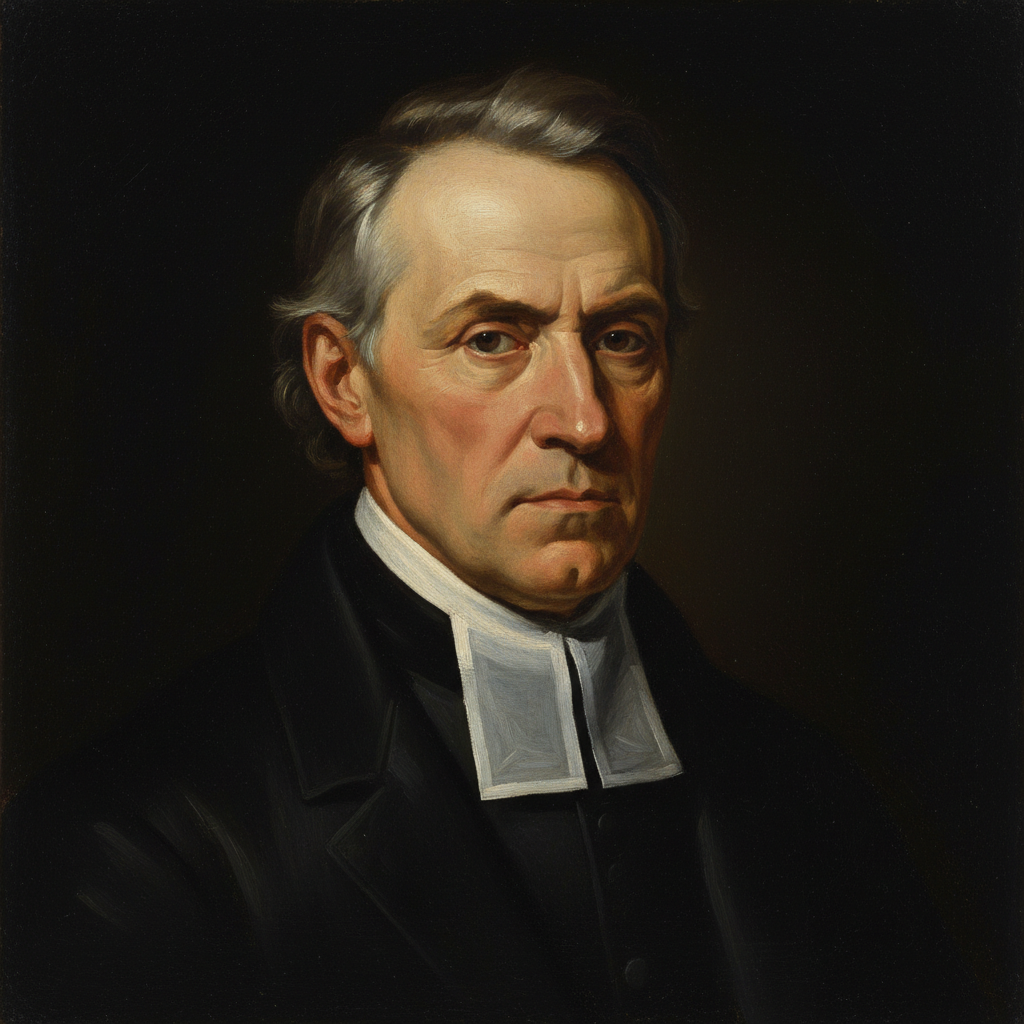
John Wesley — "I am a debtor both to the wise and to the unwise."
I am a debtor both to the wise and to the unwise.
I am a debtor both to the wise and to the unwise.
Click any product to generate a realistic preview. Up to 3 at a time.
* Initial load can take up to 90 seconds — revising the preview in another color is nearly instant.
"I have often thought, that if I were to choose a language to speak, it should be Greek."
"When I have money, I get rid of it quickly, lest it find a way into my heart."
"I believe that all true Christians are brothers and sisters, whatever their denomination."
"I have no time to be little."
"As to my own comfort, I know not that I ever felt any, from the time I was born."
English Anglican cleric and founder of Methodism, whose open-air preaching and class-meeting structure created the largest 18th-century evangelical revival. Closely associated with Charles Wesley (his hymn-writing brother) and George Whitefield (early co-revivalist, later doctrinal opponent). For an intellectual contrast, see George Whitefield, Calvinist evangelical revivalist — Whitefield's predestinarian Calvinism vs Wesley's free-grace Arminian theology split the early Methodist movement permanently in the 1739-41 break. The founding evangelical Calvinist-Arminian schism — the two parallel evangelical traditions American Christianity descends from.
Found in 1 providers: grok
1 source checked
You owe something to everyone — the brilliant and the struggling alike. The speaker rejects reserving wisdom, service, or attention only for the educated elite, acknowledging a binding obligation to all people regardless of intellect or social standing. No one is too lowly to deserve your effort, and no one too prominent to be above your service. It is a declaration of universal responsibility toward every human being.
Wesley abandoned church pulpits to preach in open fields to coal miners, factory workers, and the destitute — people the Church of England largely ignored. He founded schools for poor children, wrote plain-English tracts for the uneducated, and corresponded with leading intellectuals. This universal obligation defined his entire ministry: riding 40,000 miles on horseback, delivering 40,000 sermons, reaching every soul regardless of rank or learning.
Eighteenth-century England was rigidly class-stratified. The Church of England ministered primarily to the propertied classes while early industrialization created vast urban poverty. The Great Awakening was sweeping Britain and the American colonies, exposing the established church's neglect of the poor. The Enlightenment simultaneously celebrated educated reason, making Wesley's insistence on equal duty to the unwise deliberately countercultural and radical within both ecclesiastical and intellectual circles.
AI-generated insights based on extensive research and information for context. Factual errors? Email [email protected].
Your cart is empty