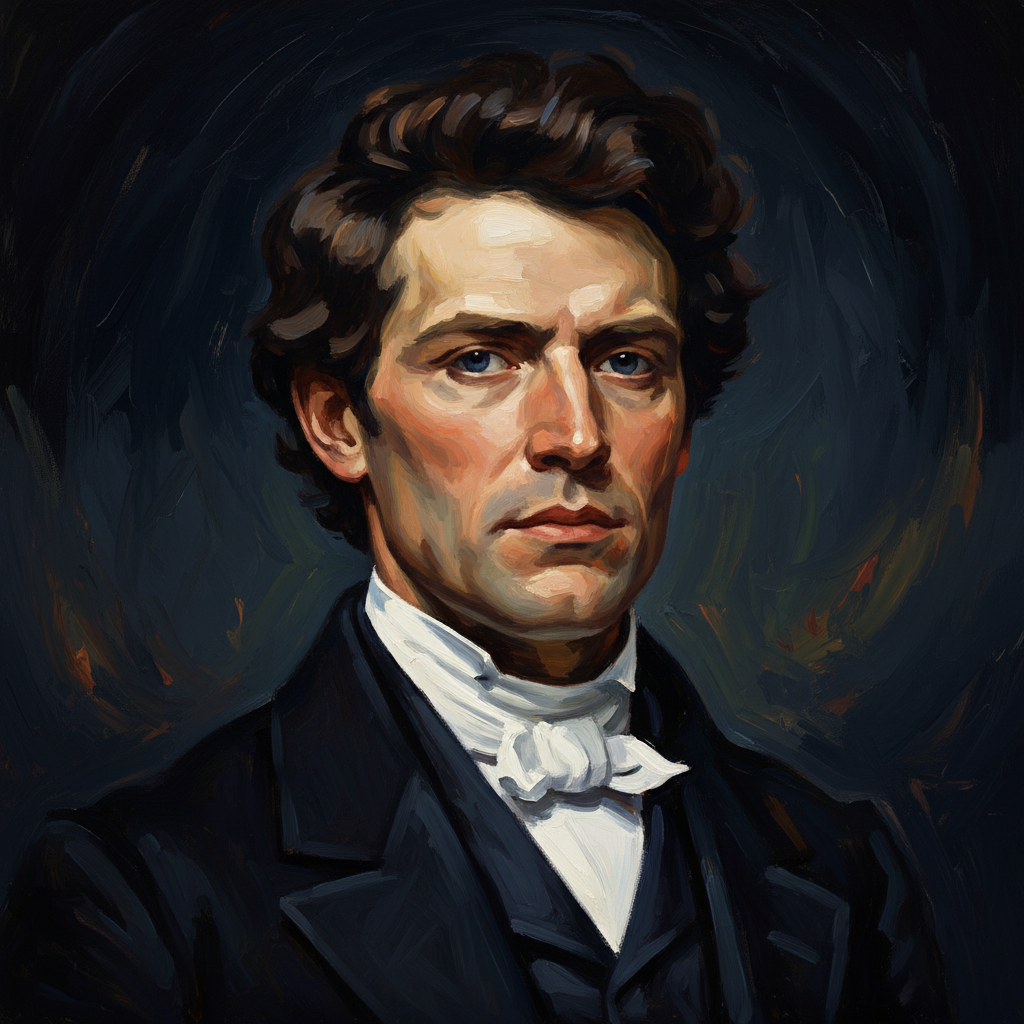
Joseph Smith — "I am a man of virtue, and I will be virtuous in all things."
I am a man of virtue, and I will be virtuous in all things.
I am a man of virtue, and I will be virtuous in all things.
Click any product to generate a realistic preview. Up to 3 at a time.
* Initial load can take up to 90 seconds — revising the preview in another color is nearly instant.
"I told them I was a Prophet of God, and had a right to obtain revelations, and that I should not be trammelled by men."
"This church, being 'the only true and living church upon the face of the whole earth, with which I, the Lord, am well pleased.'"
"I have asked of the Lord concerning the practice of the Saints, and I have received for answer, that I should take unto myself more wives than one, and that the Saints should do likewise."
"I was answered that I must join none of them [the religious sects of the day], for they were all wrong; and the Personage who addressed me said that all their creeds were an abomination in his sight; …"
"I am a friend to the whole human race."
Found in 1 providers: grok
1 source checked
A public pledge of total moral commitment: virtue isn't a selective behavior but a defining identity applied to every domain of life. The speaker claims integrity not as an aspiration but as a fixed characteristic, pledging that nothing—private conduct, public action, or difficult choices—will compromise goodness. In modern terms, it means living your values without exception, refusing to compartmentalize ethics into convenient and inconvenient situations.
Smith founded the Church of Jesus Christ of Latter-day Saints in 1830, claiming prophetic visions and divine authority. His entire leadership rested on personal moral credibility—followers believed God chose him because he was righteous. Yet he faced constant accusations of fraud, illegal banking, and polygamy. This declaration mirrors his pattern of asserting virtue loudly and publicly, using personal character claims as both spiritual testimony and defense against mounting legal and social attacks.
Smith lived during the Second Great Awakening, a wave of early 19th-century frontier revivals reshaping American spirituality. The young republic prized civic virtue as a democratic foundation, and religious leaders faced intense public scrutiny. A prophet's legitimacy depended entirely on his righteousness. Smith also navigated intense anti-Mormon persecution, legal battles, and mob violence. Publicly claiming virtue was both a theological statement and a survival tactic in a deeply hostile social environment.
AI-generated insights based on extensive research and information for context. Factual errors? Email [email protected].
Your cart is empty