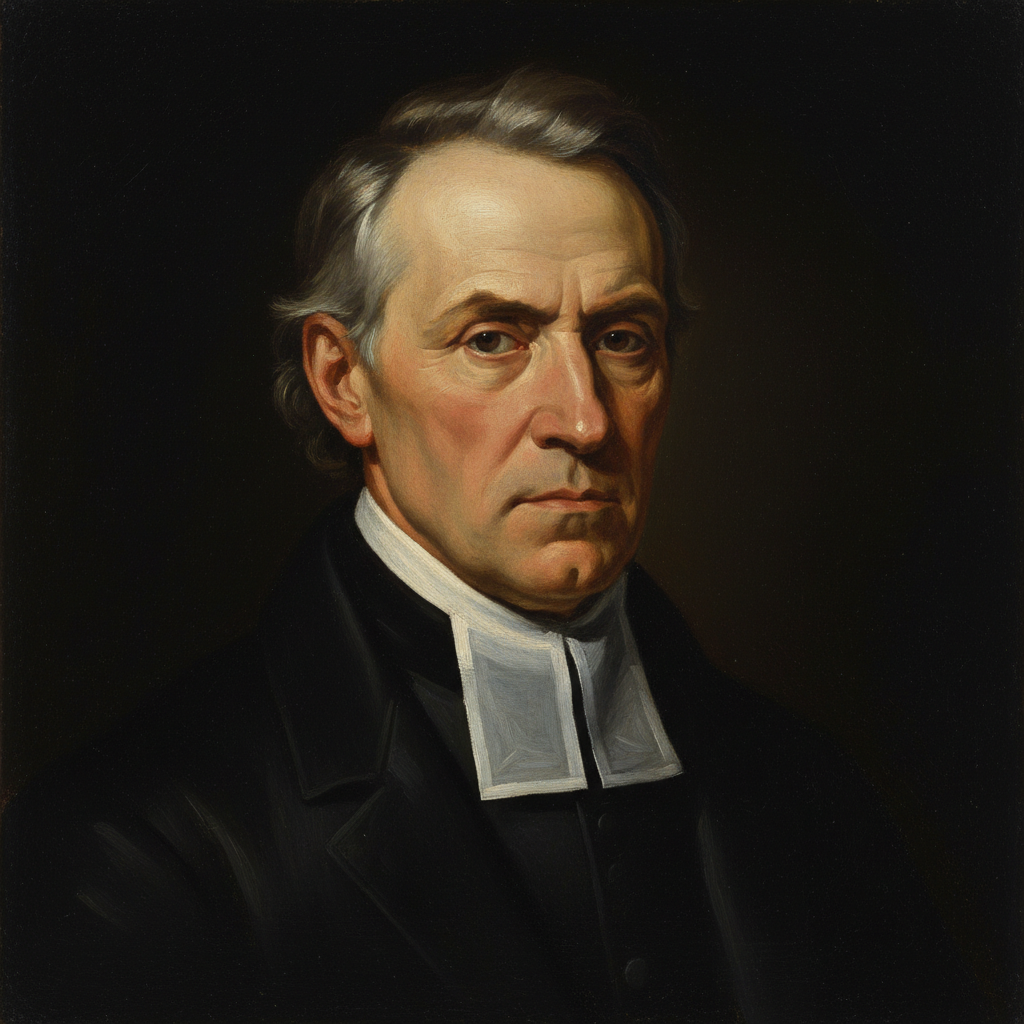
John Wesley — "I am a very little man, and I have a very little heart."
I am a very little man, and I have a very little heart.
I am a very little man, and I have a very little heart.
Click any product to generate a realistic preview. Up to 3 at a time.
* Initial load can take up to 90 seconds — revising the preview in another color is nearly instant.
"The more I see of the working of the present government, the more I am convinced that they are ripe for destruction."
"I have often thought, that if I were to choose a servant, it should be one that needed no wages."
"To candid, reasonable men, I am not afraid to lay open what has been the course of my life."
"I am never long in one place. I am a bird of passage, always on the wing."
"Women's preaching is flatly contrary to the Bible."
English Anglican cleric and founder of Methodism, whose open-air preaching and class-meeting structure created the largest 18th-century evangelical revival. Closely associated with Charles Wesley (his hymn-writing brother) and George Whitefield (early co-revivalist, later doctrinal opponent). For an intellectual contrast, see George Whitefield, Calvinist evangelical revivalist — Whitefield's predestinarian Calvinism vs Wesley's free-grace Arminian theology split the early Methodist movement permanently in the 1739-41 break. The founding evangelical Calvinist-Arminian schism — the two parallel evangelical traditions American Christianity descends from.
Found in 1 providers: grok
1 source checked
The speaker frankly admits he is small in stature and limited in emotional depth — in his capacity for love, compassion, and generosity. Rather than projecting authority or greatness, he confesses personal inadequacy honestly. This is radical humility: acknowledging that one's heart, one's inner moral capacity, is insufficient on its own. Such self-awareness is the necessary foundation for genuine transformation, suggesting that recognizing limitation is more honest and more useful than pretending to wholeness.
Wesley was physically short — roughly 5'3" — but this confession runs far deeper. His Methodist theology centered on sanctification: the lifelong pursuit of 'perfect love' toward God and neighbor. His journals repeatedly document spiritual failures measured against that demanding ideal. Calling his heart 'little' wasn't self-pity but honest theology — Wesley believed only God's transforming grace could enlarge human capacity for love, and clear-eyed self-knowledge was the necessary first step toward that enlargement.
In 18th-century England, the established Church was entangled with wealth, class, and social prestige while largely ignoring the urban poor flooding industrial cities. Enlightenment culture prized human reason and moral self-sufficiency. Amid this confidence, admitting personal smallness was countercultural. Wesley's Methodism arose as a grassroots corrective, insisting human nature required divine transformation — making this humble confession not just personal piety but a pointed theological challenge to an age that celebrated self-made authority and institutional pride.
AI-generated insights based on extensive research and information for context. Factual errors? Email [email protected].
Your cart is empty