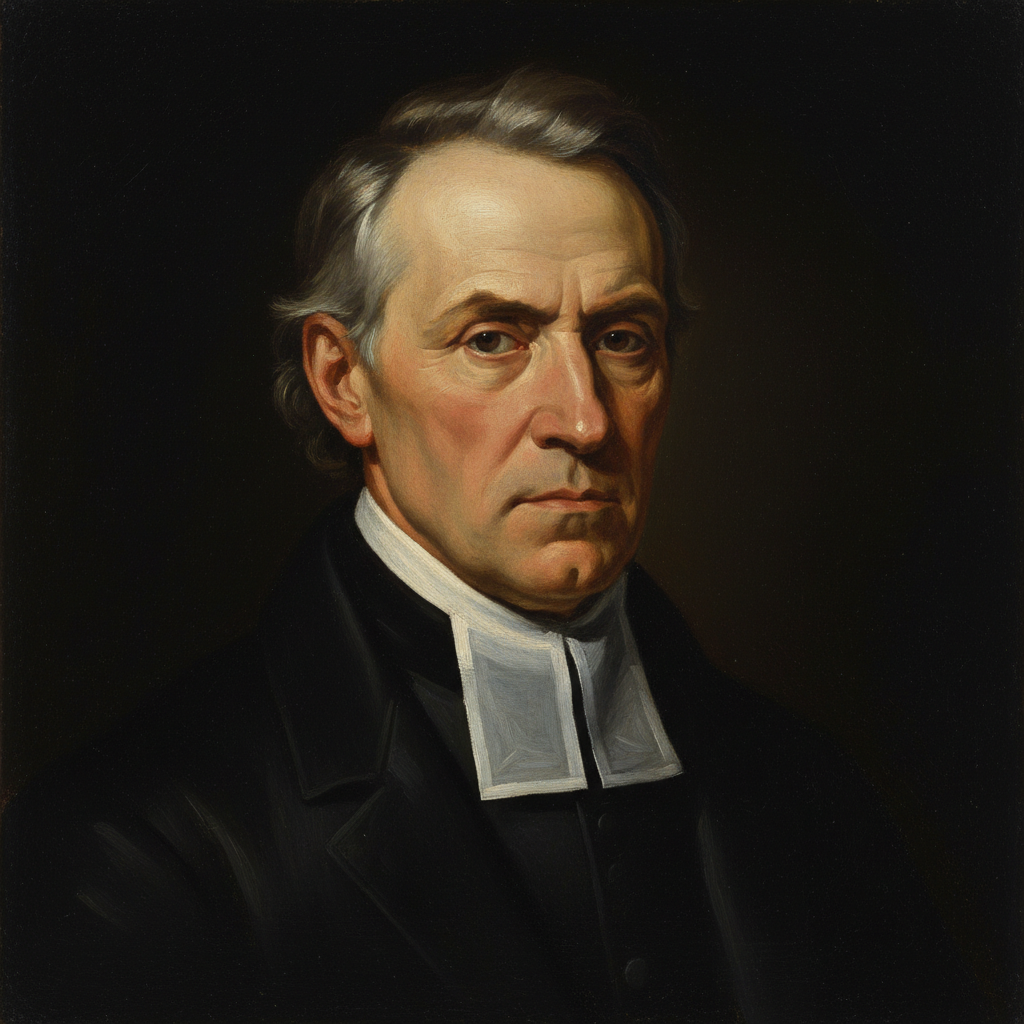
John Wesley — "I am never long in one place. I am a bird of passage, always on the wing."
I am never long in one place. I am a bird of passage, always on the wing.
I am never long in one place. I am a bird of passage, always on the wing.
Click any product to generate a realistic preview. Up to 3 at a time.
* Initial load can take up to 90 seconds — revising the preview in another color is nearly instant.
"I have learned to suffer in silence, and not to make my complaints known to any but God."
"Sing lustily and with a good courage. Beware of singing as if you were half dead, or half asleep; but lift up your voice with strength."
"I do not think that I have ever spent an hour in my life, from the age of twenty-one to this day, without employing it in some useful way."
"The world is my parish."
"And are we not to use our reason? Unquestionably. But no more than we are to use our hands or feet. We are to use it as a servant, not as a master."
English Anglican cleric and founder of Methodism, whose open-air preaching and class-meeting structure created the largest 18th-century evangelical revival. Closely associated with Charles Wesley (his hymn-writing brother) and George Whitefield (early co-revivalist, later doctrinal opponent). For an intellectual contrast, see George Whitefield, Calvinist evangelical revivalist — Whitefield's predestinarian Calvinism vs Wesley's free-grace Arminian theology split the early Methodist movement permanently in the 1739-41 break. The founding evangelical Calvinist-Arminian schism — the two parallel evangelical traditions American Christianity descends from.
Found in 1 providers: grok
1 source checked
Never settling in one place, this quote captures a life defined by constant travel and purposeful movement. Like a migratory bird that never roosts, Wesley describes himself as always mid-journey. It conveys the mindset of someone whose work is inherently mobile — spreading an idea, a mission, a message — rather than building from a fixed location. Restlessness here is not aimlessness; it is method.
Wesley lived this literally: he rode an estimated 250,000 miles on horseback across Britain and Ireland over five decades, preaching more than 40,000 sermons. Refused entry by Anglican parish churches, he preached in open fields, mines, and marketplaces. His entire model for Methodism was built on itinerant preachers traveling circuits rather than settling in parishes. Motion was not metaphor for Wesley — it was the operating principle of his ministry.
In 18th-century Britain, the Church of England served fixed parishes, leaving the rapidly urbanizing poor and industrial workers spiritually neglected. Wesley's era saw early industrialization uprooting communities, creating masses of laborers in mines and factories with no church connection. His traveling ministry was a direct response — going where institutions would not. Itinerant preaching was controversial but proved uniquely suited to a society in geographic and social upheaval.
AI-generated insights based on extensive research and information for context. Factual errors? Email [email protected].
Your cart is empty