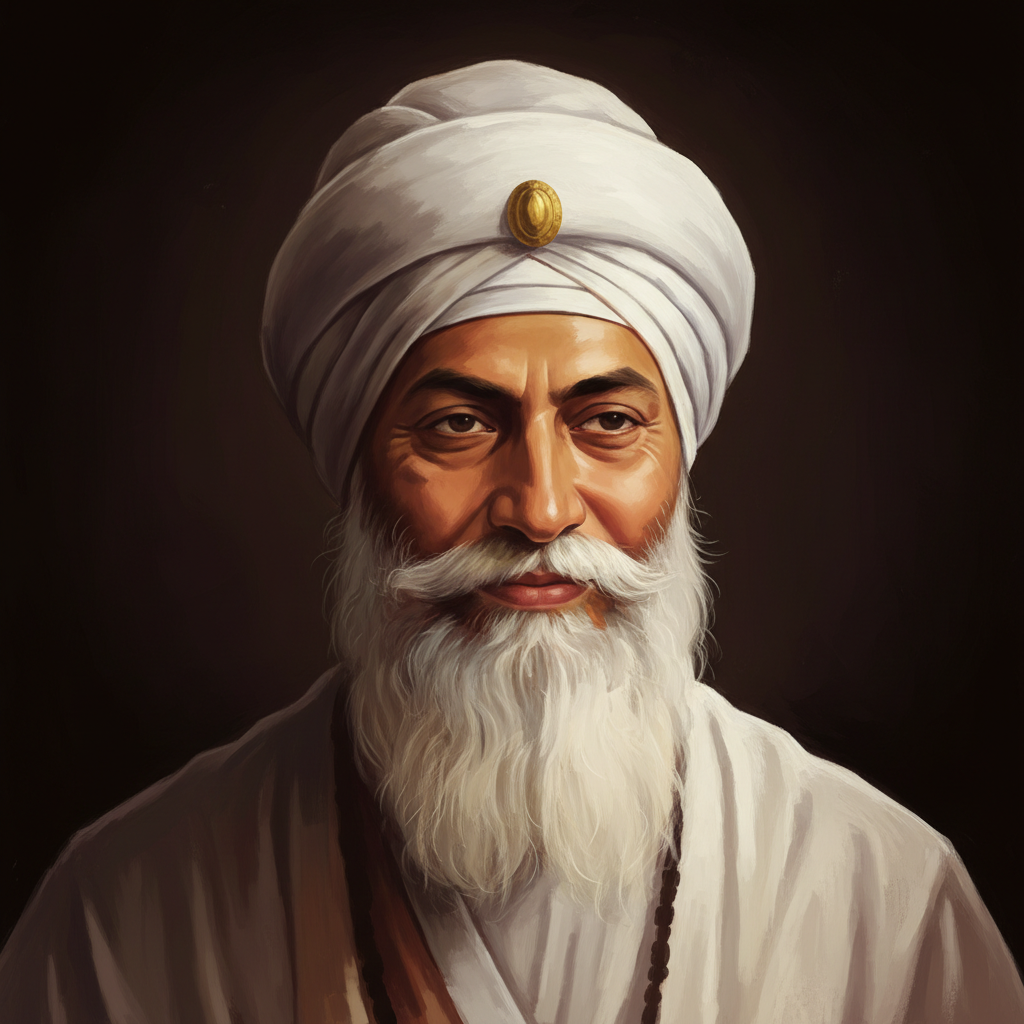
Guru Nanak — "I am neither a child, a young man, nor an ancient; nor am I of any caste."
I am neither a child, a young man, nor an ancient; nor am I of any caste.
I am neither a child, a young man, nor an ancient; nor am I of any caste.
Click any product to generate a realistic preview. Up to 3 at a time.
* Initial load can take up to 90 seconds — revising the preview in another color is nearly instant.
"He who meditates on the Lord's Name, his sins are washed away."
"He who sees the Lord in all, he alone is truly wise."
"Alone let him constantly meditate in solitude on that which is salutary for his soul, for he who meditates in solitude attains supreme bliss."
"With your hands carve out your own destiny."
"He who is born into a high caste but does not praise God, is like a worm in filth."
Founder of Sikhism and the first of the Ten Sikh Gurus, whose teachings of one universal God and rejection of caste shaped Punjab. Closely associated with Kabir (mystical poet whose verses appear in the Sikh Guru Granth Sahib). For an intellectual contrast, see Brahmanical orthodoxy, the Hindu caste-and-ritual establishment of his era — Sikhism was founded as a deliberate alternative to both Hindu ritual hierarchy and Islamic exclusivism — Nanak's universalism was a structural rejection of caste and priestly mediation.
Found in 2 providers: deepseek,gemini
2 sources checked
The speaker rejects every label society uses to sort people—age, life stage, and caste. By denying he fits any of these categories, he asserts that his true identity lies beyond such divisions. Human worth, he suggests, is not measured by how old you are, what family you were born into, or what rung of the social ladder you occupy. The real self is something deeper that these boxes cannot contain or define.
Guru Nanak founded Sikhism explicitly on the rejection of caste hierarchy and ritual division. He traveled across South Asia and the Middle East preaching that one humanity stands equal before a single divine reality. He established the langar, a communal kitchen where people of every caste eat side by side. This saying mirrors his core teaching: the soul transcends body, age, and birth-status, and spiritual truth belongs to no social category.
Nanak lived from 1469 to 1539 in Punjab, during early Mughal consolidation and sharp Hindu-Muslim tension. Rigid caste stratification governed Hindu society while Islamic rule added another layer of religious identity politics. Ordinary people were locked into birth-assigned occupations and barred from shared worship, wells, and meals. Against this backdrop, declaring oneself outside caste and age was radical social defiance, laying groundwork for a new faith built on equality rather than inherited hierarchy.
AI-generated insights based on extensive research and information for context. Factual errors? Email [email protected].
Your cart is empty