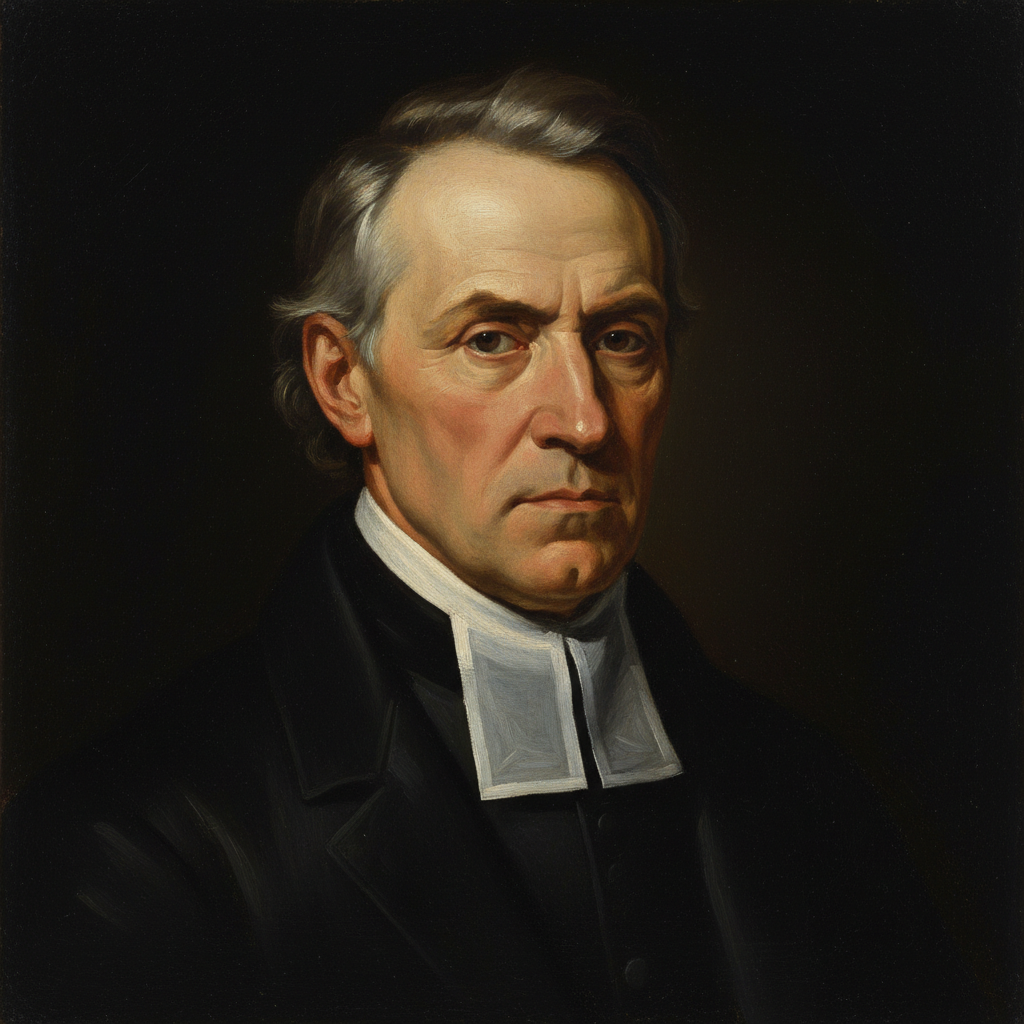
John Wesley — "I am not afraid of any man, but I am afraid of God."
I am not afraid of any man, but I am afraid of God.
I am not afraid of any man, but I am afraid of God.
Click any product to generate a realistic preview. Up to 3 at a time.
* Initial load can take up to 90 seconds — revising the preview in another color is nearly instant.
"We have nothing to do but to save souls."
"I found myself much out of order, and apprehended that my end was near. I had no fear of death, but I was concerned for the cause of God, which I apprehended would suffer by my removal."
"I have often thought, that if I were to choose a profession, it should be that of a physician."
"Cleanliness is indeed next to godliness."
"I have not much time to spare for trifles."
English Anglican cleric and founder of Methodism, whose open-air preaching and class-meeting structure created the largest 18th-century evangelical revival. Closely associated with Charles Wesley (his hymn-writing brother) and George Whitefield (early co-revivalist, later doctrinal opponent). For an intellectual contrast, see George Whitefield, Calvinist evangelical revivalist — Whitefield's predestinarian Calvinism vs Wesley's free-grace Arminian theology split the early Methodist movement permanently in the 1739-41 break. The founding evangelical Calvinist-Arminian schism — the two parallel evangelical traditions American Christianity descends from.
Found in 1 providers: grok
1 source checked
Fear of God, not arrogance, is the foundation here. Wesley is saying that human opinion, social pressure, mob threats, or institutional authority hold no ultimate power over his conscience — only divine accountability matters. This is principled fearlessness: not recklessness or bravado, but the conviction that being answerable to God makes every earthly threat secondary. Courage flows from where you place your highest allegiance.
Wesley was physically attacked by mobs, barred from Anglican pulpits, and condemned by Church of England authorities throughout his ministry. He rode 250,000 miles preaching to coal miners and the poor despite constant violent opposition. His journals document stonings and riots. He openly defied clerical hierarchy by ordaining ministers for America. Human opposition was never abstract for Wesley — this quote captures the source of his undaunted persistence.
Wesley lived 1703–1791, when the Church of England wielded enormous social and political power, and religious nonconformity risked persecution, mob violence, and social exclusion. Britain's industrial revolution was displacing rural poor into cities with no institutional support. The Great Awakening swept both Britain and America, challenging religious complacency. Defying ecclesiastical authority was not merely theological — it carried real legal and social consequences, making Wesley's declared indifference to human judgment an act of genuine courage.
AI-generated insights based on extensive research and information for context. Factual errors? Email [email protected].
Your cart is empty