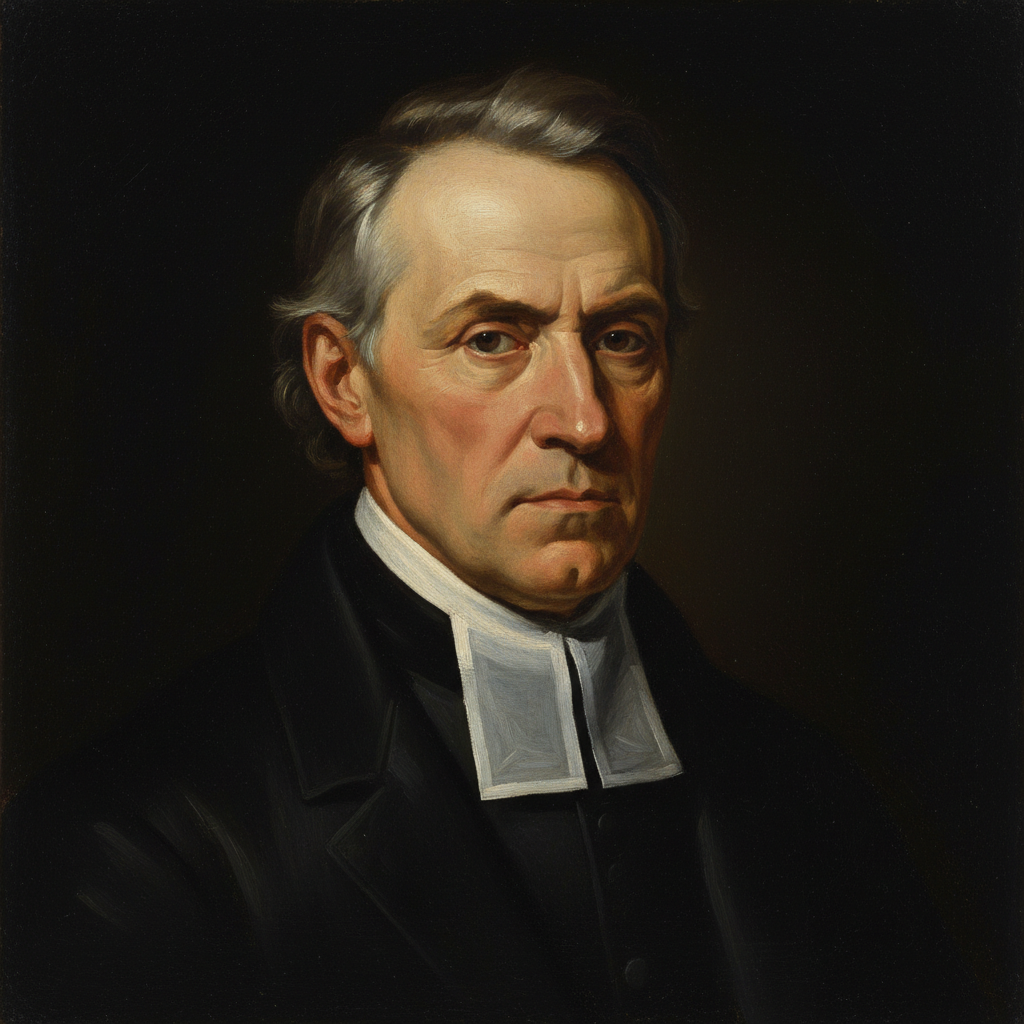
John Wesley — "I am not afraid of the devil himself."
I am not afraid of the devil himself.
I am not afraid of the devil himself.
Click any product to generate a realistic preview. Up to 3 at a time.
* Initial load can take up to 90 seconds — revising the preview in another color is nearly instant.
"I have no time to be in a hurry."
"To candid, reasonable men, I am not afraid to lay open what has been the course of my life."
"Beware you be not swallowed up in books! An ounce of love is worth a pound of knowledge."
"I have not lost a day since I was born."
"I conceive slavery to be such a thing as is odious to the God of love."
English Anglican cleric and founder of Methodism, whose open-air preaching and class-meeting structure created the largest 18th-century evangelical revival. Closely associated with Charles Wesley (his hymn-writing brother) and George Whitefield (early co-revivalist, later doctrinal opponent). For an intellectual contrast, see George Whitefield, Calvinist evangelical revivalist — Whitefield's predestinarian Calvinism vs Wesley's free-grace Arminian theology split the early Methodist movement permanently in the 1739-41 break. The founding evangelical Calvinist-Arminian schism — the two parallel evangelical traditions American Christianity descends from.
Found in 1 providers: grok
1 source checked
A bold declaration of fearlessness against ultimate evil. The speaker claims that even the most powerful adversary imaginable holds no power over them. It communicates absolute spiritual confidence — not recklessness, but a conviction that faith and righteousness strip away fear entirely. Nothing, not even the worst conceivable threat, can break someone whose beliefs are rooted deep enough to face any opposition without flinching.
Wesley rode over 250,000 miles preaching across Britain, repeatedly facing violent mobs who threw rocks and threatened his life — notably during the 1743 Wednesbury riots. Churches locked their doors to him, so he preached in open fields and coal pits. His theology centered on sanctification: the ongoing battle against sin and evil. This declaration wasn't rhetorical posturing; it matched a life lived under constant physical and spiritual threat.
Wesley lived through the 18th-century Enlightenment, when rational skepticism was eroding traditional religious authority across Britain and Europe. Yet the literal devil remained a vivid theological reality for most ordinary people. The Church of England had grown complacent, and Wesley's enthusiastic Methodist revival was seen as dangerously radical. Declaring fearlessness toward Satan was both a theological statement and a public act of defiance in an age that increasingly dismissed fervent faith.
AI-generated insights based on extensive research and information for context. Factual errors? Email [email protected].
Your cart is empty